
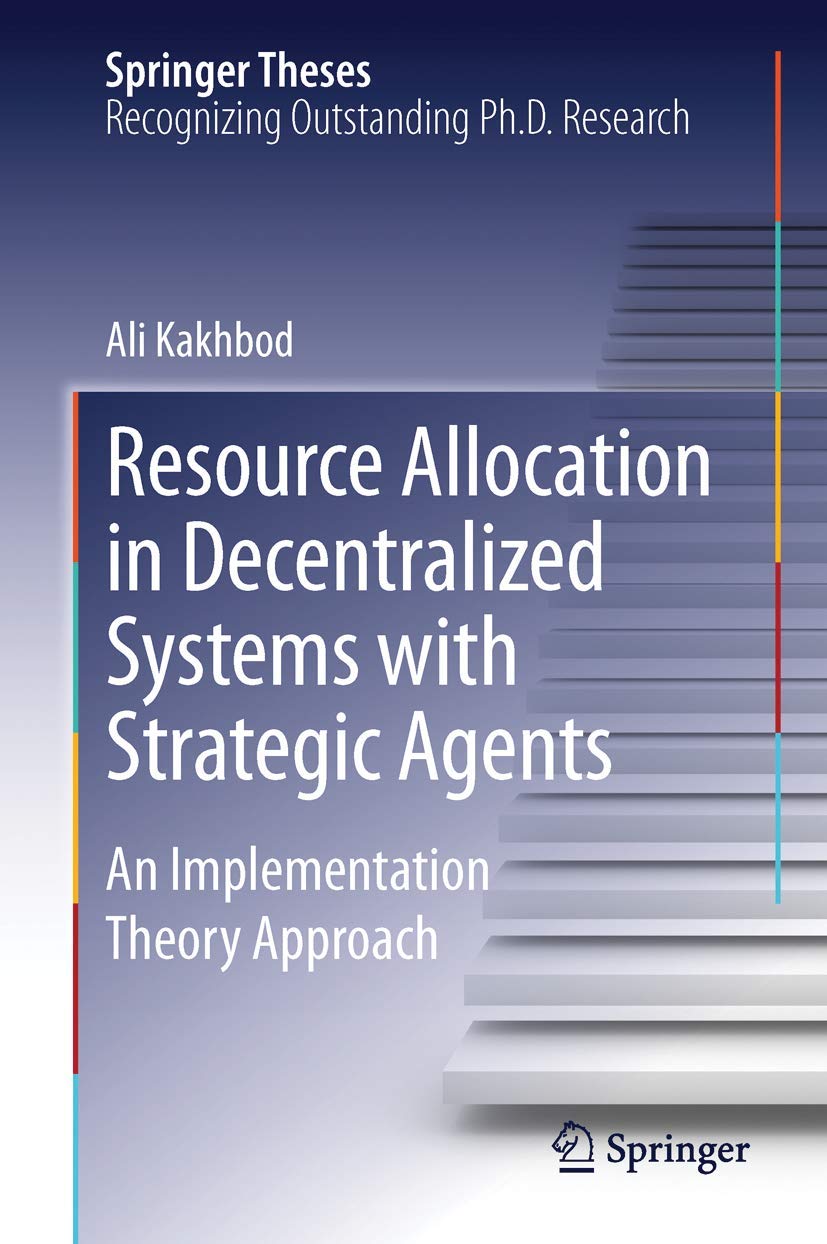
Title
Resource Allocation in Decentralized Systems with Strategic Agents: An Implementation Theory Approach (Springer Theses),Used
Sold by Ergodebooks, an authorized reseller.
Returns accepted within 30 days | support@ergodebooks.com
Shipping Information
- Free Standard Shipping — United States only
- Processing Time: 3–5 business days
- Estimated Delivery: 6–10 business days after dispatch
- Double-boxed, fully insured & discreetly packaged
- Tracking number sent via email once dispatched
Returns & Refund
Returns accepted within 30 days of delivery.
Damaged or Defective Item
Free return shipping + replacement or full refund
Wrong Item Received
Free return shipping + replacement or full refund
Change of Mind
Return shipping at customer's expense · 25% restocking fee applies
Payment Option

This thesis presents a significant contribution to decentralized resource allocation problems with strategic agents. The study focused on three classes of problems arising in communication networks. (C1). Unicast service provisioning in wired networks. (C2). Multirate multicast service provisioning in wired networks. (C3). Power allocation and spectrum sharing in multiuser multichannel wireless communication systems. Problems in (C1) are market problems; problems in (C2) are a combination of markets and public goods; problems in (C3) are public goods. Dr. Kakhbod developed game forms/mechanisms for unicast and multirate multicast service provisioning that possess specific properties. First, the allocations corresponding to all Nash equilibria (NE) of the games induced by the mechanisms are optimal solutions of the corresponding centralized allocation problems, where the objective is the maximization of the sum of the agents' utilities. Second, the strategic agents voluntarily participate in the allocation process. Third, the budget is balanced at the allocations corresponding to all NE of the game induced by the mechanism as well as at all other feasible allocations. For the power allocation and spectrum sharing problem, he developed a game form that possesses the second and third properties as detailed above along with a fourth property: the allocations corresponding to all NE of the game induced by the mechanism are Pareto optimal. The thesis contributes to the state of the art of mechanism design theory. In particular, designing efficient mechanisms for the class of problems that are a combination of markets and public goods, for the first time, have been addressed in this thesis. The exposition, although highly rigorous and technical, is elegant and insightful which makes this thesis work easily accessible to those just entering this field and will also be much appreciated by experts in the field.
⚠️ WARNING (California Proposition 65):
This product may contain chemicals known to the State of California to cause cancer, birth defects, or other reproductive harm.
For more information, please visit www.P65Warnings.ca.gov.