If you have any questions, you are always welcome to contact us. We'll get back to you as soon as possible, withing 24 hours on weekdays.
Customer service
All questions about your order, return and delivery must be sent to our customer service team by e-mail at yourstore@yourdomain.com
Sale & Press
If you are interested in selling our products, need more information about our brand or wish to make a collaboration, please contact us at press@yourdomain.com
Help
If you have any questions, you are always welcome to contact us. We'll get back to you as soon as possible, withing 24 hours on weekdays.
Customer service
All questions about your order, return and delivery must be sent to our customer service team by e-mail at yourstore@yourdomain.com
Sale & Press
If you are interested in selling our products, need more information about our brand or wish to make a collaboration, please contact us at press@yourdomain.com
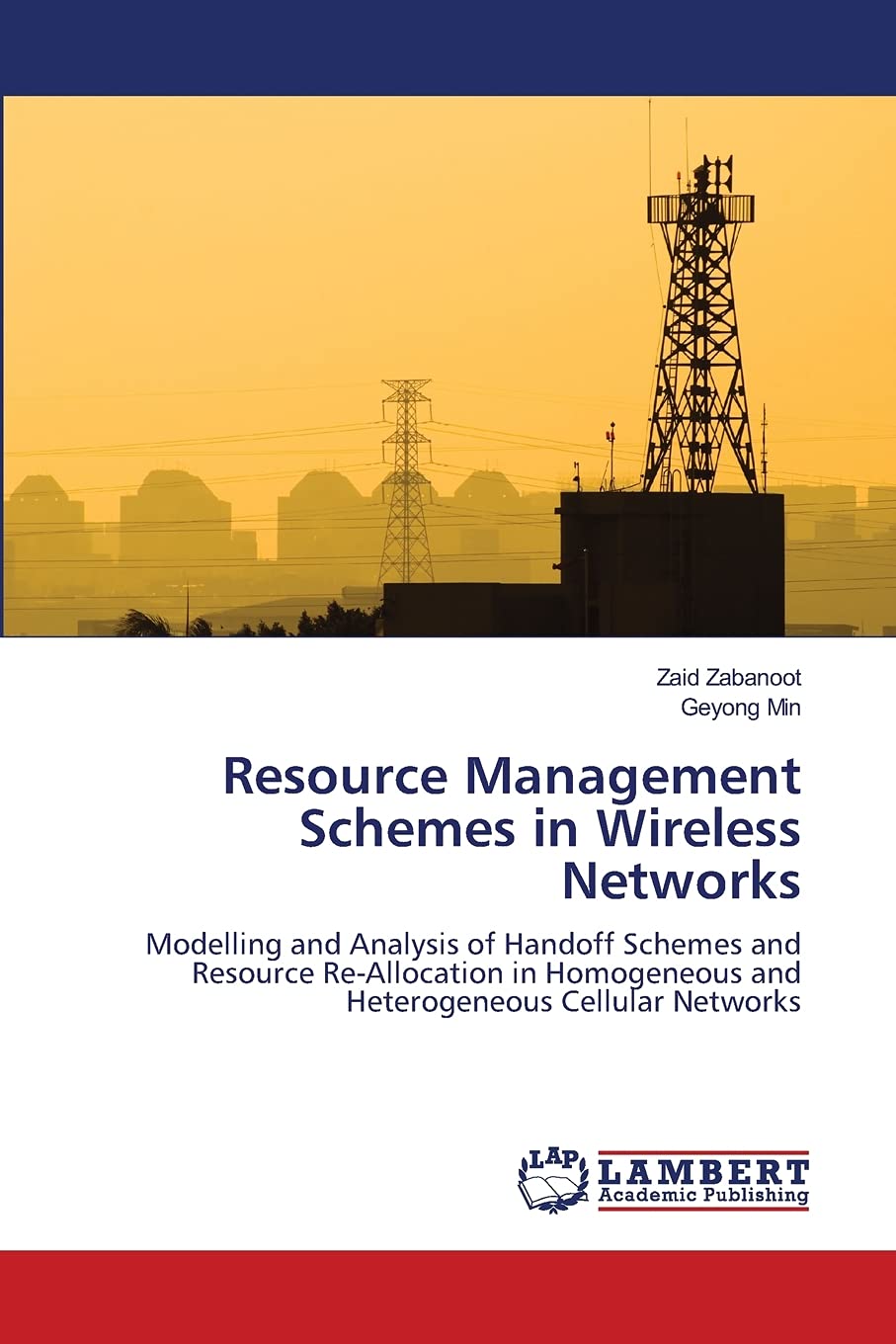
Over recent years, wireless communication systems have been experiencing a dramatic and continuous growth in the number of subscribers, thus placing extra demands on system capacity. At the same time, keeping Quality of Service (QoS) at an acceptable level is a critical concern and a challenge to the wireless network designer. In this sense, performance analysis must be the first step in designing or improving a network. A good modelling and analysis of the wireless cellular networks will lead to a high level of QoS. In this book, different analytical models of various handoff schemes and resource reallocation in homogeneous and heterogeneous wireless cellular networks are developed and investigated. The sustained increase in users and the request for advanced services are some of the key motivations for considering the designing of Hierarchical Cellular Networks (HCN). In HCN, calls blocked in a microcell flow over to an overlay macrocell. Microcells can be replaced by WLANs as this can provide high bandwidth and its users have limited mobility features. Efficient sharing of resources between wireless cellular networks and WLANs will improve the capacity as well as QoS metrics.
⚠️ WARNING (California Proposition 65):
This product may contain chemicals known to the State of California to cause cancer,
birth defects, or other reproductive harm.
For MAP (Minimum Advertised Price) violations and Intellectual Property (IP) or Trademark concerns, please contact:
support@ergodebooks.com
⚠️ California Proposition 65 Warning: Some products sold on this website may expose you to chemicals known to the State of California to cause cancer, birth defects, or other reproductive harm. For more information, visit www.P65Warnings.ca.gov.