
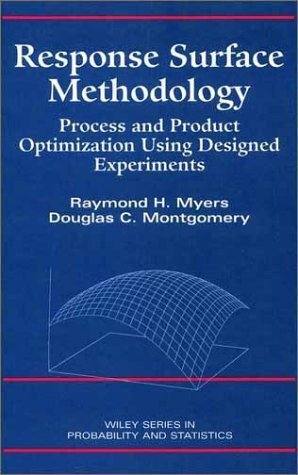
Title
Response Surface Methodology: Process and Product Optimization Using Designed Experiments,New
Sold by Ergodebooks, an authorized reseller.
Returns accepted within 30 days | support@ergodebooks.com
Shipping Information
- Free Standard Shipping — United States only
- Processing Time: 3–5 business days
- Estimated Delivery: 6–10 business days after dispatch
- Double-boxed, fully insured & discreetly packaged
- Tracking number sent via email once dispatched
Returns & Refund
Returns accepted within 30 days of delivery.
Damaged or Defective Item
Free return shipping + replacement or full refund
Wrong Item Received
Free return shipping + replacement or full refund
Change of Mind
Return shipping at customer's expense · 25% restocking fee applies
Payment Option

Gets you quickly up and running with the full range of powerful statistical experimental design, modeling, and optimization techniquesCoauthored by widely recognized experts in the fields of quality control and the design of experiments, this book is a practical guide to Response Surface Methodology (RSM)the process of identifying and fitting an appropriate response surface model from experimental data. While in the opening chapters the authors lay down the basic conceptual groundwork preliminary to a working understanding of the methods described, the bulk of the book is devoted to providing students and professionals with clear, stepbystep guidance on the use of powerful statistical and empirical modeling techniques that have proven their efficacy in industry. Throughout, numerous realworld examples help illuminate critical points covered, and chapterend problems help you to gauge your command of the concepts and procedures described. Important topics covered include: Twolevel factorial and fractional factorial designs Empirical modeling using regression techniques Elementary optimization methods Classical and modern response surface designs Robust parameter design methodology Mixture experiments Computeraided design and problemsolving techniques And much moreProviding clear, handson guidance to the application of some of today's most useful techniques, Response Surface Methodology is an essential working resource for process development and quality engineering professionals, engineering designers, product formulators, engineers, chemists, and all those whose professional activities involve the design of experiments.
⚠️ WARNING (California Proposition 65):
This product may contain chemicals known to the State of California to cause cancer, birth defects, or other reproductive harm.
For more information, please visit www.P65Warnings.ca.gov.
- Q: What is Response Surface Methodology (RSM)? A: Response Surface Methodology (RSM) is a statistical technique used for modeling and analyzing problems where several variables influence the outcome. It helps in optimizing processes and products by fitting a response surface model to experimental data.
- Q: Who is the author of the book 'Response Surface Methodology'? A: The book is authored by Raymond H. Myers, who is recognized as an expert in quality control and the design of experiments.
- Q: What topics are covered in this book? A: The book covers a range of topics including factorial designs, regression techniques, optimization methods, and robust parameter design methodology, among others.
- Q: Is this book suitable for beginners? A: Yes, the book starts with basic concepts and gradually progresses to more advanced techniques, making it suitable for both beginners and professionals.
- Q: How many pages does the book have? A: The book contains 728 pages, providing comprehensive coverage of Response Surface Methodology.
- Q: What type of binding does the book have? A: This book is available in hardcover binding, which provides durability and a professional appearance.
- Q: What is the publication date of the book? A: The book was published on August 29, 1995.
- Q: Are there practical examples included in the book? A: Yes, the book includes numerous real-world examples and chapter-end problems to help readers understand and apply the concepts discussed.
- Q: Who would benefit from reading this book? A: This book is beneficial for process development and quality engineering professionals, engineering designers, product formulators, chemists, and anyone involved in the design of experiments.
- Q: Does the book include exercises or problems to practice? A: Yes, the book features chapter-end problems designed to help readers gauge their understanding of the concepts and procedures.