
Title
Restorative Juvenile Justice: An Exploration of the Restorative Justice Paradigm for Reforming Juvenile Justice,Used
Sold by Ergodebooks, an authorized reseller.
Returns accepted within 30 days | support@ergodebooks.com
Shipping Information
- Free Standard Shipping — United States only
- Processing Time: 3–5 business days
- Estimated Delivery: 6–10 business days after dispatch
- Double-boxed, fully insured & discreetly packaged
- Tracking number sent via email once dispatched
Returns & Refund
Returns accepted within 30 days of delivery.
Damaged or Defective Item
Free return shipping + replacement or full refund
Wrong Item Received
Free return shipping + replacement or full refund
Change of Mind
Return shipping at customer's expense · 25% restocking fee applies
Payment Option

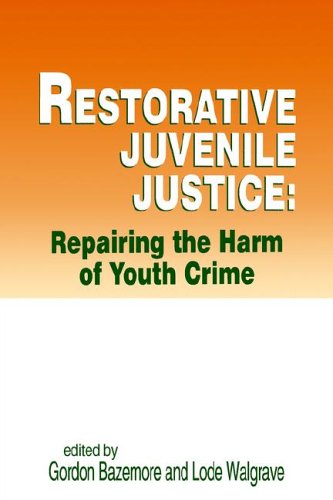
An anthology includes 14 previously unpublished papers exploring the potential of restorative justice to serve as an overarching vision for the juvenile justice system and outlining a research agenda for the concept's further development. Earlier drafts of the papers were originally presented at a conference held in Leuven, Belgium in 1997. An introduction is provided by editors Gordon Bazemore and Lode Walgrave. Part 1, 'Key Principles,' begins with Barry C. Feld's reflections on alternative conceptions of juvenile justice. Bazemore and Walgrave offer an outline for systemic restorative justiceoriented reform of juvenile justice. The history of restorative justice is recounted by Elmar G.M. Weitekamp. John Braithwaite and Christine Parker equate restorative justice with what Braithwaite has previously called republican justice. Part 2, 'Process, Programs and Practices,' begins with Walgrave's essay on community service as a cornerstone of restorative juvenile justice. Bazemore analyzes links between restorative justice and relational rehabilitation. The importance of protecting public safety role in a restorative juvenile justice system is highlighted by Susan GuarinoGhezzi and Andrew Klein. How to avoid the marginalization of victimoffender mediation is Mark S. Umbreit's theme. In Part 3, 'Implementation Issues,' a Canadian case study is presented by Curt Taylor Griffiths and Ray Corrado. Legal issues raised by restorative justice are assessed by Daniel W. Van Ness. Part 4 is devoted to research issues. Klaus Sessar examines reality and myth concerning the public's punitive attitudes. Russ Immarigeon provides a review of the literature on restorative justice, juvenile offenders and crime victims. The impact of restorative interventions on juvenile offenders is analyzed by Mara Schiff. The editors conclude the volume with reflections on the future of restorative justice for juveniles
⚠️ WARNING (California Proposition 65):
This product may contain chemicals known to the State of California to cause cancer, birth defects, or other reproductive harm.
For more information, please visit www.P65Warnings.ca.gov.