
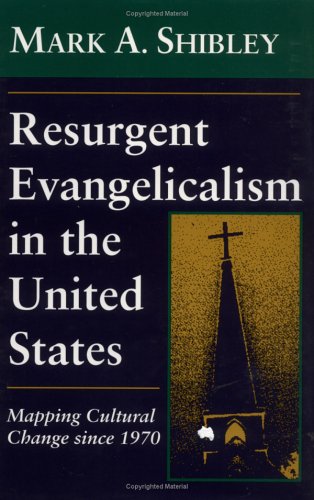
Title
Resurgent Evangelicalism in the United States: Mapping Cultural Change Since 1970,Used
Sold by Ergodebooks, an authorized reseller.
Returns accepted within 30 days | support@ergodebooks.com
Shipping Information
- Free Standard Shipping — United States only
- Processing Time: 3–5 business days
- Estimated Delivery: 6–10 business days after dispatch
- Double-boxed, fully insured & discreetly packaged
- Tracking number sent via email once dispatched
Returns & Refund
Returns accepted within 30 days of delivery.
Damaged or Defective Item
Free return shipping + replacement or full refund
Wrong Item Received
Free return shipping + replacement or full refund
Change of Mind
Return shipping at customer's expense · 25% restocking fee applies
Payment Option

How evangelicalism is transformingand being transformed byAmerican cultureIn this provocative look at evangelicalism in the United States, Mark A. Shibley tests the widely ascribed "southernization of American religion" thesis, or the idea that the recent resurgence of bornagain Christianity represents the spread of southernstyle religion from the historically conservative, Protestant South to America's mainstream. While confirming a link between evangelicalism's initial growth and the diffusion of southernstyle religion, Shibley uncovers a reciprocity in the relationship between evangelicalism and secularism. He demonstrates that even as evangelicalism changes the face of American culture, it is transformed by its encounter with secularism.The price of success for bornagain Christianity, according to Shibley, is cultural accommodation. He argues that evangelicalism forfeits some of its "southernness"including its moral strictnessin order to thrive outside the South, and he contends that congregations that embrace secular elements of the surrounding culture grow more rapidly than those that hold tightly to traditional evangelical beliefs.Shibley predicts that evangelicalism outside the South will increasingly shape itself to meet individual rather than collective needs and that the restructuring of American religion and culture will follow a publictoprivate, rather than liberaltoconservative, continuum. Disagreeing with some recent obituaries of the New Christian Right, he suggests that evangelicalism will continue to have a significant effect on American culture in the foreseeable future, but not in the domineering way once feared by the liberal cultural establishment.
⚠️ WARNING (California Proposition 65):
This product may contain chemicals known to the State of California to cause cancer, birth defects, or other reproductive harm.
For more information, please visit www.P65Warnings.ca.gov.