
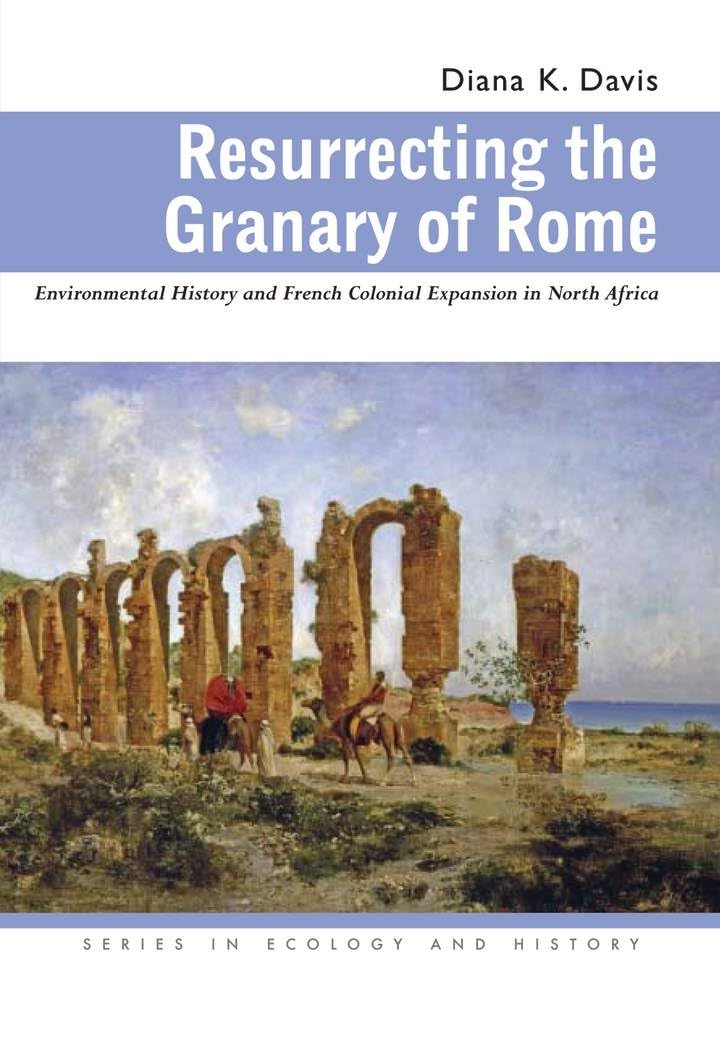
Title
Resurrecting The Granary Of Rome: Environmental History And French Colonial Expansion In North Africa (Ecology & History),Used
Sold by Ergodebooks, an authorized reseller.
Returns accepted within 30 days | support@ergodebooks.com
Shipping Information
- Free Standard Shipping — United States only
- Processing Time: 3–5 business days
- Estimated Delivery: 6–10 business days after dispatch
- Double-boxed, fully insured & discreetly packaged
- Tracking number sent via email once dispatched
Returns & Refund
Returns accepted within 30 days of delivery.
Damaged or Defective Item
Free return shipping + replacement or full refund
Wrong Item Received
Free return shipping + replacement or full refund
Change of Mind
Return shipping at customer's expense · 25% restocking fee applies
Payment Option

Tales of deforestation and desertification in North Africa have been told from the Roman period to the present. Such stories of environmental decline in the Maghreb are still recounted by experts and are widely accepted without question today. International organizations such as the United Nations frequently invoke these inaccurate stories to justify environmental conservation and development projects in the arid and semiarid lands in North Africa and around the Mediterranean basin. Recent research in arid lands ecology and new paleoecological evidence, however, do not support many claims of deforestation, overgrazing, and desertification in this region.Diana K. Daviss pioneering analysis reveals the critical influence of French scientists and administrators who established much of the purported scientific basis of these stories during the colonial period in Algeria, Morocco, and Tunisia, illustrating the key role of environmental narratives in imperial expansion. The processes set in place by the use of this narrative not only systematically disadvantaged the majority of North Africans but also led to profound changes in the landscape, some of which produced the land degradation that continues to plague the Maghreb today.Resurrecting the Granary of Rome exposes many of the political, economic, and ideological goals of the French colonial project in these arid lands and the resulting definition of desertification that continues to inform global environmental and development projects. The first book on the environmental history of the Maghreb, this volume reframes much conventional thinking about the North African environment. Daviss book is essential reading for those interested in global environmental history.
⚠️ WARNING (California Proposition 65):
This product may contain chemicals known to the State of California to cause cancer, birth defects, or other reproductive harm.
For more information, please visit www.P65Warnings.ca.gov.
- Q: What is the page count of this book? A: The book has three hundred twelve pages. It covers various environmental history topics related to North Africa.
- Q: What type of binding does this book have? A: This book is published in paperback format. Paperback bindings are flexible and lightweight, making them easy to carry.
- Q: Who is the author of this book? A: The author of the book is Diana K. Davis. She is recognized for her contributions to environmental history.
- Q: How do I use this book for research? A: You can use this book as a scholarly resource for understanding environmental history. It provides insights into colonial narratives and their impact.
- Q: Is this book suitable for high school students? A: Yes, the book is suitable for advanced high school students. It delves into complex themes related to environmental history and colonialism.
- Q: Can I use this book for a college course? A: Yes, this book is ideal for college courses in environmental studies or history. It offers a comprehensive analysis of North African environmental issues.
- Q: How should I care for this paperback book? A: Keep the book in a dry place and avoid exposure to direct sunlight. Store it upright on a shelf to prevent bending.
- Q: Is this book safe for children? A: No, this book is primarily intended for adults and older students. It contains complex themes related to environmental and political issues.
- Q: What if the book arrives damaged? A: If the book arrives damaged, you should contact the seller for a return or exchange. Most sellers have a return policy for such situations.
- Q: How can I find more books by Diana K. Davis? A: You can search for more books by Diana K. Davis through online bookstores or academic publishers. Look for her other works in environmental history.
- Q: What themes are explored in this book? A: The book explores themes of environmental decline, colonial narratives, and the political implications of environmental conservation in North Africa.
- Q: Is this book part of a series? A: No, this book is not part of a series. It stands alone as a comprehensive study of environmental history in the Maghreb.
- Q: Does this book include illustrations? A: No, this book does not specifically mention illustrations. It focuses on textual analysis and scholarly discourse.
- Q: What are the dimensions of this book? A: The book's dimensions are six inches in length, eight tenths of an inch in width, and nine inches in height. These dimensions make it portable.
- Q: Can this book help with understanding modern environmental issues? A: Yes, the book provides historical context that can enhance understanding of current environmental issues in North Africa and beyond.