
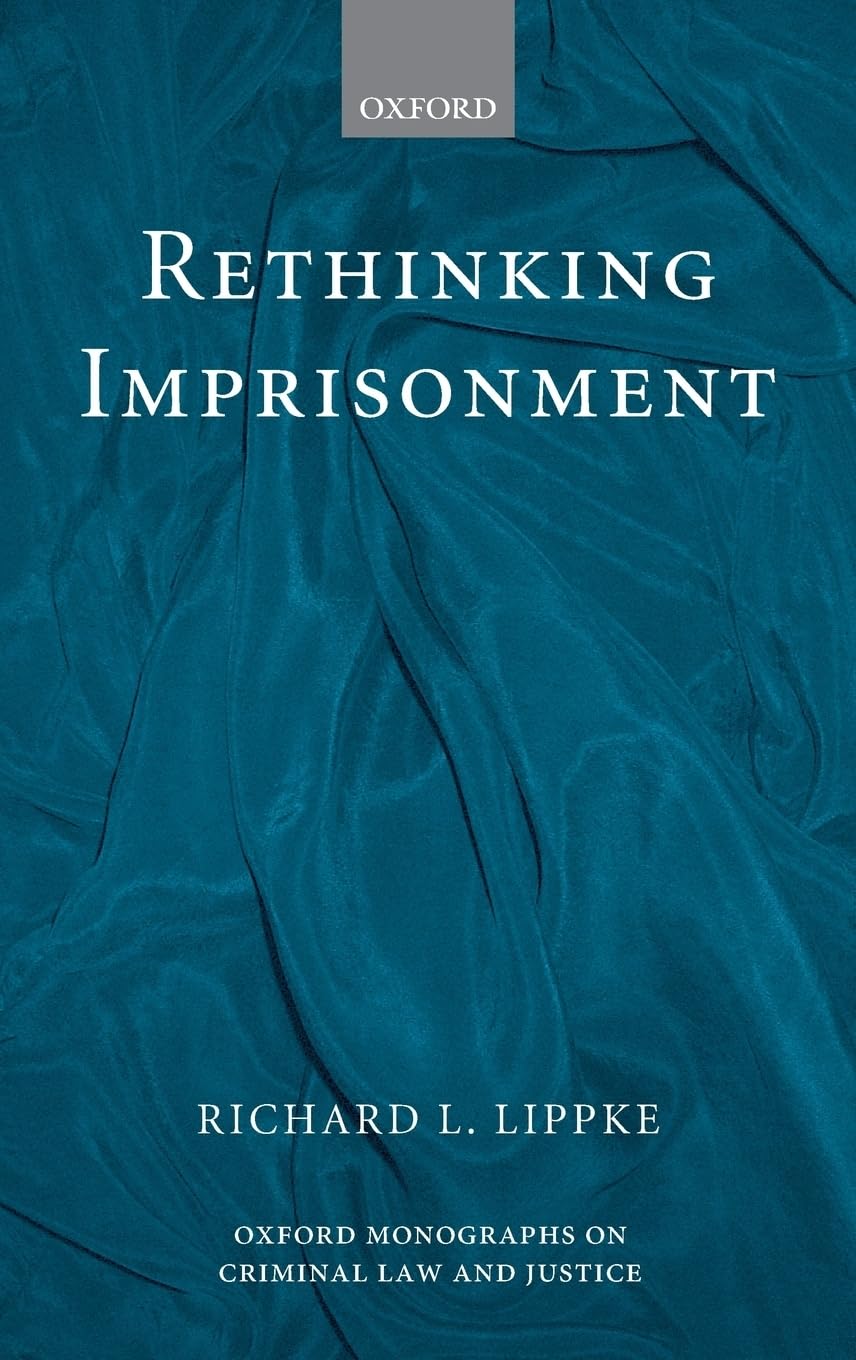
Title
Rethinking Imprisonment (Oxford Monographs on Criminal Law and Justice),Used
Sold by Ergodebooks, an authorized reseller.
Returns accepted within 30 days | support@ergodebooks.com
Shipping Information
- Free Standard Shipping — United States only
- Processing Time: 3–5 business days
- Estimated Delivery: 6–10 business days after dispatch
- Double-boxed, fully insured & discreetly packaged
- Tracking number sent via email once dispatched
Returns & Refund
Returns accepted within 30 days of delivery.
Damaged or Defective Item
Free return shipping + replacement or full refund
Wrong Item Received
Free return shipping + replacement or full refund
Change of Mind
Return shipping at customer's expense · 25% restocking fee applies
Payment Option

Drawing on philosophical arguments, criminological evidence, and the legal literature on prisoners' rights, Rethinking Imprisonment defends a normative theory of imprisonment. Such a theory provides an account of the justified conditions of prison confinement the restrictions and deprivations that can be legitimately imposed on serious offenders in the name of punishment.The theory of legal punishment upon which this account builds combines retributive and crime reduction elements, with the former accorded priority on both moral and epistemic grounds. Contrary to its formidable reputation, retributivism is shown to place important and substantial limits on the character of imprisonment, its appropriate use, and duration. Much of the contemporary use of imprisonment as a legal sanction is arguably unjustified on all three counts.Rethinking Imprisonment urges the adoption of prison conditions at or near the 'minimum conditions of confinement' which severely curtail the freedom of movement, freedom of association, and privacy of prisoners, yet are still consistent with ensuring the basic physical and psychological welfare of prisoners, and provide them with access to paid labor, visitation, entertainment, recreation, and retained civic and political rights. This book argues that firstly the punishment of serious offenders generally requires no more than the imposition of 'minimum conditions of confinement' and secondly that moral constraints on punishment derived from retributivism in conjunction with the available evidence about the prison regimes most likely to reduce crime point towards more humane and less restrictive prisons.
⚠️ WARNING (California Proposition 65):
This product may contain chemicals known to the State of California to cause cancer, birth defects, or other reproductive harm.
For more information, please visit www.P65Warnings.ca.gov.
- Q: How many pages does the book have? A: The book has two hundred ninety-four pages. It offers a comprehensive exploration of imprisonment and its implications.
- Q: What is the binding type of this book? A: The book is hardcover. This durable binding is designed to withstand frequent use while maintaining its quality.
- Q: What are the dimensions of the book? A: The book measures nine point twenty-one inches in length, six point fourteen inches in width, and five point ninety-eight inches in height. These dimensions make it suitable for easy handling.
- Q: How should I read this book? A: You can read this book at your own pace. It is suitable for anyone interested in criminal law, philosophy, or justice.
- Q: Is this book suitable for beginners in criminal law? A: Yes, the book is suitable for beginners. It provides foundational insights into the philosophical and legal aspects of imprisonment.
- Q: What themes does this book cover? A: The book covers themes of legal punishment, imprisonment conditions, and prisoners' rights. It challenges conventional views on punishment.
- Q: How should I store this book to keep it in good condition? A: Store the book upright on a shelf away from direct sunlight. This helps preserve its binding and pages from wear and fading.
- Q: Can I clean the book if it gets dirty? A: Yes, you can gently wipe the cover with a soft, dry cloth. Avoid using water or cleaning solutions that may damage the material.
- Q: What is the best way to protect this book from damage? A: Keep the book in a cool, dry place and avoid excessive bending of its pages. Consider using a book cover for extra protection.
- Q: Is there a warranty for this book? A: No, there is no warranty for this book. However, it is published by Oxford University Press, known for high-quality academic publications.
- Q: What if the book arrives damaged? A: If the book arrives damaged, you should contact the seller for a return or replacement. Most sellers have a policy for handling such cases.
- Q: How does this book compare to others in the criminal law genre? A: This book uniquely integrates philosophical arguments with legal analysis. It stands out by advocating for humane prison conditions compared to other texts.
- Q: Is this book appropriate for academic study? A: Yes, this book is appropriate for academic study. It is part of the Oxford Monographs on Criminal Law and Justice series.
- Q: Who is the author of this book? A: The author of the book is Richard Lippke. He is known for his work in criminal law and philosophy.
- Q: Does this book address contemporary issues in criminal justice? A: Yes, the book addresses contemporary issues related to imprisonment and punishment. It critiques the current state of prison conditions.
- Q: What makes this book a significant read? A: This book is significant for its defense of a normative theory of imprisonment. It challenges existing punitive practices and advocates for reform.