If you have any questions, you are always welcome to contact us. We'll get back to you as soon as possible, withing 24 hours on weekdays.
Customer service
All questions about your order, return and delivery must be sent to our customer service team by e-mail at yourstore@yourdomain.com
Sale & Press
If you are interested in selling our products, need more information about our brand or wish to make a collaboration, please contact us at press@yourdomain.com
Help
If you have any questions, you are always welcome to contact us. We'll get back to you as soon as possible, withing 24 hours on weekdays.
Customer service
All questions about your order, return and delivery must be sent to our customer service team by e-mail at yourstore@yourdomain.com
Sale & Press
If you are interested in selling our products, need more information about our brand or wish to make a collaboration, please contact us at press@yourdomain.com
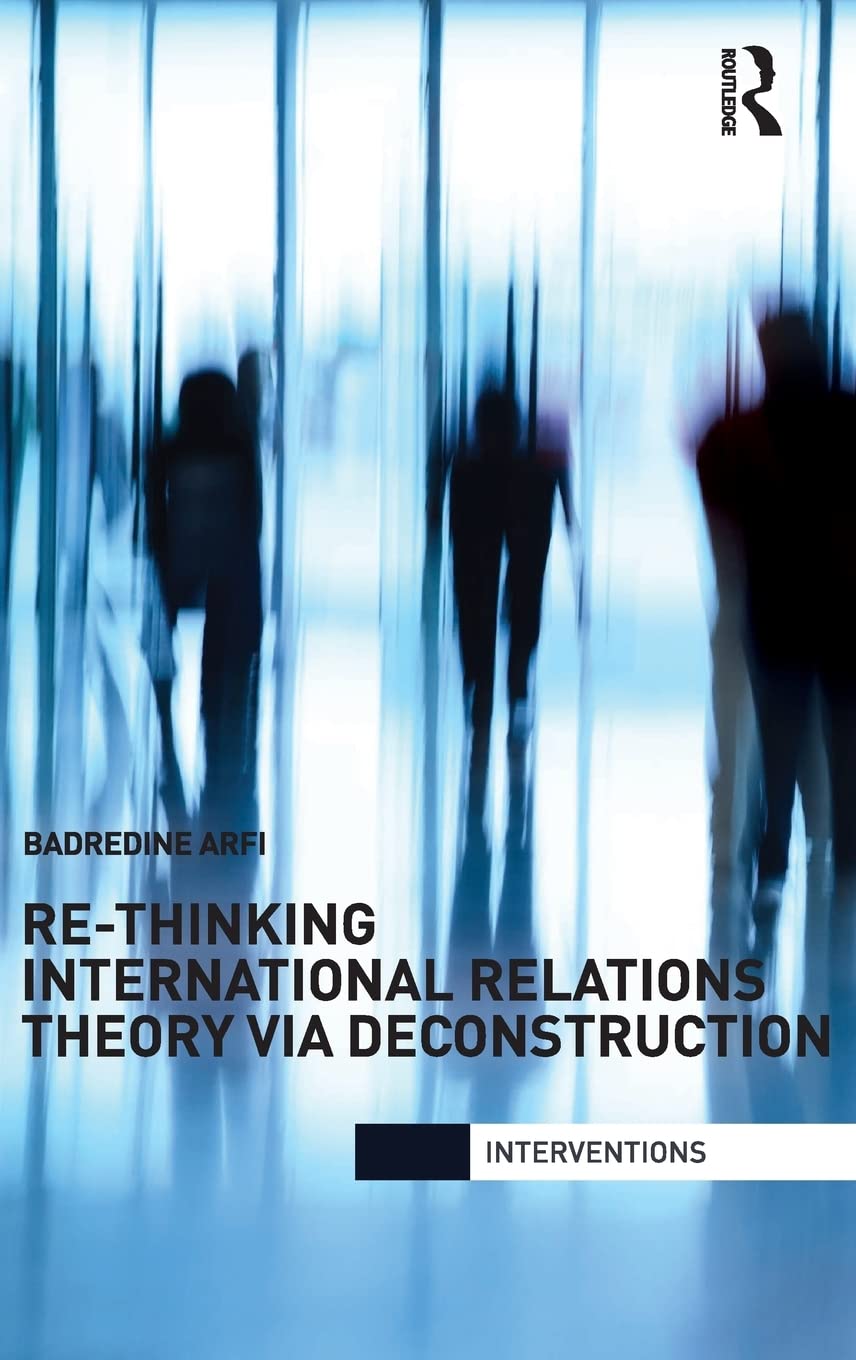
International Relations (IR) theorists have ceaselessly sought to understand, explain, and transform the experienced reality of international politics. Running through all these attempts is a persistent, yet unquestioned, quest by theorists to develop strategies to eliminate or reduce the antinomies, contradictions, paradoxes, dilemmas, and inconsistencies dogging their approaches. A serious critical assessment of the logic behind these strategies is however lacking. This new work addresses this issue by seeking to reformulate IR theory in an original way.Arfi begins by providing a thorough critique of leading contemporary IR theories, including pragmatism, critical/scientific realism, rationalism, neoliberal institutionalism and socialconstructivism, and then moves on to strengthen and go beyond the valuable contributions of each approach by employing the logic of deconstruction pioneered by Derrida to explicate the consequences of taking into account the dilemmas and inconsistencies of these theories. The book demonstrates that the logic of deconstruction is resourceful and rigorous in its questioning of the presuppositions of prevailing IR approaches, and argues that relying on deconstruction leads to richer and more powerfully insightful pluralist IR theories and is an invaluable resource for taking IR theory beyond currently paralyzing wars of paradigms.Questioning universally accepted presuppositions in existing theories, this book provides an innovative and exciting contribution to the field, and will be of great interest to scholars of international relations theory, critical theory and international relations.
⚠️ WARNING (California Proposition 65):
This product may contain chemicals known to the State of California to cause cancer,
birth defects, or other reproductive harm.
For MAP (Minimum Advertised Price) violations and Intellectual Property (IP) or Trademark concerns, please contact:
support@ergodebooks.com
⚠️ California Proposition 65 Warning: Some products sold on this website may expose you to chemicals known to the State of California to cause cancer, birth defects, or other reproductive harm. For more information, visit www.P65Warnings.ca.gov.