
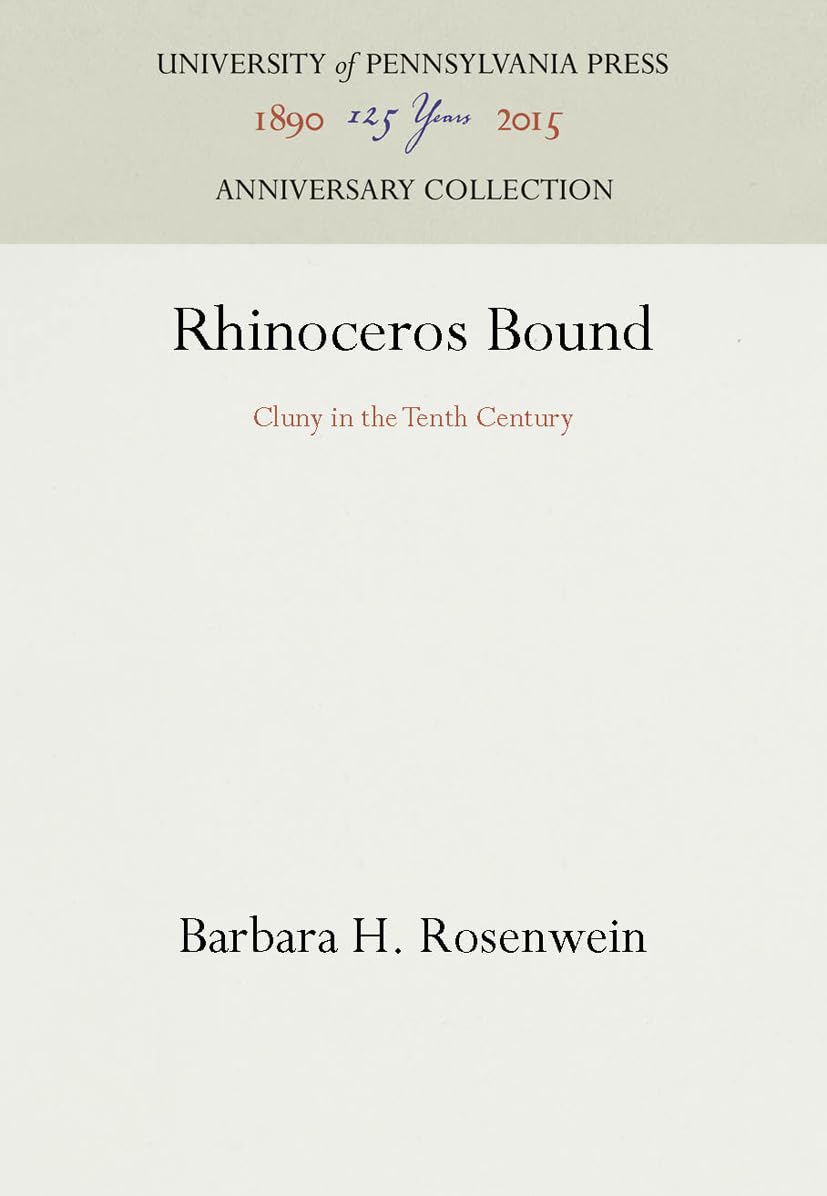
Title
Rhinoceros Bound: Cluny in the Tenth Century (Anniversary Collection),Used
Sold by Ergodebooks, an authorized reseller.
Returns accepted within 30 days | support@ergodebooks.com
Shipping Information
- Free Standard Shipping — United States only
- Processing Time: 3–5 business days
- Estimated Delivery: 6–10 business days after dispatch
- Double-boxed, fully insured & discreetly packaged
- Tracking number sent via email once dispatched
Returns & Refund
Returns accepted within 30 days of delivery.
Damaged or Defective Item
Free return shipping + replacement or full refund
Wrong Item Received
Free return shipping + replacement or full refund
Change of Mind
Return shipping at customer's expense · 25% restocking fee applies
Payment Option

The rhinoceros, that is, any powerful man, is bound with a thong so that he may crush the clods of the valleys, that is, the oppressors of the humble.'Odo of Cluny, Vita Geraldi i.8To the second abbot of the great monastery at Cluny, Saint Odo, tenthcentury Europe was a world filled with violent men oppressing at whim the poor and the powerless. As royal authority waned, local magnates, unrestrained by any authority, divine or human, seized the opportunity to enhance their positions. Odo, along with Cluny's other founding spiritual and ideological leaders, created within the protective walls of the monastery a model of restraint, instituting in place of the instability of everyday life an interpretation of the Benedictine Rule that stressed ritual, order, and lawfulness. Such were the beginnings of the monastery that Pope Urban II in the eleventh century would call 'the light of the world,' the fountainhead of what would become one of the most farreaching religious reform movements in European history.Barbara Rosenwein in Rhinoceros Bound focuses on Cluny's founding and early growth within the context of a society shaped by the needs of those set adrift in the social upheaval of the tenth century. Examining in the first chapter traditional approaches to Cluniac studies, the author reveals that historians have generally considered Cluny's eleventhcentury role in church reform without analyzing the peculiar combination of forces and founders that created the Cluniac ideal and gave it its original momentum. This fundamental problem is the topic of the second chapter. She then examines how the early Cluniacs perceived the world outside the monastery and how they viewed their own world inside of it.Rosenwein concludes with a chapter on Cluny in the tenth century that combines traditional historical techniques with contemporary sociological insights. She provides in this study a significant reassessment of a period crucial to the political development of Europe, as well as a case study of institutional response to acute and political change.
⚠️ WARNING (California Proposition 65):
This product may contain chemicals known to the State of California to cause cancer, birth defects, or other reproductive harm.
For more information, please visit www.P65Warnings.ca.gov.