If you have any questions, you are always welcome to contact us. We'll get back to you as soon as possible, withing 24 hours on weekdays.
Customer service
All questions about your order, return and delivery must be sent to our customer service team by e-mail at yourstore@yourdomain.com
Sale & Press
If you are interested in selling our products, need more information about our brand or wish to make a collaboration, please contact us at press@yourdomain.com
Help
If you have any questions, you are always welcome to contact us. We'll get back to you as soon as possible, withing 24 hours on weekdays.
Customer service
All questions about your order, return and delivery must be sent to our customer service team by e-mail at yourstore@yourdomain.com
Sale & Press
If you are interested in selling our products, need more information about our brand or wish to make a collaboration, please contact us at press@yourdomain.com
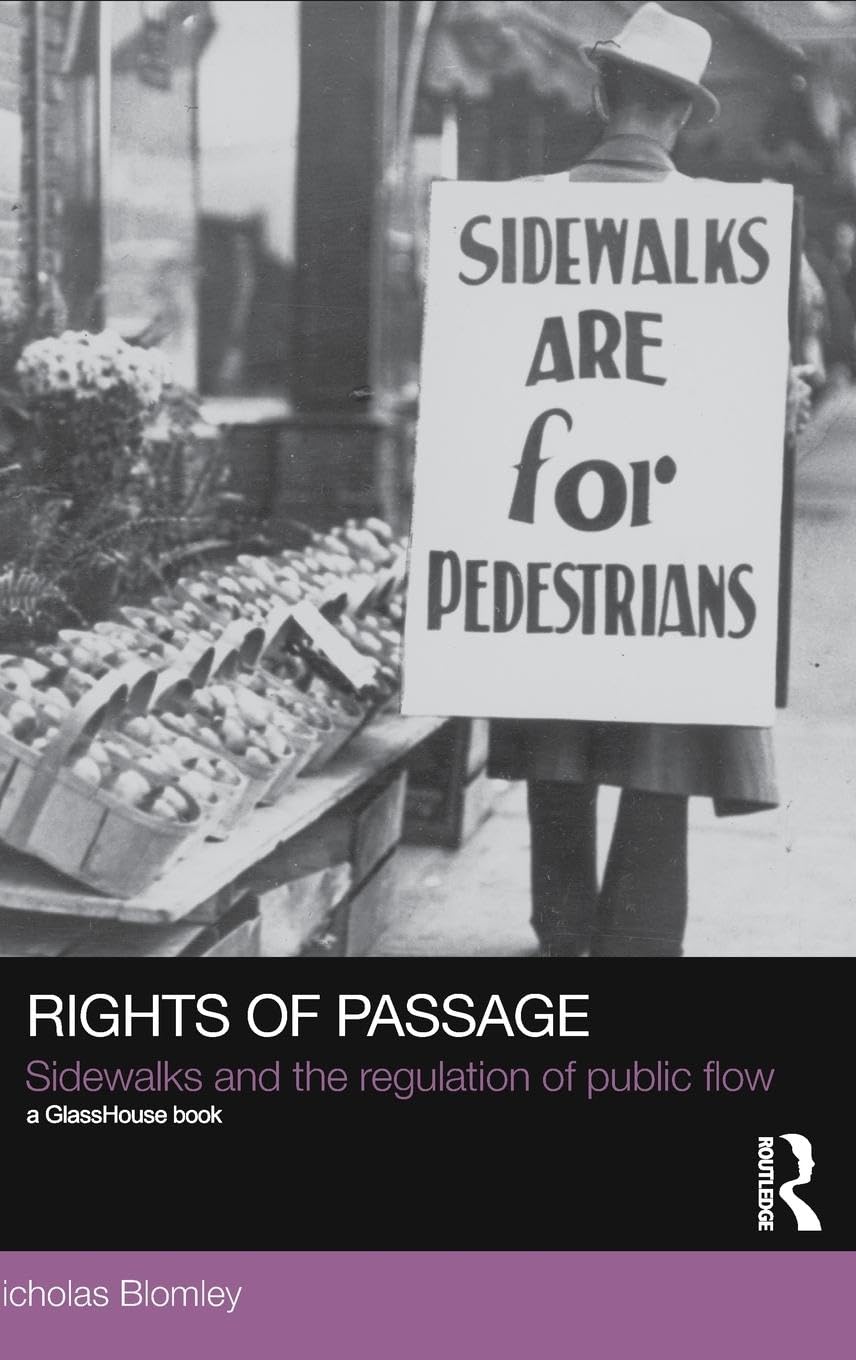
Rights of Passage: Sidewalks and the Regulation of Public Flow documents a powerful and underresearched form of urban governance that focuses on pedestrian flow. This logic, which Nicholas Blomley terms 'pedestrianism', values public space not in terms of its aesthetic merits, or its success in promoting public citizenship and democracy. Rather, the function of the sidewalk is understood to be the promotion and facilitation of pedestrian flow and circulation, predicated on the appropriate arrangement of people and objects. This remarkably pervasive yet overlooked logic shapes the ways in which public space is regulated, conceived of, and argued about. Rights of Passage shows how the sidewalk is literally produced, encoded, rendered legible and operational with reference to a dense array of codes, diagrams, specifications, academic and professional networks, engineering rubrics, regulation and case law all in the name of unfettered circulation.Although a powerful form of governance, pedestrianism tends to be obscured by grander and more visible forms of urban regulation. The rationality at work here may appear commonplace; but, precisely because it is uncontroversial, pedestrianism is able to operate below the academic and political radar. Complicating the prevailing tendency to focus on the socially directive nature of public space regulation, Blomley reveals the particular ways in which pedestrianism deactivates rightsbased claims to public space.
⚠️ WARNING (California Proposition 65):
This product may contain chemicals known to the State of California to cause cancer,
birth defects, or other reproductive harm.
For MAP (Minimum Advertised Price) violations and Intellectual Property (IP) or Trademark concerns, please contact:
support@ergodebooks.com
⚠️ California Proposition 65 Warning: Some products sold on this website may expose you to chemicals known to the State of California to cause cancer, birth defects, or other reproductive harm. For more information, visit www.P65Warnings.ca.gov.