If you have any questions, you are always welcome to contact us. We'll get back to you as soon as possible, withing 24 hours on weekdays.
Customer service
All questions about your order, return and delivery must be sent to our customer service team by e-mail at yourstore@yourdomain.com
Sale & Press
If you are interested in selling our products, need more information about our brand or wish to make a collaboration, please contact us at press@yourdomain.com
Help
If you have any questions, you are always welcome to contact us. We'll get back to you as soon as possible, withing 24 hours on weekdays.
Customer service
All questions about your order, return and delivery must be sent to our customer service team by e-mail at yourstore@yourdomain.com
Sale & Press
If you are interested in selling our products, need more information about our brand or wish to make a collaboration, please contact us at press@yourdomain.com
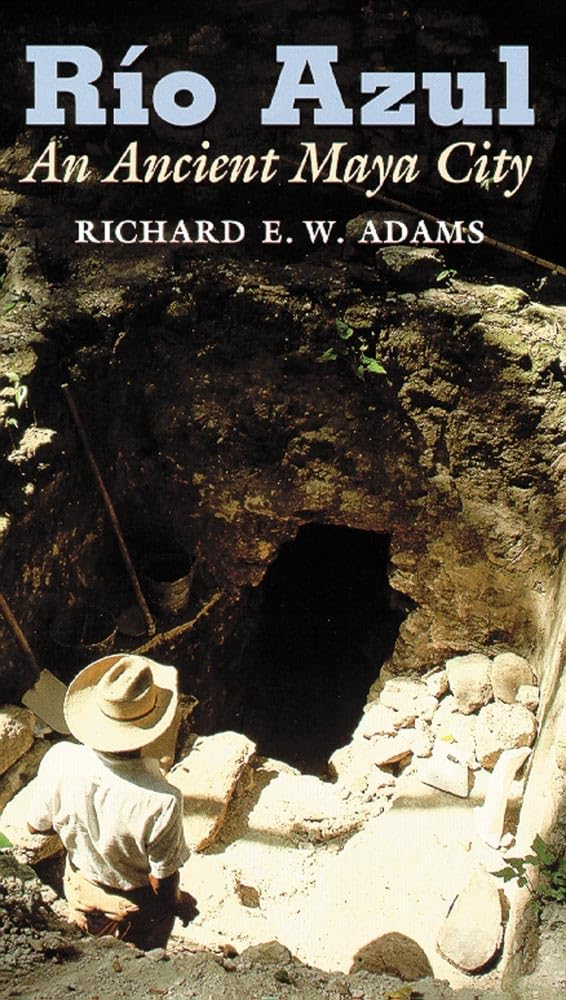
Deep within the forest in northern Guatemala lie the ruins of Ro Azul, a Maya city that reached onethird the size of Tikal. Discovered and partially explored in the early 1960s, Ro Azul and the surrounding region were more fully investigated between 1983 and 1987 by an archaeological team led by Richard E. W. Adams. In this summary, Adams integrates the findings of field archaeologists with those of the epigraphers and art historians to recreate the life of this Maya city from the littleknown Early Classic period.Remains in the Ro Azul area date from 900 B.C. to A.D. 850. The data indicate that, unlike most Maya cities that have been studied, Ro Azul was a frontier town, an administrative center, with alternating defense and trade outpost functions. About A.D. 385, the Ro Azul region was conquered and the city founded by Tikal, serving as a Teotihuacanlinked garrison for that capital. Nearly all of the more than seven hundred structures found within Ro Azul were erected between A.D. 390 and 530.Acres of pavement were laid down around some thirty complexes of residences, temples, and tombs notable for the brightly painted red hieroglyphs and murals on their walls. The elaborate complexes and sumptuous artifacts suggest a city with a heavy proportion of aristocratic families and retainers.Around A.D. 530, Ro Azul appears to have been suddenly destroyed. The city was abandoned, then reoccupiedonly to stagnate and finally collapse, like many other Classic Maya cities, in the late ninth century.
⚠️ WARNING (California Proposition 65):
This product may contain chemicals known to the State of California to cause cancer,
birth defects, or other reproductive harm.
For MAP (Minimum Advertised Price) violations and Intellectual Property (IP) or Trademark concerns, please contact:
support@ergodebooks.com
⚠️ California Proposition 65 Warning: Some products sold on this website may expose you to chemicals known to the State of California to cause cancer, birth defects, or other reproductive harm. For more information, visit www.P65Warnings.ca.gov.