
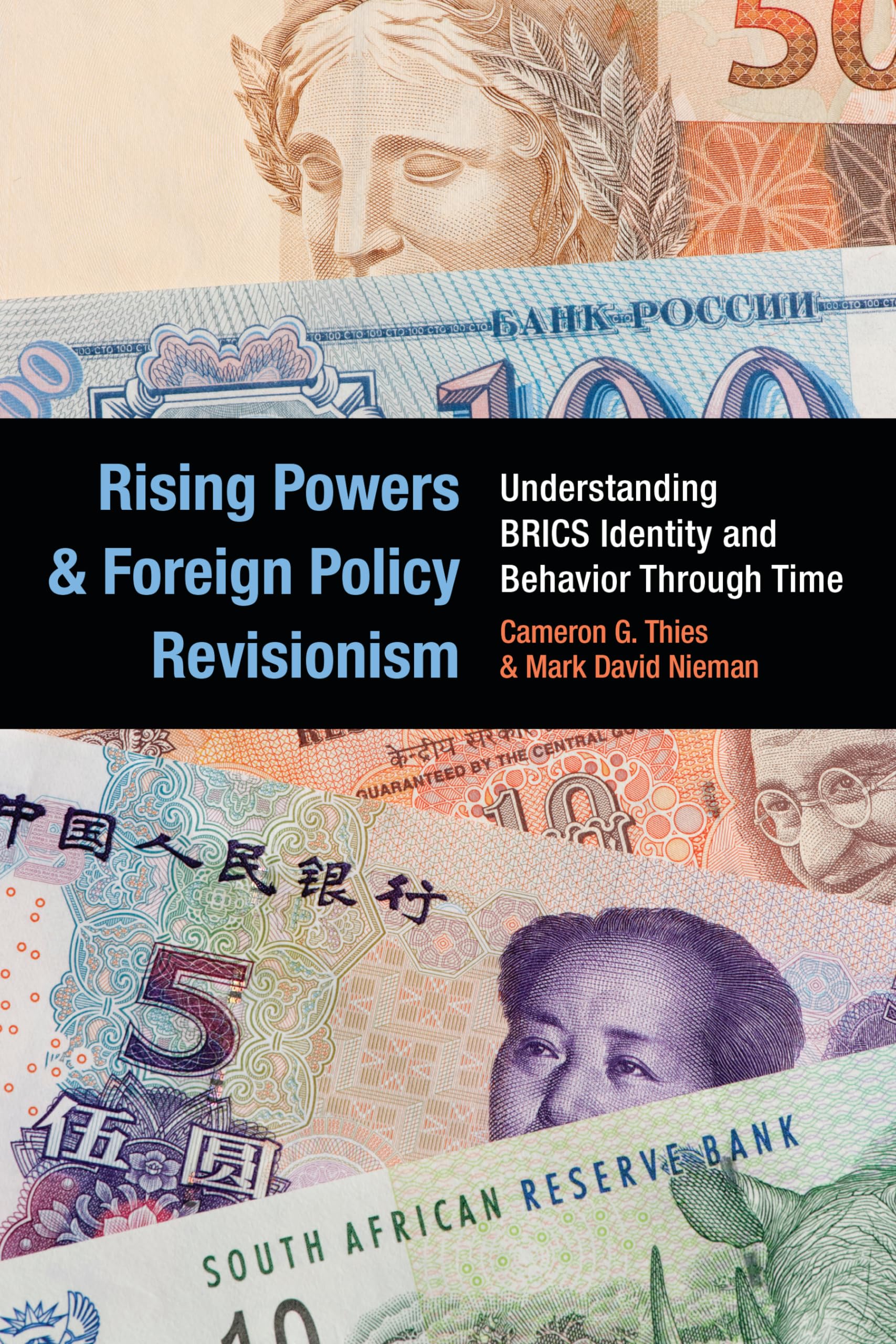
Title
Rising Powers and Foreign Policy Revisionism: Understanding BRICS Identity and Behavior Through Time,Used
Sold by Ergodebooks, an authorized reseller.
Returns accepted within 30 days | support@ergodebooks.com
Shipping Information
- Free Standard Shipping — United States only
- Processing Time: 3–5 business days
- Estimated Delivery: 6–10 business days after dispatch
- Double-boxed, fully insured & discreetly packaged
- Tracking number sent via email once dispatched
Returns & Refund
Returns accepted within 30 days of delivery.
Damaged or Defective Item
Free return shipping + replacement or full refund
Wrong Item Received
Free return shipping + replacement or full refund
Change of Mind
Return shipping at customer's expense · 25% restocking fee applies
Payment Option

In Rising Powers and Foreign Policy Revisionism, Cameron Thies and Mark Nieman examine the identity and behavior of the BRICS (Brazil, Russia, India, China, and South Africa) over time in light of academic and policymaker concerns that rising powers may become more aggressive and conflictprone. The authors develop a theoretical framework that encapsulates pressures for revisionism through the mechanism of competition and pressures for accommodation and assimilation through the mechanism of socialization. The identity and behavior of the BRICS should be a product of the push and pull of these two forces as mediated by their domestic foreign policy processes.State identity is investigated qualitatively through the use of role theory and the identification of national role conceptions. Both economic and militarized conflict behavior are examined using Bayesian changepoint modeling, which identifies structural breaks in time series data, revealing potential wholesale revision of foreign policy. Using this innovative approach to show that the behavior of rising powers is governed not simply by the structural dynamics of power but also by the roles that these rising powers define for themselves, they assert that this process will likely lead to a much more evolutionary approach to foreign policy and will not necessarily generate international conflict.
⚠️ WARNING (California Proposition 65):
This product may contain chemicals known to the State of California to cause cancer, birth defects, or other reproductive harm.
For more information, please visit www.P65Warnings.ca.gov.
- Q: How many pages does this book have? A: This book has two hundred sixteen pages. It's a comprehensive examination of the BRICS nations' foreign policy.
- Q: What is the binding type of this book? A: This book is a hardcover edition. The hardcover binding ensures durability and longevity for frequent use.
- Q: What are the dimensions of this book? A: This book measures six inches in length, zero point eight inches in width, and nine point zero two inches in height. These dimensions make it portable yet substantial for reading.
- Q: Who are the authors of this book? A: The authors are Cameron Thies and Mark Nieman. They provide insights into the identity and behavior of BRICS over time.
- Q: What is the main theme of this book? A: The main theme is the identity and foreign policy behavior of the BRICS nations. It explores the balance between revisionism and accommodation.
- Q: Is this book suitable for academic research? A: Yes, this book is suitable for academic research. It offers a theoretical framework and utilizes innovative methodologies for analysis.
- Q: How can I apply the theories discussed in this book? A: You can apply the theories by analyzing contemporary international relations involving BRICS. The frameworks provide a lens for understanding their actions.
- Q: Is this book appropriate for beginners in international relations? A: Yes, this book is appropriate for beginners. It presents complex ideas in an understandable format, making it accessible.
- Q: What type of reader would benefit from this book? A: Students, policymakers, and scholars interested in foreign policy dynamics will benefit from this book. It addresses crucial issues in global politics.
- Q: How should I care for this hardcover book? A: To care for the book, keep it in a dry place and avoid exposure to direct sunlight. This will prevent wear and tear.
- Q: Can I store this book on a shelf with other books? A: Yes, you can store this book on a shelf with other books. Ensure it’s upright to maintain its shape and condition.
- Q: What if the book arrives damaged? A: If the book arrives damaged, contact customer support for a return or replacement. Ensure you have your order details handy.
- Q: Is there a return policy for this book? A: Yes, there is a return policy. Most retailers offer returns within a specified period if the book is in new condition.
- Q: How can I find more resources on BRICS after reading this book? A: You can find more resources in academic journals, online databases, and libraries that focus on international relations and BRICS studies.
- Q: What analytical methods are used in this book? A: This book employs Bayesian change-point modeling. This method helps identify structural breaks in time series data related to foreign policy.
- Q: Does this book discuss future implications of BRICS behavior? A: Yes, the book discusses future implications. It suggests that the identities of BRICS will evolve, possibly leading to less conflict.