
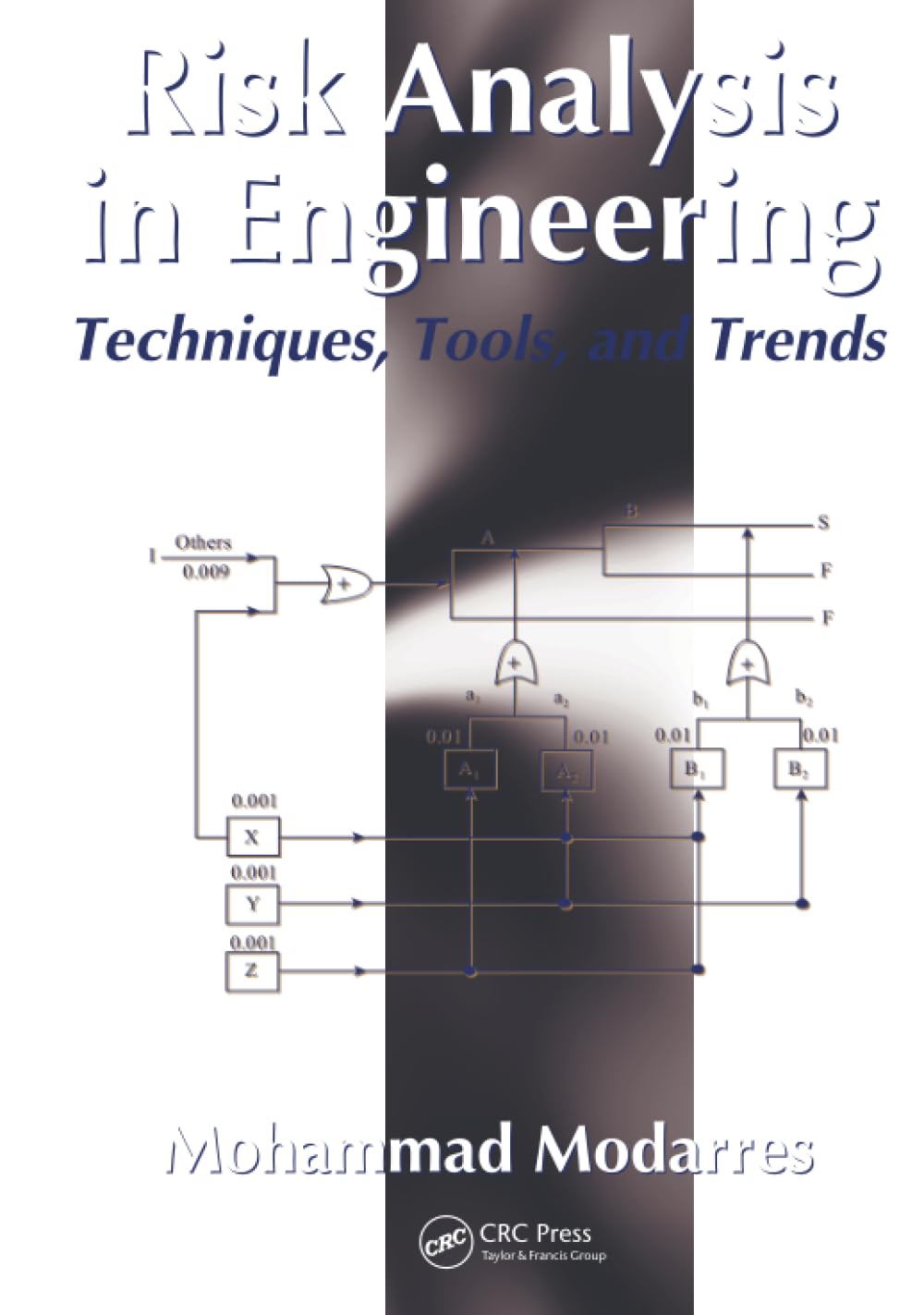
Title
Risk Analysis in Engineering,New
Sold by Ergodebooks, an authorized reseller.
Returns accepted within 30 days | support@ergodebooks.com
Shipping Information
- Free Standard Shipping — United States only
- Processing Time: 3–5 business days
- Estimated Delivery: 6–10 business days after dispatch
- Double-boxed, fully insured & discreetly packaged
- Tracking number sent via email once dispatched
Returns & Refund
Returns accepted within 30 days of delivery.
Damaged or Defective Item
Free return shipping + replacement or full refund
Wrong Item Received
Free return shipping + replacement or full refund
Change of Mind
Return shipping at customer's expense · 25% restocking fee applies
Payment Option

Based on the authors 20 years of teaching, Risk Analysis in Engineering: Techniques, Tools, and Trends presents an engineering approach to probabilistic risk analysis (PRA). It emphasizes methods for comprehensive PRA studies, including techniques for risk management. The author assumes little or no prior knowledge of risk analysis on the part of the student and provides the necessary mathematical and engineering foundations. The text relies heavily on, but is not limited to, examples from the nuclear industry, because that is where PRA techniques were first developed. Since PRA provides a bestestimate approach, the author pays special attention to explaining uncertainty characterization.The book begins with a description of the basic definitions and principles of risk, safety, and performance and presents the elements of risk analysis and their applications in engineering. After highlighting the methods for performing PRAs, the author describes how to assess and measure performance of the building blocks of PRAs, such as reliability of hardware subsystems, structures, components, human actions, and software. He covers methods of characterizing uncertainties and methods for propagating them through the PRA model to estimate uncertainties of the results. The book explores how to identify and rank important and sensitive contributors to the estimated risk using the PRA and performance assessment models. It also includes a description of risk acceptance criteria and the formal methods for making decisions related to risk management options and strategies. The book concludes with a brief review of the main aspects, issues, and methods of risk communication.Drawing on notes, homework problems, and exams from courses he has taught as well as feedback from his students, Professor Modarres provides a fromthetrenches method for teaching risk assessment for engineers. This is a textbook that is easy to use for students and professors alike.
⚠️ WARNING (California Proposition 65):
This product may contain chemicals known to the State of California to cause cancer, birth defects, or other reproductive harm.
For more information, please visit www.P65Warnings.ca.gov.
- Q: What is the main focus of 'Risk Analysis in Engineering'? A: The book emphasizes an engineering approach to probabilistic risk analysis (PRA), focusing on methods for comprehensive studies and techniques for risk management.
- Q: Who is the author of this book? A: The author is Mohammad Modarres, who has over 20 years of teaching experience in the field.
- Q: Is prior knowledge of risk analysis required to understand this book? A: No, the author assumes little or no prior knowledge of risk analysis, providing the necessary mathematical and engineering foundations.
- Q: What topics are covered in the book? A: The book covers definitions of risk, safety, performance elements, methods for performing PRAs, uncertainty characterization, risk acceptance criteria, and risk communication methods.
- Q: What type of binding does this book have? A: The book is available in hardcover binding.
- Q: How many pages are in 'Risk Analysis in Engineering'? A: The book contains 418 pages.
- Q: When was this book published? A: The book was published on January 13, 2006.
- Q: What condition is the book in? A: The book is listed as new.
- Q: Does this book include practical examples? A: Yes, the book relies heavily on examples from the nuclear industry, where PRA techniques were first developed.
- Q: What makes this textbook suitable for students and professors? A: The book is structured to be easy to use, drawing on teaching notes, homework problems, and exams from the author's courses, making it practical for both students and educators.