
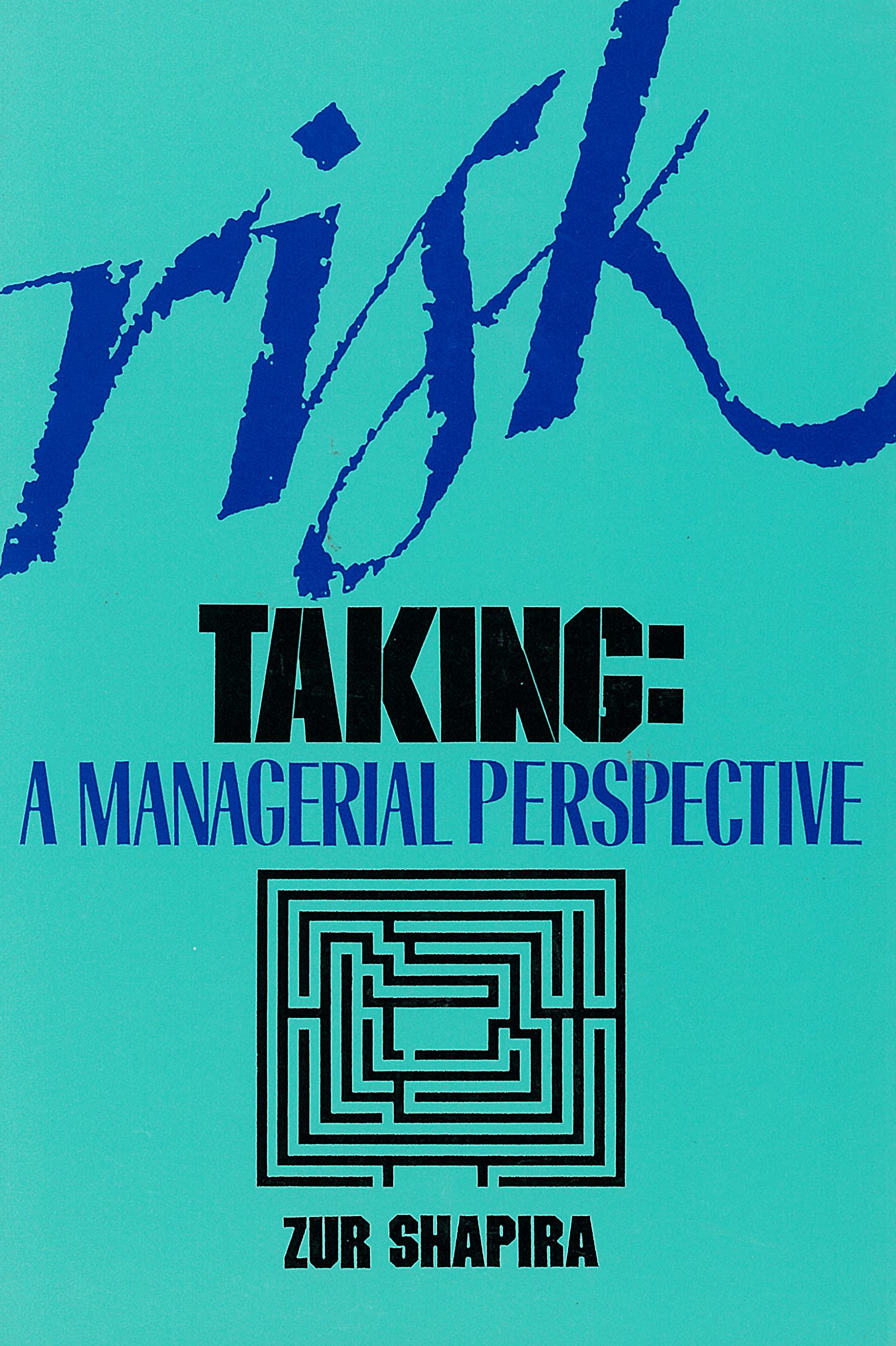
Title


Risk Taking: A Managerial Perspective,Used
Sold by Ergodebooks, an authorized reseller.
Returns accepted within 30 days | support@ergodebooks.com
Shipping Information
- Free Standard Shipping — United States only
- Processing Time: 3–5 business days
- Estimated Delivery: 6–10 business days after dispatch
- Double-boxed, fully insured & discreetly packaged
- Tracking number sent via email once dispatched
Returns & Refund
Returns accepted within 30 days of delivery.
Damaged or Defective Item
Free return shipping + replacement or full refund
Wrong Item Received
Free return shipping + replacement or full refund
Change of Mind
Return shipping at customer's expense · 25% restocking fee applies
Payment Option

Classical economic theory assumes that people in risk situations follow a course of action based on a rational, consistent assessment of likely outcomes. But as Zur Shapira demonstrates in Risk Taking, corporate managers consistently stray from the prescribed path into far more subjective territory. Risk Taking offers a critical assessment of the relationship between theory and action in managerial decision making. Shapira offers a definitive account of the classical conception of risky decision making, which derives behavioral prescriptions from a calculation of both the value and the likelihood of possible outcomes. He then demonstrates how theories in this vein have been historically at odds with empirical observations. Risk Taking reports the results of an extensive survey of seven hundred managers that probed their attitudes and beliefs about risk and examined how they had actually made decisions in the face of uncertainty. The picture that emerges is of a dynamic, flexible process in which each manager's personal expertise and perceptions play profound roles. Managerial strategies are continually modified to suit changing circumstances. Rather than formulating probability estimates, executives create potential scenarios based not only on the possible outcomes but also on the many arbitrary factors inherent in their own situations. As Shapira notes, risk taking propensities vary among managers, and the need to maintain control and avoid particularly dangerous results exercises a powerful influence. Shapira also examines the impact of organizational structure, longterm management objectives, and incentives on decision making. With perceptive observations of the cognitive, emotional, and organizational dimensions of corporate decision making, Risk Taking propels the study of managerial risk behavior into new directions. This volume signals the way toward improving managerial decision making by revealing the need for more inclusive choice models that augment classical theory with vital behavioral observations.
⚠️ WARNING (California Proposition 65):
This product may contain chemicals known to the State of California to cause cancer, birth defects, or other reproductive harm.
For more information, please visit www.P65Warnings.ca.gov.