
Title
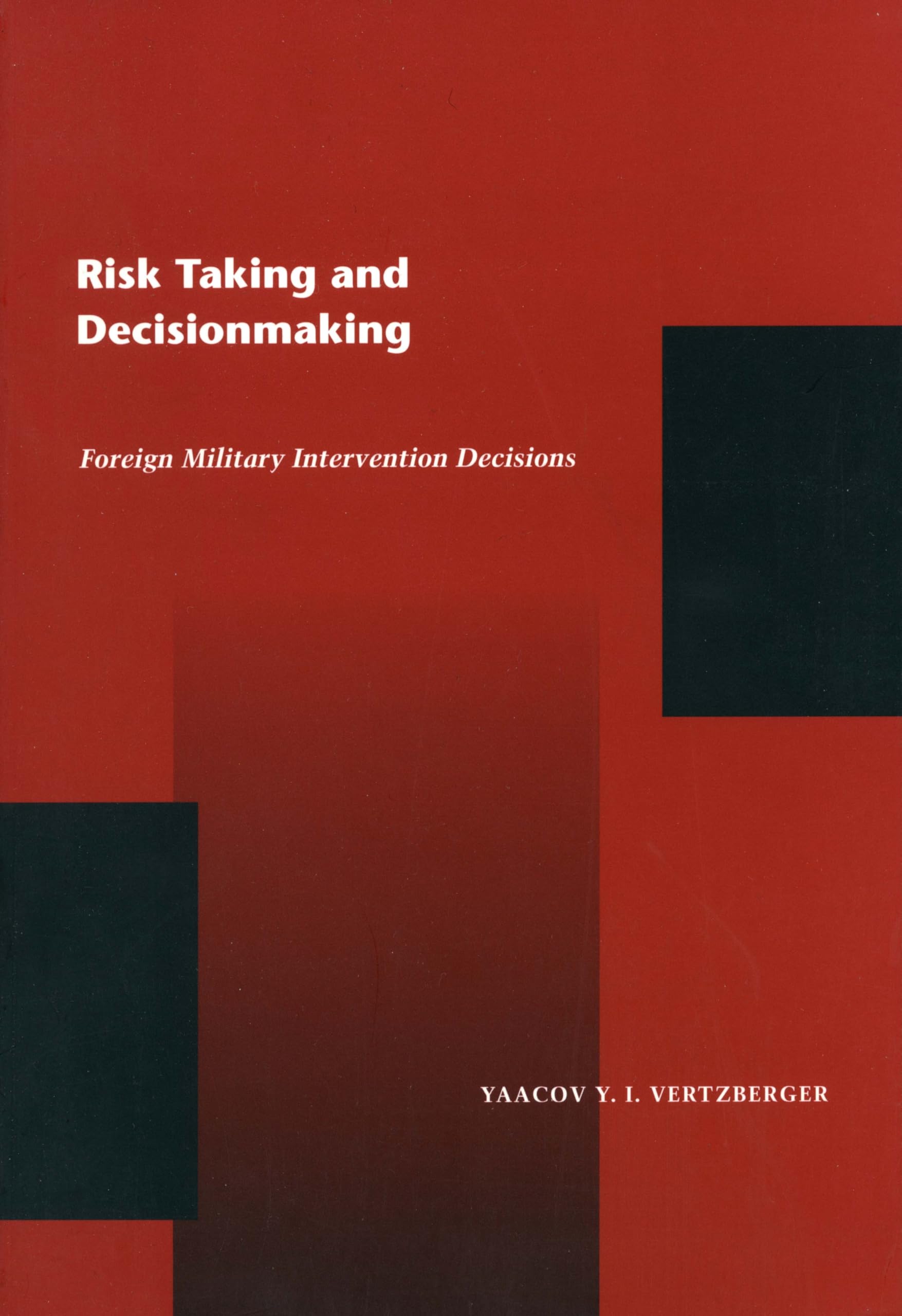
Risk Taking and Decision Making: Foreign Military Intervention Decisions,New
Sold by Ergodebooks, an authorized reseller.
Returns accepted within 30 days | support@ergodebooks.com
Shipping Information
- Free Standard Shipping — United States only
- Processing Time: 3–5 business days
- Estimated Delivery: 6–10 business days after dispatch
- Double-boxed, fully insured & discreetly packaged
- Tracking number sent via email once dispatched
Returns & Refund
Returns accepted within 30 days of delivery.
Damaged or Defective Item
Free return shipping + replacement or full refund
Wrong Item Received
Free return shipping + replacement or full refund
Change of Mind
Return shipping at customer's expense · 25% restocking fee applies
Payment Option

Risks are an integral part of complex, highstakes decisions, and decisionmakers are faced with the unavoidable tasks of assessing risks and forming risk preferences. This is true for all decision domains, including financial, environmental, and foreign policy domains, among others. How well decisionmakers deal with risk affects, to a considerable extent, the quality of their decisions. This book provides the most comprehensive analysis available of the elements that influence risk judgments and preferences.The book has two dimensions: theoretical and comparativehistorical. The study of risktaking behavior has been dominated by the rational choice approach. Instead, the author adopts a sociocognitive approach involving: a multivariate theory integrating contextual, cognitive, motivational, and personality factors that affect an individual decisionmakers judgment and preferences; the social interaction and structural effects of the decisionmaking group and its organizational setting; and the role of culturalsocietal values and norms that sanction or discourage risk taking behavior.The books theoretical approach is applied and tested in five historical case studies of foreign military interventions. The richly detailed empirical data on the case studies make them, metaphorically speaking, an ideal laboratory for applying a processtracing approach in studying judgment and decision processes at varying risk levels. The case studies analyzed are: U.S. interventions in Grenada in 1983 and Panama in 1989 (both low risk); Soviet intervention in Czechoslovakia in 1968 (moderate risk): U.S. intervention in Vietnam in 196468 (high risk); and Israels intervention in Lebanon in 198283 (high risk).
⚠️ WARNING (California Proposition 65):
This product may contain chemicals known to the State of California to cause cancer, birth defects, or other reproductive harm.
For more information, please visit www.P65Warnings.ca.gov.