
Title
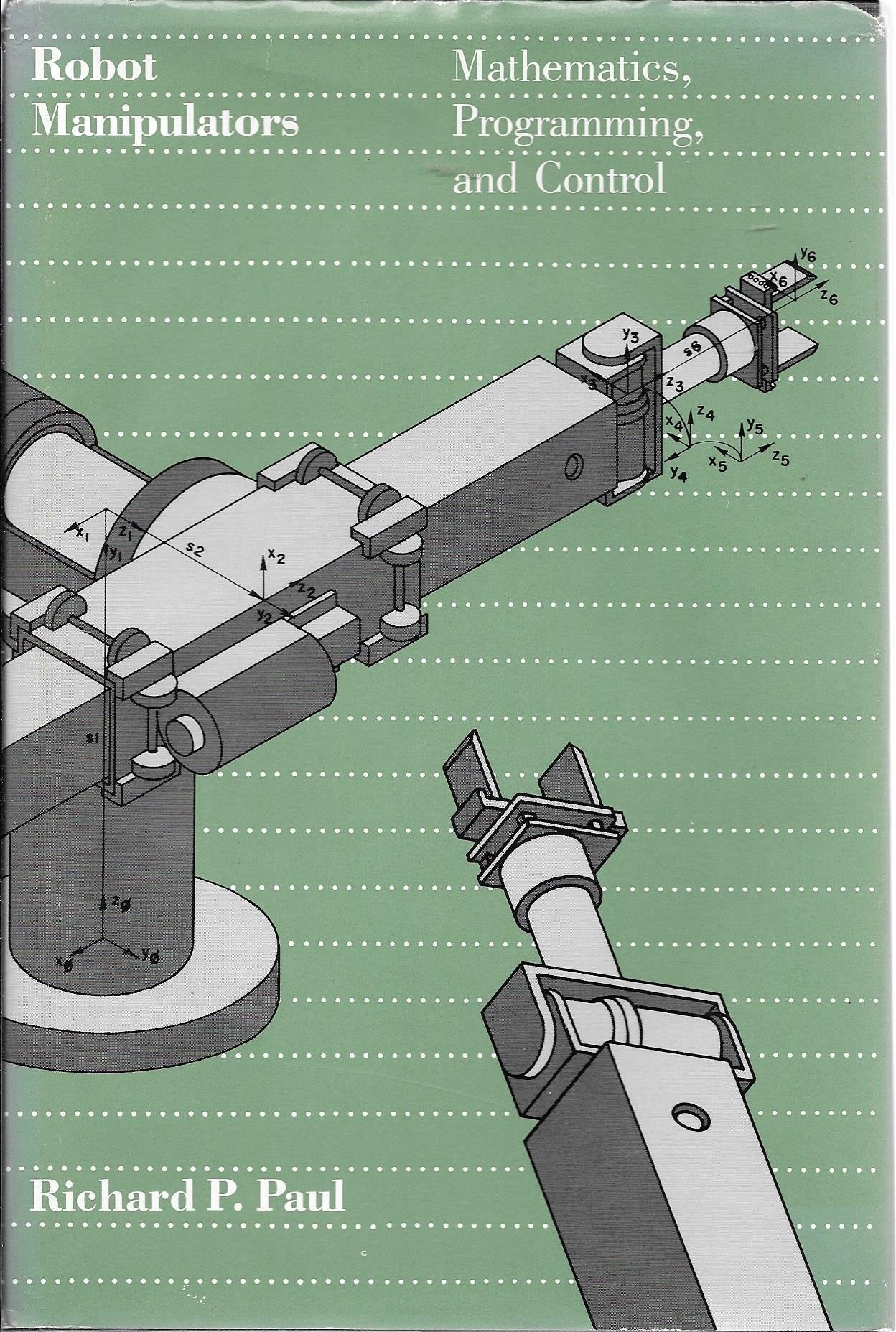
Robot Manipulators: Mathematics, Programming and Control,Used
Sold by Ergodebooks, an authorized reseller.
Returns accepted within 30 days | support@ergodebooks.com
Shipping Information
- Free Standard Shipping — United States only
- Processing Time: 3–5 business days
- Estimated Delivery: 6–10 business days after dispatch
- Double-boxed, fully insured & discreetly packaged
- Tracking number sent via email once dispatched
Returns & Refund
Returns accepted within 30 days of delivery.
Damaged or Defective Item
Free return shipping + replacement or full refund
Wrong Item Received
Free return shipping + replacement or full refund
Change of Mind
Return shipping at customer's expense · 25% restocking fee applies
Payment Option

Richard Paul is perhaps the world's leading authority on the science of robot manipulation. He has contributed to almost every aspect of the field. His impressive publication record includes important articles on the kinematics of robot arms, their dynamics, and their control. He has developed a succession of interesting ideas concerning representation, specifically the use of homogeneous matrices.... Paul's book is written in his usual clear style, and it contains numerous interesting examples.'Patrick H. Winston and Mike Brady, editors, The MIT Press Artificial Intelligence SeriesRobot Manipulators is firmly grounded on the theoretical principles of the subject and makes considerable use of vector and matrix methods in its development. It is the first full treatment to be published, and it is designed for graduate courses in robotics as well as for practicing engineers. Following an introduction, the book's ten chapters cover homogeneous transformations, defining transformation equations, solving transformation equations, differential transformation relationships, motion trajectories, dynamics, digital servo systems, force transformations, compliance, and manipulation languages.Paul writes that the impact of robot manipulators on the workplace and the economy over the coming decade could be profound: 'While currently available industrial robots will probably not have a major impact on manufacturing, a lowcost, massproduced, sensorcontrolled robot could have a revolutionary effect.... Such robots would represent the conclusion of the industrial revolution, replacing the type of labor required at its outset to perform the repetitive machinelinked tasks whose ideal performance is characterized by our conception of a robot, not a human. Based on current research work, laboratory demonstrations, and the general level of technology in this country, we believe that it is possible to achieve such a robot within the coming decade.'
⚠️ WARNING (California Proposition 65):
This product may contain chemicals known to the State of California to cause cancer, birth defects, or other reproductive harm.
For more information, please visit www.P65Warnings.ca.gov.
- Q: How many pages does the book have? A: The book has two hundred seventy-nine pages. It provides an in-depth exploration of robot manipulators, making it suitable for both students and professionals.
- Q: What are the dimensions of this book? A: The book measures six point two six inches in length, one inch in width, and nine point five inches in height. These dimensions make it a manageable size for reading and reference.
- Q: What type of binding does this book have? A: This book is bound in hardcover. The hardcover binding enhances its durability, making it suitable for frequent use.
- Q: Who is the author of this book? A: The author is Richard P. Paul. He is recognized as a leading authority in the field of robot manipulation.
- Q: What subjects does the book cover? A: The book covers topics such as homogeneous transformations, dynamics, and manipulation languages. It serves as a comprehensive resource for understanding robot manipulators.
- Q: Is this book suitable for beginners? A: Yes, the book is suitable for beginners. It starts with fundamental concepts before progressing to advanced topics in robotics.
- Q: Can this book be used in a graduate course? A: Yes, it is designed for graduate courses in robotics. Its thorough treatment of theoretical principles makes it an excellent textbook for advanced studies.
- Q: What is the reading level for this book? A: The reading level is appropriate for graduate students and practicing engineers. It assumes a foundational understanding of mathematics and robotics.
- Q: Is the book appropriate for practicing engineers? A: Yes, it is particularly beneficial for practicing engineers. The content is grounded in practical applications and theoretical principles relevant to the field.
- Q: How should I care for this book? A: To care for this book, store it in a cool, dry place and avoid exposure to direct sunlight. This helps preserve the binding and pages.
- Q: Are there any safety precautions with this book? A: There are no specific safety precautions needed for this book. It is a standard hardcover book intended for educational purposes.
- Q: What if my book arrives damaged? A: If your book arrives damaged, contact the seller to initiate a return or exchange. Most sellers have policies in place for damaged goods.
- Q: What is the warranty for this book? A: Books typically do not come with a warranty. However, you can check with the seller regarding return policies for damaged items.
- Q: Can I return this book if I don't like it? A: Yes, you can usually return the book if it is within the seller's return policy timeframe. Be sure to check the specific return conditions.
- Q: Is this book part of a series? A: Yes, it is part of The MIT Press Artificial Intelligence Series. This series covers various aspects of artificial intelligence and robotics.
- Q: How does this book compare to others in its field? A: This book is considered a comprehensive resource in robotics. It stands out for its thorough treatment of mathematical and programming aspects of robot manipulators.