If you have any questions, you are always welcome to contact us. We'll get back to you as soon as possible, withing 24 hours on weekdays.
Customer service
All questions about your order, return and delivery must be sent to our customer service team by e-mail at yourstore@yourdomain.com
Sale & Press
If you are interested in selling our products, need more information about our brand or wish to make a collaboration, please contact us at press@yourdomain.com
Help
If you have any questions, you are always welcome to contact us. We'll get back to you as soon as possible, withing 24 hours on weekdays.
Customer service
All questions about your order, return and delivery must be sent to our customer service team by e-mail at yourstore@yourdomain.com
Sale & Press
If you are interested in selling our products, need more information about our brand or wish to make a collaboration, please contact us at press@yourdomain.com
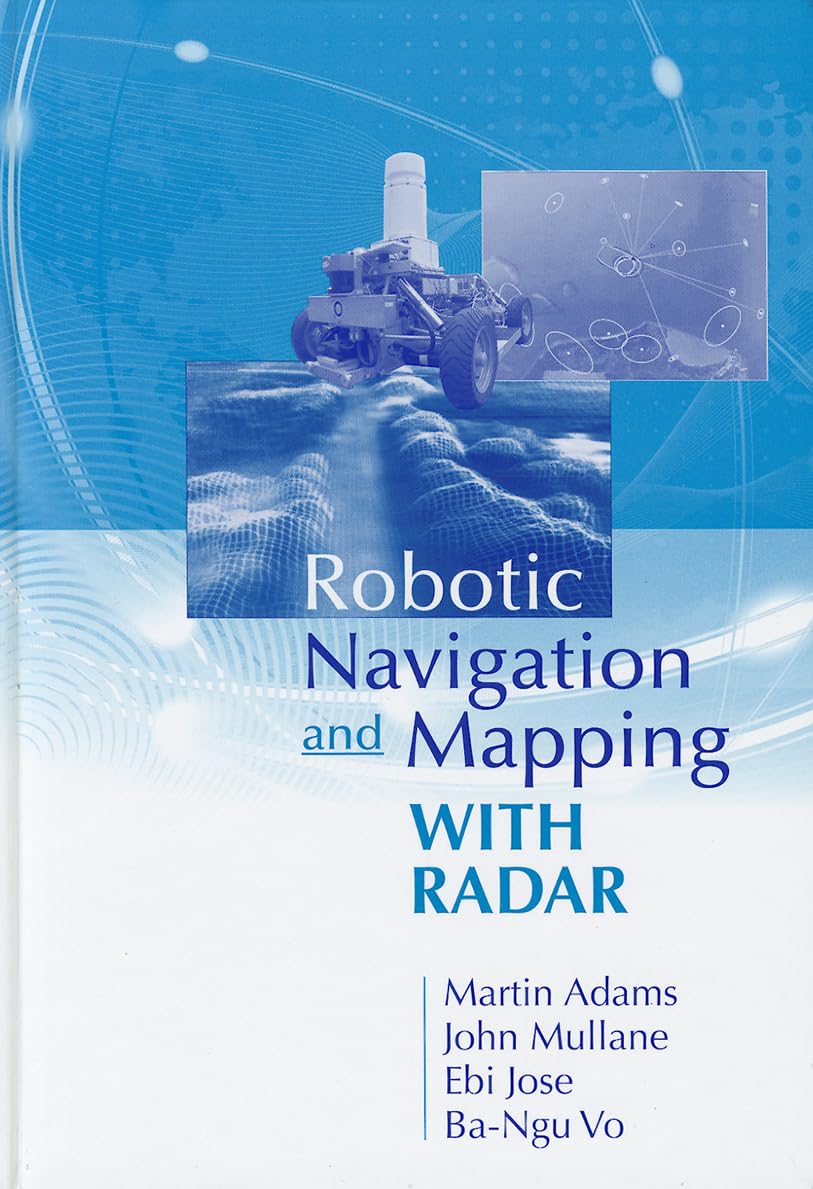
Focusing on autonomous robotic applications, this cuttingedge resource offers you a practical treatment of shortrange radar processing for reliable object detection at the ground level. This unique book demonstrates probabilistic radar models and detection algorithms specifically for robotic land vehicles. It examines grid based robotic mapping with radar based on measurement likelihood estimation.You find detailed coverage of simultaneous localization and Map Building (SLAM) an area referred to as the Holy Grail of autonomous robotic research. The book derives an extended Kalman Filter SLAM algorithm which exploits the penetrating ability of radar. This algorithm allows for the observation of visually occluded objects, as well as the usual directly observed objects, which contributes to a robot s position and the map state update. Moreover, you discover how the Random Finite Set (RFS) provides a more appropriate approach for representing radar based maps than conventional frameworks.Contents: Introduction. Part I: Detection and Mapping with Radar Mapping with Radar. Case Study: Short Range FMCW Radar. Detection Based on target Presence Probability. Robot Mapping Using Measurement Likelihoods. Part II: Radar Based Simultaneous Localization and Map Building Exploiting Radar s Multiple Line of Sight Capabilities. Part III: Map Representations for Radar Random Finite Set Based Mapping and Navigation. Coastal Feature Extraction with XBand Marine Radar. Conclusions and Future Directions.
⚠️ WARNING (California Proposition 65):
This product may contain chemicals known to the State of California to cause cancer,
birth defects, or other reproductive harm.
For MAP (Minimum Advertised Price) violations and Intellectual Property (IP) or Trademark concerns, please contact:
support@ergodebooks.com
⚠️ California Proposition 65 Warning: Some products sold on this website may expose you to chemicals known to the State of California to cause cancer, birth defects, or other reproductive harm. For more information, visit www.P65Warnings.ca.gov.