If you have any questions, you are always welcome to contact us. We'll get back to you as soon as possible, withing 24 hours on weekdays.
Customer service
All questions about your order, return and delivery must be sent to our customer service team by e-mail at yourstore@yourdomain.com
Sale & Press
If you are interested in selling our products, need more information about our brand or wish to make a collaboration, please contact us at press@yourdomain.com
Help
If you have any questions, you are always welcome to contact us. We'll get back to you as soon as possible, withing 24 hours on weekdays.
Customer service
All questions about your order, return and delivery must be sent to our customer service team by e-mail at yourstore@yourdomain.com
Sale & Press
If you are interested in selling our products, need more information about our brand or wish to make a collaboration, please contact us at press@yourdomain.com
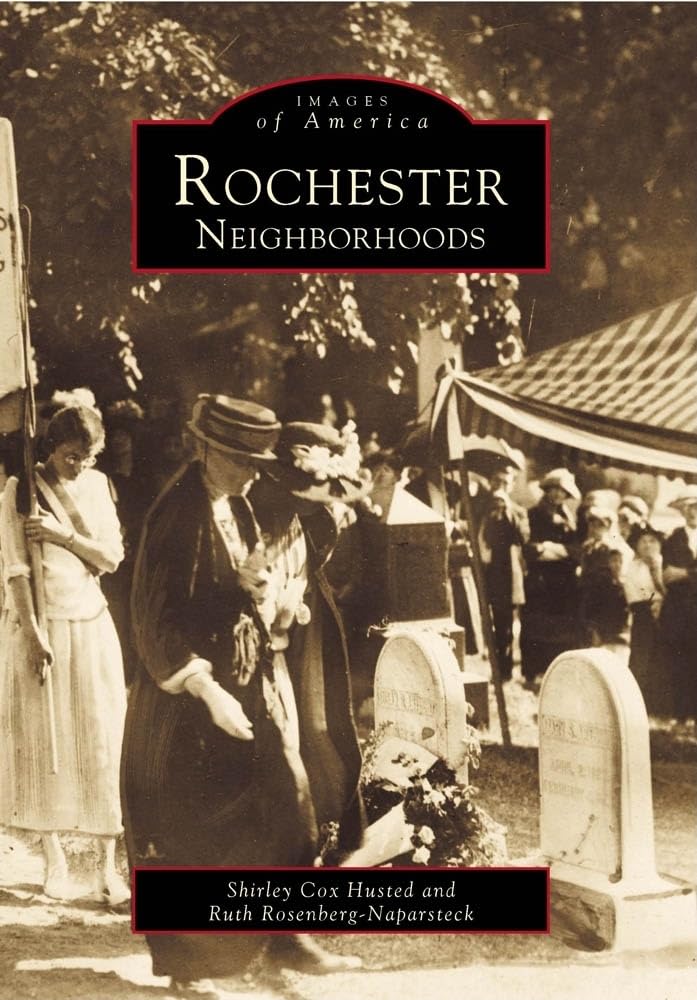
Authors Parma Historian Shirley Cox Husted and Rochester City Historian Ruth RosenbergNaparsteck offer more than 200 fascinating photographssome published here for the first time.Even in its early days, Rochester had multiple neighborhoods, small settlements with names such as Swillburg, Goat Hill and the Butter Bowl. Today, Rochester is a community of 128 neighborhoods, each happily pursuing a local identity while united together with justifiable pride in their role as New York State's third largest city outside of the New York City metropolis. Located in the Genesee River Valley just below Lake Ontario, Rochester is on an old Indian trail that once brought Seneca families here to hunt and fish. The milling industry began here in 1789 and, as it flourished, Rochester became known as the ''Flour City.'' By the mid1800s, the seed industry and the widespread production of flowers, trees, and shrubs had recreated Rochester as the ''Flower City.'' Later, thanks to the Eastman Kodak Company and the Xerox Corporation, Rochester became the ''Picture City'' and the ''World's Image Centre.'' Rochester was a haven on the Underground Railroad between 1830 and 1860. Always an ethnic city, it became a hotbed for inventors, reformers, educators, and spiritual leaders. Its leaders were independent, sometimes outrageous, outspoken, colorful, and courageous. Many were womenforemost among them was Susan Brownell Anthony.
⚠️ WARNING (California Proposition 65):
This product may contain chemicals known to the State of California to cause cancer,
birth defects, or other reproductive harm.
For MAP (Minimum Advertised Price) violations and Intellectual Property (IP) or Trademark concerns, please contact:
support@ergodebooks.com
⚠️ California Proposition 65 Warning: Some products sold on this website may expose you to chemicals known to the State of California to cause cancer, birth defects, or other reproductive harm. For more information, visit www.P65Warnings.ca.gov.