
Title
Romantic Writing And The Empire Of Signs: Periodical Culture And Postnapoleonic Authorship,Used
Sold by Ergodebooks, an authorized reseller.
Returns accepted within 30 days | support@ergodebooks.com
Shipping Information
- Free Standard Shipping — United States only
- Processing Time: 3–5 business days
- Estimated Delivery: 6–10 business days after dispatch
- Double-boxed, fully insured & discreetly packaged
- Tracking number sent via email once dispatched
Returns & Refund
Returns accepted within 30 days of delivery.
Damaged or Defective Item
Free return shipping + replacement or full refund
Wrong Item Received
Free return shipping + replacement or full refund
Change of Mind
Return shipping at customer's expense · 25% restocking fee applies
Payment Option

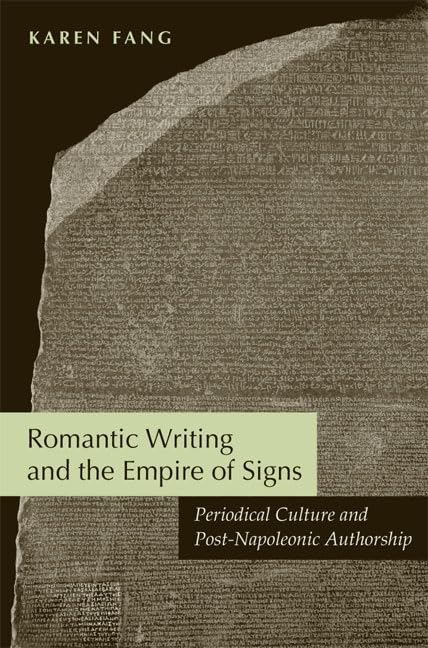
Nineteenthcentury periodicals frequently compared themselves to the imperial powers then dissecting the globe, and this interest in imperialism can be seen in the exotic motifs that surfaced in works by such late Romantic authors as John Keats, Charles Lamb, James Hogg, Letitia Landon, and Lord Byron. Karen Fang explores the collaboration of these authors with periodical magazines to show how an interdependent relationship between these visual themes and rhetorical style enabled these authors to model their writing on the imperial project.Fang argues that in the decades after Waterloo late Romantic authors used imperial culture to capitalize on the contemporary explosion of periodical magazines. This proliferation of 'postNapoleonic' writingoften referencing exotic localesboth revises longstanding notions about literary orientalism and reveals a remarkable synthesis of Romantic idealism with contemporary cultural materialism that heretofore has not been explored. Indeed, in interlocking case studies that span the reach of British conquest, ranging from Greece, China, and Egypt to Italy and Tahiti, Fang challenges a major convention of periodical publication. While periodicals are usually thought to be defined by time, this account of the geographic attention exerted by late Romantic authors shows them to be equally concerned with space.With its exploration of magazines and imperialism as a context for Romantic writing, culture, and aesthetics, this book will appeal not only to scholars of book history and reading cultures but also to those of nineteenthcentury British writing and history.
⚠️ WARNING (California Proposition 65):
This product may contain chemicals known to the State of California to cause cancer, birth defects, or other reproductive harm.
For more information, please visit www.P65Warnings.ca.gov.