If you have any questions, you are always welcome to contact us. We'll get back to you as soon as possible, withing 24 hours on weekdays.
Customer service
All questions about your order, return and delivery must be sent to our customer service team by e-mail at yourstore@yourdomain.com
Sale & Press
If you are interested in selling our products, need more information about our brand or wish to make a collaboration, please contact us at press@yourdomain.com
Help
If you have any questions, you are always welcome to contact us. We'll get back to you as soon as possible, withing 24 hours on weekdays.
Customer service
All questions about your order, return and delivery must be sent to our customer service team by e-mail at yourstore@yourdomain.com
Sale & Press
If you are interested in selling our products, need more information about our brand or wish to make a collaboration, please contact us at press@yourdomain.com
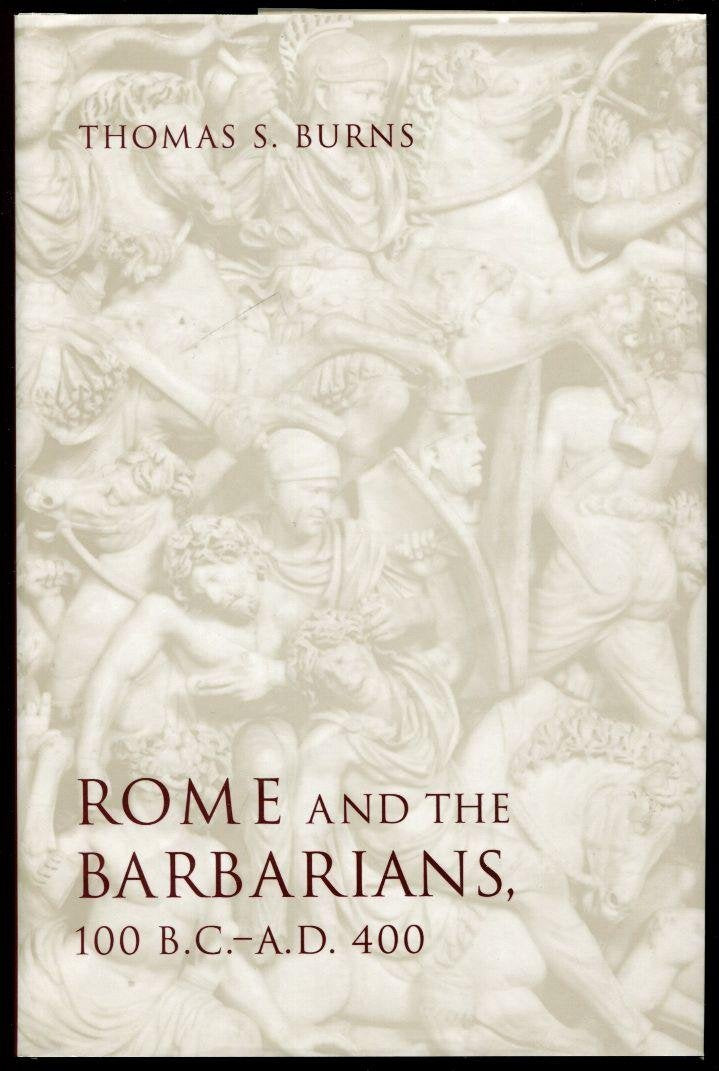
The barbarians of antiquity, so long a fixture of the public imagination as the savages who sacked and destroyed Rome, emerge in this colorful, richly textured history as a much more complexand far more interestingfactor in the expansion, and eventual unmaking, of the Roman Empire. Thomas S. Burns marshals an abundance of archeological and literary evidence, as well as three decades of study and experience, to bring forth an unusually farsighted and wideranging account of the relations between Romans and nonRomans along the frontiers of western Europe from the last years of the Republic into late antiquity.Looking at a 500year time span beginning with early encounters between barbarians and Romans around 100 B.C. and ending with the spread of barbarian settlement in the western Empire around A.D. 400, Burns removes the barbarians from their narrow niche as invaders and conquerors and places them in the broader context of neighbors, (sometimes bitter) friends, and settlers. His nuanced history subtly shows how Rome's relations with the barbariansand vice versaslowly but inexorably evolved from general ignorance, hostility, and suspicion toward tolerance, synergy, and integration. What he describes is, in fact, a drawnout period of acculturation, characterized more by continuity than by change and conflict and leading to the creation of a new Romanobarbarian hybrid society and culture that anticipated the values and traditions of medieval civilization.
⚠️ WARNING (California Proposition 65):
This product may contain chemicals known to the State of California to cause cancer,
birth defects, or other reproductive harm.
For MAP (Minimum Advertised Price) violations and Intellectual Property (IP) or Trademark concerns, please contact:
support@ergodebooks.com
⚠️ California Proposition 65 Warning: Some products sold on this website may expose you to chemicals known to the State of California to cause cancer, birth defects, or other reproductive harm. For more information, visit www.P65Warnings.ca.gov.