
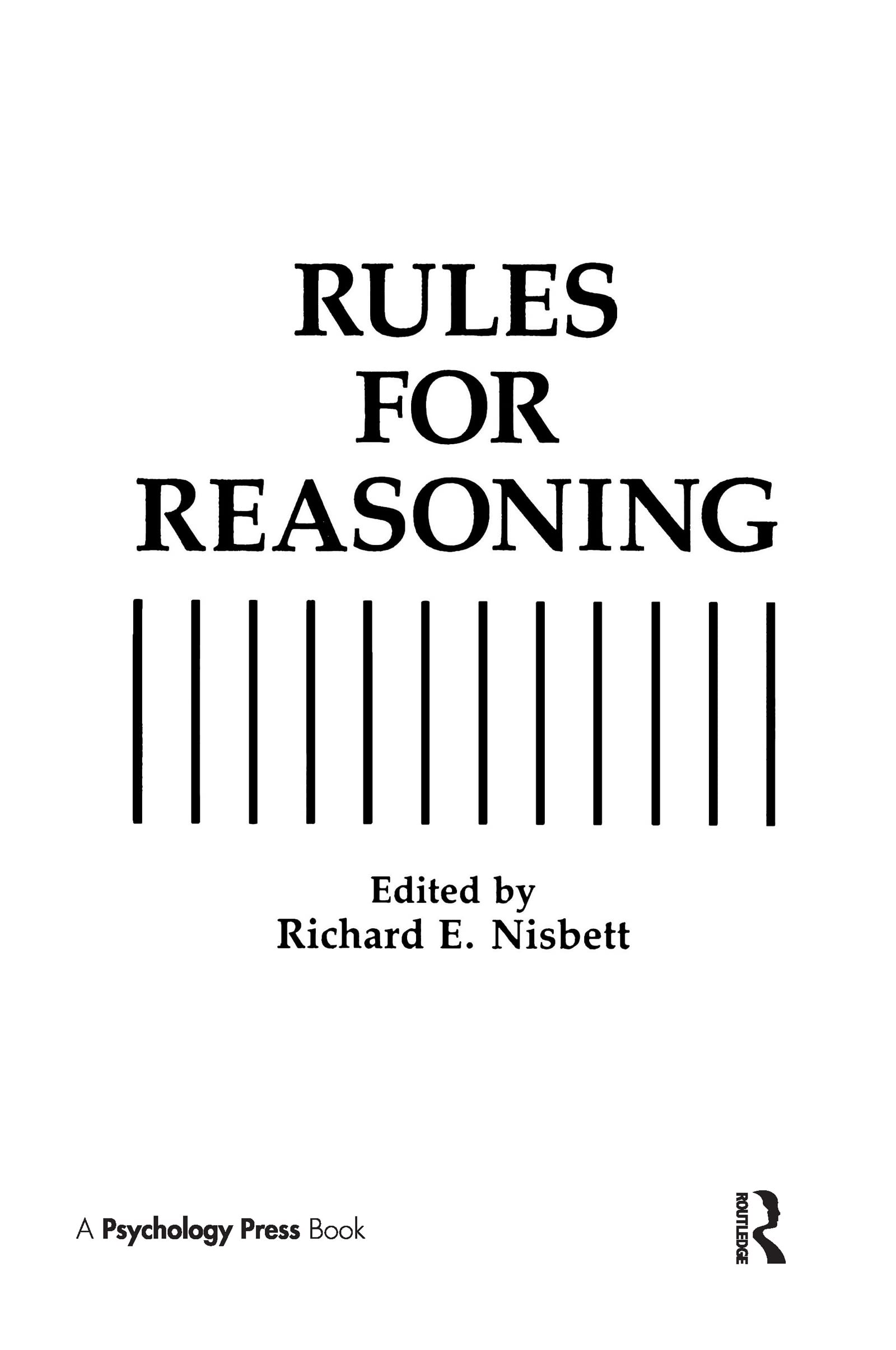
Title
Rules For Reasoning,Used
Sold by Ergodebooks, an authorized reseller.
Returns accepted within 30 days | support@ergodebooks.com
Shipping Information
- Free Standard Shipping — United States only
- Processing Time: 3–5 business days
- Estimated Delivery: 6–10 business days after dispatch
- Double-boxed, fully insured & discreetly packaged
- Tracking number sent via email once dispatched
Returns & Refund
Returns accepted within 30 days of delivery.
Damaged or Defective Item
Free return shipping + replacement or full refund
Wrong Item Received
Free return shipping + replacement or full refund
Change of Mind
Return shipping at customer's expense · 25% restocking fee applies
Payment Option

This book examines two questions: Do people make use of abstract rules such as logical and statistical rules when making inferences in everyday life? Can such abstract rules be changed by training? Contrary to the spirit of reductionist theories from behaviorism to connectionism, there is ample evidence that people do make use of abstract rules of inference including rules of logic, statistics, causal deduction, and costbenefit analysis. Such rules, moreover, are easily alterable by instruction as it occurs in classrooms and in brief laboratory training sessions. The fact that purely formal training can alter them and that those taught in one content domain can 'escape' to a quite different domain for which they are also highly applicable shows that the rules are highly abstract. The major implication for cognitive science is that people are capable of operating with abstract rules even for concrete, mundane tasks; therefore, any realistic model of human inferential capacity must reflect this fact. The major implication for education is that people can be far more broadly influenced by training than is generally supposed. At high levels of formality and abstraction, relatively brief training can alter the nature of problemsolving for an infinite number of content domains.
⚠️ WARNING (California Proposition 65):
This product may contain chemicals known to the State of California to cause cancer, birth defects, or other reproductive harm.
For more information, please visit www.P65Warnings.ca.gov.
- Q: How many pages does this book have? A: This book has four hundred thirty-two pages. It provides a comprehensive exploration of reasoning and inference.
- Q: What are the dimensions of 'Rules for Reasoning'? A: The book measures six inches in length, zero point ninety-eight inches in width, and nine point zero two inches in height. These dimensions make it a convenient size for reading and storage.
- Q: What is the binding type of this book? A: This book is paperback bound. The paperback format is lightweight and easy to handle.
- Q: Who is the author of 'Rules for Reasoning'? A: The author is Richard E. Nisbett. He is known for his work in psychology and cognitive science.
- Q: What category does this book fall under? A: This book is categorized under Mental Health. It addresses cognitive processes and reasoning.
- Q: Is this book suitable for beginners in psychology? A: Yes, this book is suitable for beginners. It discusses foundational concepts in reasoning in an accessible manner.
- Q: How can I apply the concepts in this book? A: You can apply the concepts by using the abstract rules discussed in everyday decision-making. The book offers insights into improving your reasoning skills.
- Q: Who would benefit from reading 'Rules for Reasoning'? A: Students, educators, and anyone interested in cognitive science would benefit from this book. It provides valuable insights into inference and reasoning.
- Q: How should I store this book? A: Store this book in a cool, dry place, away from direct sunlight. Proper storage will help maintain its condition.
- Q: Can this book be used in educational settings? A: Yes, this book can be used in educational settings. It offers content that can enhance critical thinking and reasoning skills in students.
- Q: What if I receive a damaged copy of the book? A: If you receive a damaged copy, contact the seller for a return or exchange. Most sellers offer policies for such situations.
- Q: Is there a warranty for this book? A: No, books typically do not come with warranties. However, check with the seller for return policies.
- Q: What if I have trouble understanding the concepts? A: If you have trouble, consider discussing the concepts with peers or using supplementary resources. Engaging with others can enhance understanding.
- Q: Are there any safety concerns with this book? A: No, there are no safety concerns with this book. It is a scholarly text intended for educational purposes.
- Q: Is there any training recommended while reading this book? A: Yes, engaging in practical exercises or discussions can enhance understanding of the concepts presented in the book.
- Q: What is the publisher of 'Rules for Reasoning'? A: The publisher is Psychology Press, an established publisher in the field of psychology and cognitive science.