
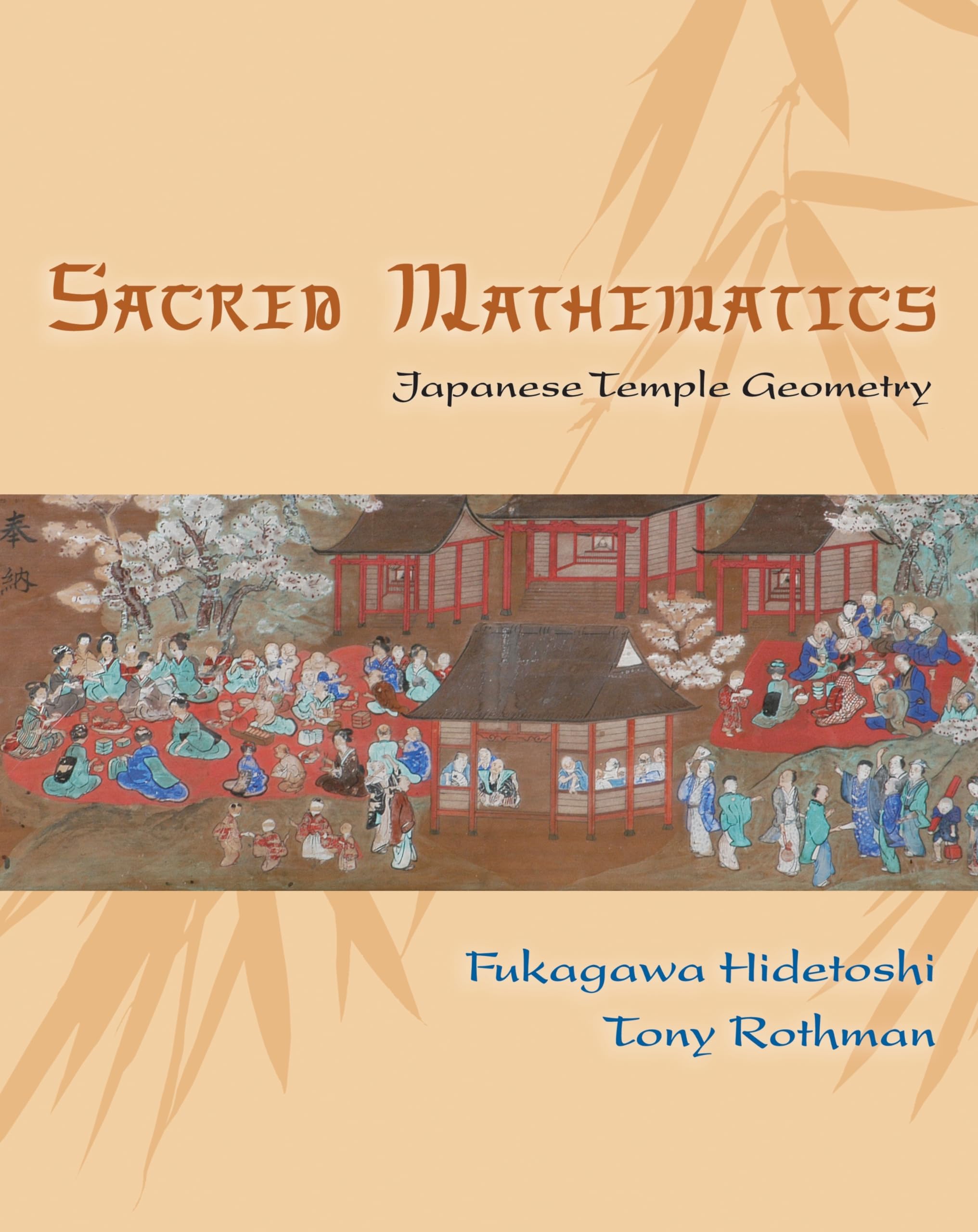
Title
Sacred Mathematics: Japanese Temple Geometry,Used
Sold by Ergodebooks, an authorized reseller.
Returns accepted within 30 days | support@ergodebooks.com
Shipping Information
- Free Standard Shipping — United States only
- Processing Time: 3–5 business days
- Estimated Delivery: 6–10 business days after dispatch
- Double-boxed, fully insured & discreetly packaged
- Tracking number sent via email once dispatched
Returns & Refund
Returns accepted within 30 days of delivery.
Damaged or Defective Item
Free return shipping + replacement or full refund
Wrong Item Received
Free return shipping + replacement or full refund
Change of Mind
Return shipping at customer's expense · 25% restocking fee applies
Payment Option

Between the seventeenth and nineteenth centuries Japan was totally isolated from the West by imperial decree. During that time, a unique brand of homegrown mathematics flourished, one that was completely uninfluenced by developments in Western mathematics. People from all walks of lifesamurai, farmers, and merchantsinscribed a wide variety of geometry problems on wooden tablets called sangaku and hung them in Buddhist temples and Shinto shrines throughout Japan. Sacred Mathematics is the first book published in the West to fully examine this tantalizingand incredibly beautifulmathematical tradition.Fukagawa Hidetoshi and Tony Rothman present for the first time in English excerpts from the travel diary of a nineteenthcentury Japanese mathematician, Yamaguchi Kanzan, who journeyed on foot throughout Japan to collect temple geometry problems. The authors set this fascinating travel narrativeand almost everything else that is known about temple geometrywithin the broader cultural and historical context of the period. They explain the sacred and devotional aspects of sangaku, and reveal how Japanese folk mathematicians discovered many wellknown theorems independently of mathematicians in the Westand in some cases much earlier. The book is generously illustrated with photographs of the tablets and stunning artwork of the period. Then there are the geometry problems themselves, nearly two hundred of them, fully illustrated and ranging from the utterly simple to the virtually impossible. Solutions for most are provided.A unique book in every respect, Sacred Mathematics demonstrates how mathematical thinking can vary by culture yet transcend cultural and geographic boundaries.
⚠️ WARNING (California Proposition 65):
This product may contain chemicals known to the State of California to cause cancer, birth defects, or other reproductive harm.
For more information, please visit www.P65Warnings.ca.gov.
- Q: What is the main theme of 'Sacred Mathematics: Japanese Temple Geometry'? A: The book explores the unique mathematical tradition of Japan between the seventeenth and nineteenth centuries, focusing on temple geometry problems inscribed on wooden tablets called sangaku.
- Q: Who are the authors of this book? A: The book is authored by Fukagawa Hidetoshi and Tony Rothman.
- Q: What kind of content can I expect in this book? A: The book includes historical context, excerpts from a nineteenth-century Japanese mathematician's travel diary, and nearly two hundred illustrated geometry problems, ranging from simple to complex.
- Q: Is this book suitable for beginners in mathematics? A: Yes, the book contains problems ranging from the utterly simple to the virtually impossible, making it suitable for readers with varying levels of mathematical understanding.
- Q: When was 'Sacred Mathematics' published? A: The book was published on July 21, 2008.
- Q: What type of binding does this book have? A: The book is available in hardcover binding.
- Q: How many pages does 'Sacred Mathematics' contain? A: The book contains a total of 392 pages.
- Q: Are there any illustrations in the book? A: Yes, the book is generously illustrated with photographs of the sangaku tablets and artwork from the period.
- Q: What is the condition of the book upon purchase? A: The book is sold in new condition.
- Q: In which category is this book listed? A: This book is categorized under 'Criticism'.