
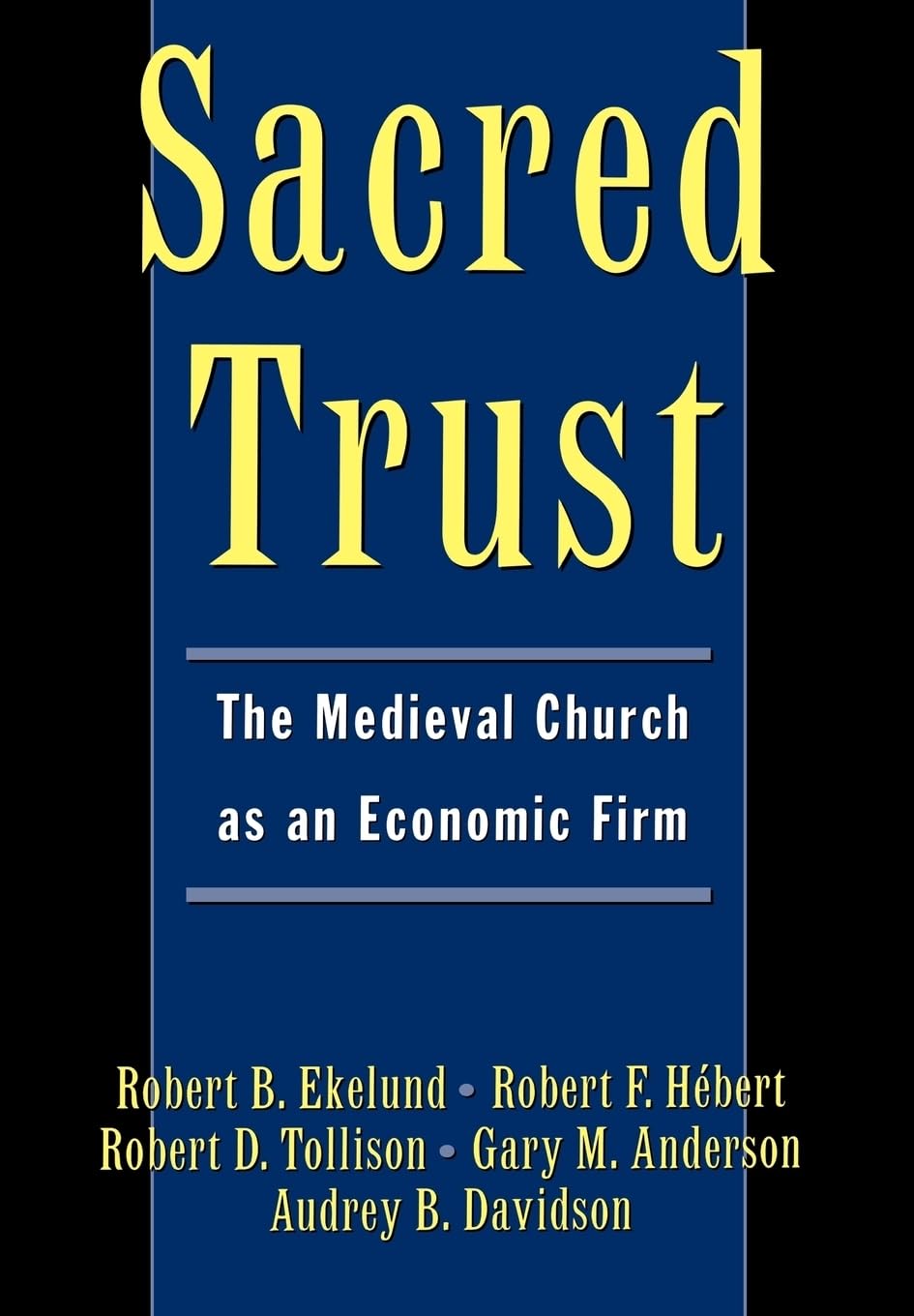
Title
Sacred Trust: The Medieval Church As An Economic Firm,New
Sold by Ergodebooks, an authorized reseller.
Returns accepted within 30 days | support@ergodebooks.com
Shipping Information
- Free Standard Shipping — United States only
- Processing Time: 3–5 business days
- Estimated Delivery: 6–10 business days after dispatch
- Double-boxed, fully insured & discreetly packaged
- Tracking number sent via email once dispatched
Returns & Refund
Returns accepted within 30 days of delivery.
Damaged or Defective Item
Free return shipping + replacement or full refund
Wrong Item Received
Free return shipping + replacement or full refund
Change of Mind
Return shipping at customer's expense · 25% restocking fee applies
Payment Option

Without Meaning To Be Irreverent, It Is Fair To Say That In The Middle Ages, At The Height Of Its Political And Economic Power, The Roman Catholic Church Functioned In Part As A Powerful And Sophisticated Corporation. The Church Dealt In A 'Product' Many Consumers Felt They Had To Have: The Salvation Of Their Immortal Souls. The Pope Served As Its Ceo, The College Of Cardinals As Its Board Of Directors, Bishoprics And Monasteries As Its Franchises. And While The Church Certainly Had Moral And Social Goals, This Early Antecedent To At&T And General Motors Had Economic Motives And Methods As Well, Seeking To Maximize Profits By Eliminating Competitors And Extending Its Markets.In Sacred Trust: The Medieval Church As An Economic Firm, Five Highly Respected Economists Advance The Controversial Argument That The Story Of The Roman Catholic Church In The Middle Ages Is In Large Part A Story Of Supply And Demand. Without Denying The Centralityor Sincerityof Religious Motives, The Authors Employ The Tools Of Modern Economics To Analyze How The Church'S Objectives Went Well Beyond The Realm Of The Spiritual. They Explore The Myriad Sources Of The Church'S Wealth, Including Tithes And Land Rents, Donations And Bequests, Judicial Services And Monastic Agricultural Production. And They Present An Indepth Look At The Ways In Which Church Principles On Marriage, Usury, And Crusade Were Revised As Necessary To Meetand In Many Ways To Createthe Needs Of A Vast Body Of Consumers. Along The Way, The Book Raises And Answers Many Intriguing Questions. The Authors Explore The Reasons Behind The Great Crusades Against The Moslems, Probing Beyond Motives Of Pure Idealism To Highlight The Church'S Concern With Revenues From Tourism And The Sale Of Relics Threatened By Moslem Encroachment In The Holy Lands. They Examine The Church'S Involvement In The Marriage Market, Revealing How The Clergy Filled Their Coffers By Extracting Fees For Blessing Or Dissolving Marital Unions, For Hearing Marital Disputes, And Even For Granting Permission For Blood Relatives To Wed. And They Shed Light On The Concept Of Purgatory, Showing How This 'Product Innovation' Developed By The Church In The Twelfth Centurya Form Of 'Deferred Payment'Opened The Floodgates For A Fresh Market In Postmortem Atonement Through Payments On Behalf Of The Deceased. Finally, The Authors Show How The Cumulative Costs That The Faithful Were Asked To Bear Eventually Priced The Roman Catholic Church Out Of The Market, Paving The Way For Protestant Reformers Like Martin Luther.A Groundbreaking Look At The Growth And Decline Of The Medieval Church, Sacred Trust Demonstrates How Economic Reasoning Can Be Used To Cast Light On The Behavior Of Any Complex Historical Institution. It Offers Rare Insight Into One Of The Great Historical Powers Of Western Civilization, In A Analysis That Will Intrigue Anyone Interested In Life In The Middle Ages, In Church History, Or In The Influence Of Economic Motives On Historical Events.
⚠️ WARNING (California Proposition 65):
This product may contain chemicals known to the State of California to cause cancer, birth defects, or other reproductive harm.
For more information, please visit www.P65Warnings.ca.gov.
- Q: How many pages are in this book? A: There are two hundred twenty-four pages in this book. This length allows for an in-depth exploration of the medieval Church's economic role.
- Q: What are the dimensions of the book? A: The book measures nine point five seven inches in length, six point four six inches in width, and zero point nine one inches in height. These dimensions make it a conveniently sized hardcover.
- Q: Who is the author of 'Sacred Trust'? A: The author is Robert B. Ekelund. He, along with other economists, presents a unique analysis of the medieval Church.
- Q: What type of binding does this book have? A: This book is bound in hardcover. Hardcover binding ensures durability for frequent readers.
- Q: What is the genre of 'Sacred Trust'? A: The genre of 'Sacred Trust' is economic history. It combines elements of economics and historical analysis of the medieval Church.
- Q: Is this book suitable for casual readers? A: Yes, this book is suitable for casual readers interested in history and economics. It presents complex ideas in an engaging manner.
- Q: What themes does the book explore? A: The book explores themes of economic motives, supply and demand, and the historical influence of the Roman Catholic Church. These themes are woven throughout the narrative.
- Q: Can this book be used in academic settings? A: Yes, this book is appropriate for academic settings, particularly in courses on economic history or religious studies. Its analytical approach is well-supported by research.
- Q: What is the primary focus of 'Sacred Trust'? A: The primary focus of the book is the economic behavior of the medieval Church. It argues that the Church acted as a complex economic firm.
- Q: How can I best care for this hardcover book? A: To care for this hardcover book, store it upright in a cool, dry place. Avoid exposure to direct sunlight to prevent fading.
- Q: Is the book safe to read for all ages? A: Yes, the book is safe for all ages. However, it is best suited for readers who can engage with complex historical and economic concepts.
- Q: Does the book contain any illustrations or images? A: No, 'Sacred Trust' does not contain illustrations or images. It focuses on text to convey its historical arguments.
- Q: What is the book's ISBN number? A: The ISBN number for this book is nine seven eight zero one nine five one zero three three seven three. This number can be used to find or order the book.
- Q: Are there any notable discussions in the book? A: Yes, the book discusses notable topics such as the Church's role in the marriage market and the concept of purgatory. These discussions highlight the Church's economic strategies.
- Q: What is the publisher of 'Sacred Trust'? A: The publisher is Oxford University Press, USA. This publisher is known for producing high-quality academic texts.