If you have any questions, you are always welcome to contact us. We'll get back to you as soon as possible, withing 24 hours on weekdays.
Customer service
All questions about your order, return and delivery must be sent to our customer service team by e-mail at yourstore@yourdomain.com
Sale & Press
If you are interested in selling our products, need more information about our brand or wish to make a collaboration, please contact us at press@yourdomain.com
Help
If you have any questions, you are always welcome to contact us. We'll get back to you as soon as possible, withing 24 hours on weekdays.
Customer service
All questions about your order, return and delivery must be sent to our customer service team by e-mail at yourstore@yourdomain.com
Sale & Press
If you are interested in selling our products, need more information about our brand or wish to make a collaboration, please contact us at press@yourdomain.com
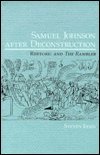
Product Description 'My other works are wine and water,' said Samuel Johnson to Samuel Rogers, 'but my Rambler is pure wine.'Some critics have disagreed, labeling the essays uneven and dismissing the bulk of them as hastily concocted hackwork by a writer taking a break from or earning money for a more important projectthe Dictionary of the English Language. Yet, Steven Lynn, in the first booklength study of The Rambler, resoundingly contradicts such critics; combining deconstruction and other current methods with eighteenthcentury rhetorical theories, Lynn refutes conventional critical wisdom among Johnsonians, asserting that the 208 Rambler essays form a coherent whole.Lynn argues that a controlling tenet in the series is that 'we are each and every one ramblers, wandering and searching for some stable meaning and satisfaction, which will inevitably elude us in this world. By confronting this absence, Johnson (like a deconstructive theologian) leads us repeatedly to acknowledge the necessity of faith.'For Lynn, furthermore, the unifying thread running through the series is expressed in the prayer Johnson composed as he embarked on the journey of The Rambler:'Almighty God, . . . without whose grace all wisdom is folly, grant, I beseech Thee, that in this my undertaking thy Holy Spirit may not be witheld from me, but that I may promote thy glory, and the Salvation both of myself and others.' As Lynn shows, though Johnson anticipates deconstruction, his controlling evangelistic aim differs profoundly and instructively from it. About the Author Steven Lynn is associate professor of English at the University of South Carolina. The author of Writing about Literature: An Introduction to Critical Practice, he has published numerous articles about rhetoric, pedagogy, and eighteenthcentury literature and philosophy.
⚠️ WARNING (California Proposition 65):
This product may contain chemicals known to the State of California to cause cancer,
birth defects, or other reproductive harm.
For MAP (Minimum Advertised Price) violations and Intellectual Property (IP) or Trademark concerns, please contact:
support@ergodebooks.com
⚠️ California Proposition 65 Warning: Some products sold on this website may expose you to chemicals known to the State of California to cause cancer, birth defects, or other reproductive harm. For more information, visit www.P65Warnings.ca.gov.