
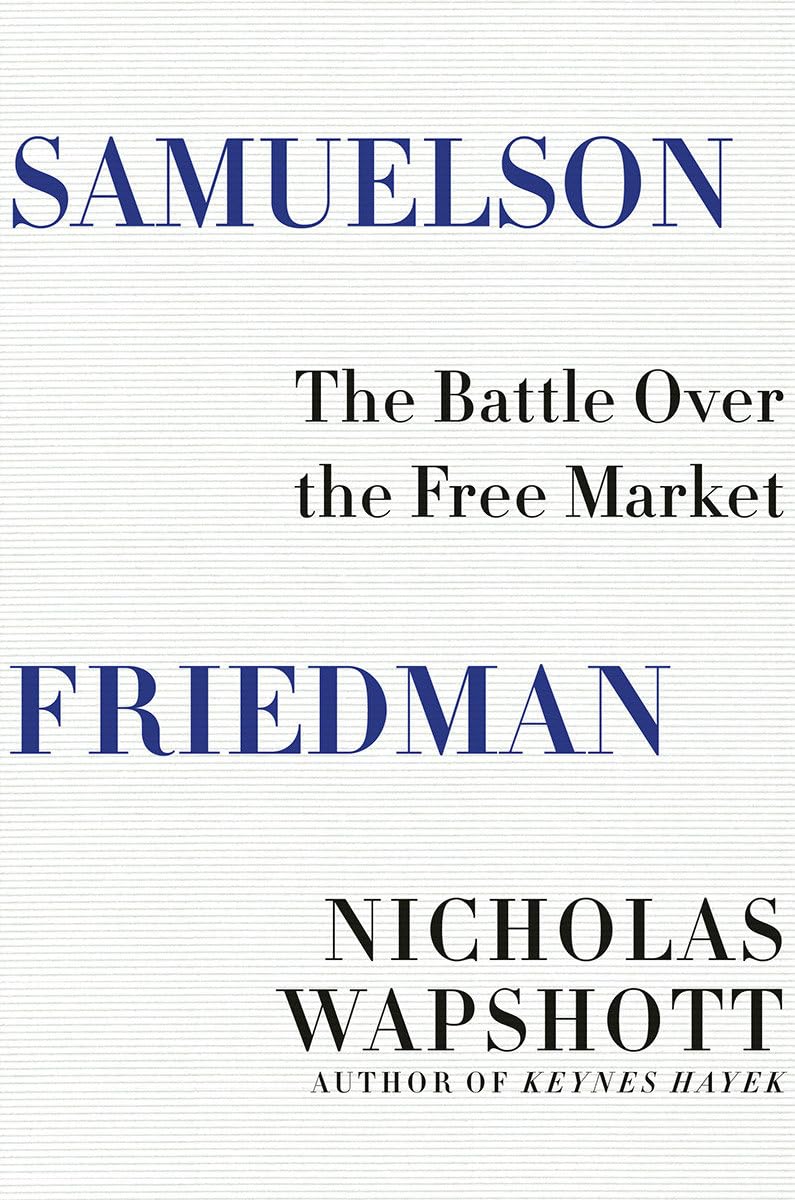
Title
Samuelson Friedman: The Battle Over the Free Market,New
Sold by Ergodebooks, an authorized reseller.
Returns accepted within 30 days | support@ergodebooks.com
Shipping Information
- Free Standard Shipping — United States only
- Processing Time: 3–5 business days
- Estimated Delivery: 6–10 business days after dispatch
- Double-boxed, fully insured & discreetly packaged
- Tracking number sent via email once dispatched
Returns & Refund
Returns accepted within 30 days of delivery.
Damaged or Defective Item
Free return shipping + replacement or full refund
Wrong Item Received
Free return shipping + replacement or full refund
Change of Mind
Return shipping at customer's expense · 25% restocking fee applies
Payment Option

A Financial Times Best Economics Book of 2021From the author of Keynes Hayek, the next great duel in the history of economics.In 1966 two columnists joined Newsweek magazine. Their assignment: debate the world of business and economics. Paul Samuelson was a towering figure in Keynesian economics, which supported the management of the economy along lines prescribed by John Maynard Keyness General Theory. Milton Friedman, little known at that time outside of conservative academic circles, championed monetarism and insisted the Federal Reserve maintain tight control over the amount of money circulating in the economy.In Samuelson Friedman, author and journalist Nicholas Wapshott brings narrative verve and puckish charm to the story of these two giants of modern economics, their braided lives and colossal intellectual battles.Samuelson, a forbidding technical genius, grew up a child of relative privilege and went on to revolutionize macroeconomics. He wrote the bestselling economics textbook of all time, famously remarking 'I dont care who writes a nations lawsor crafts its advanced treatisesif I can write its economics textbooks.' His friend and adversary for decades, Milton Friedman, studied the Great Depression and with Anna Schwartz wrote the seminal books The Great Contraction and A Monetary History of the United States. Like Friedrich Hayek before him, Friedman found fortune writing a treatise, Capitalism and Freedom, that yoked free markets and libertarian politics in a potent argument that remains a lodestar for economic conservatives today.In Wapshotts nimble hands, Samuelson and Friedmans decadeslong argument over howor whetherto manage the economy becomes a window onto one of the longest periods of economic turmoil in the United States. As the soaring economy of the 1950s gave way to decades stalked by declining prosperity and 'stagflation,' it was a time when the theory and practice of economics became the preoccupation of politicians and the focus of national debate. It is an argument that continues today.
⚠️ WARNING (California Proposition 65):
This product may contain chemicals known to the State of California to cause cancer, birth defects, or other reproductive harm.
For more information, please visit www.P65Warnings.ca.gov.
- Q: How many pages does this book have? A: This book has three hundred eighty-four pages. It offers an in-depth exploration of the intellectual battles between Paul Samuelson and Milton Friedman.
- Q: What are the dimensions of this book? A: The book measures six point four two inches in length, one point three inches in width, and nine point six one inches in height. These dimensions make it a suitable size for a standard bookshelf.
- Q: What type of binding does this book have? A: This book features hardcover binding. Hardcover books are known for their durability and classic appearance.
- Q: Who is the author of this book? A: The author of this book is Nicholas Wapshott. He is known for his engaging narrative style and thorough research.
- Q: What genre does this book belong to? A: This book belongs to the Jewish genre. It also delves into economics and historical debates.
- Q: What is the reading level for this book? A: This book is suitable for adults and advanced readers. It discusses complex economic theories and historical contexts.
- Q: How should I care for this hardcover book? A: To care for this book, store it upright on a shelf and avoid exposure to direct sunlight. This helps prevent fading and wear.
- Q: Is this book safe for young readers? A: No, this book is not specifically aimed at young readers. It discusses advanced economic theories and historical debates.
- Q: How do I clean this book if it gets dirty? A: To clean this book, gently wipe the cover with a dry cloth. Avoid using water or cleaning solutions that could damage the binding.
- Q: Can I return this book if I don't like it? A: Yes, you can return this book if it is in its original condition. Check the retailer's return policy for specific details.
- Q: What if the book arrives damaged? A: If the book arrives damaged, contact the retailer immediately for a replacement or refund. Most retailers have policies for damaged items.
- Q: Is this book a good choice for someone new to economics? A: No, this book is more suited for readers with some background in economics. It discusses complex debates between renowned economists.
- Q: How does this book compare to other economics books? A: This book offers a unique narrative approach, focusing on the rivalry between two major economists. It provides historical context not found in many textbooks.
- Q: What themes are explored in this book? A: This book explores themes of economic management, intellectual rivalry, and historical economic turmoil in the United States. It highlights the debate between Keynesianism and monetarism.
- Q: Is there a specific audience for this book? A: Yes, the target audience includes economics enthusiasts, students, and anyone interested in the history of economic thought. It is not geared towards casual readers.
- Q: What is the main focus of this book? A: The main focus of this book is the intellectual battle between Paul Samuelson and Milton Friedman over economic management. It discusses their differing philosophies and impacts.