
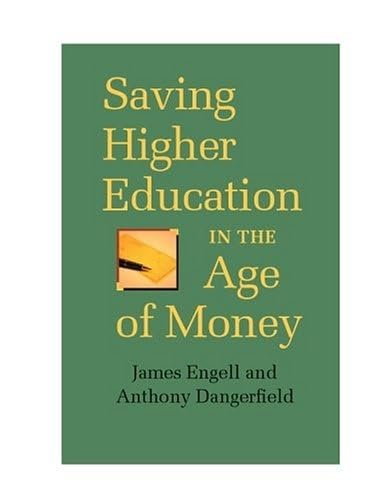
Title
Saving Higher Education In The Age Of Money,Used
Sold by Ergodebooks, an authorized reseller.
Returns accepted within 30 days | support@ergodebooks.com
Shipping Information
- Free Standard Shipping — United States only
- Processing Time: 3–5 business days
- Estimated Delivery: 6–10 business days after dispatch
- Double-boxed, fully insured & discreetly packaged
- Tracking number sent via email once dispatched
Returns & Refund
Returns accepted within 30 days of delivery.
Damaged or Defective Item
Free return shipping + replacement or full refund
Wrong Item Received
Free return shipping + replacement or full refund
Change of Mind
Return shipping at customer's expense · 25% restocking fee applies
Payment Option

Since 1965 an increasing preoccupation with money has resulted in the inversion of its role in higher education, from a practical means to an end that crowds out all others. No longer do students and parents choose the best education that 'money can buy.' Instead, they are faced with choosing which college or university will 'buy them more money.' This comes as no real surprise, as the cost of attending a fouryear college has doubled since 1985. Yet the question persists: at what real cost are we sending our students to college?Renowned educator James Engell and coauthor Anthony Dangerfield explore the answer to this question in Saving Higher Education in the Age of Money. They argue that the counterbalancing attitudes that used to temper a focus on money with other equally legitimate and more fundamental goals have steadily weakened, resulting in a new consensus that elevates money and the marketing of oneself and ones institution to the foremost ambitions of the intellectual world. This new minimization of higher education to the category of an investment to be repaid has damaged all disciplines not directly associated with money, particularly the humanities. Students often now are told they face a choice: between the practical sciences, business, and economic success, or the traditional liberal arts and sciences and expected poverty.In their comprehensive analysis of admission practices, institutional rankings, salaries, hiring practices, scholarships, student attitudes, tuition costs, research programs, library budgets, and class barriers, Engell and Dangerfield expose the major changes that the Age of Money has wrought in higher education while also offering a practical method of understanding and prioritizing the various elements involved in choosing the right school. Focusing on liberal arts and sciences colleges, private research universities, and flagship public institutions, the authors provide an explicit and coherent model of what an academic institution should offer, while encouraging individual institutions to retain their unique identities.Written for a general audience as well as for professionals, Saving Higher Education in the Age of Money will appeal to teachers and administrators, parents of students and prospective students, students and faculty in schools of higher education, and anyone interested in intellectual life.
⚠️ WARNING (California Proposition 65):
This product may contain chemicals known to the State of California to cause cancer, birth defects, or other reproductive harm.
For more information, please visit www.P65Warnings.ca.gov.