
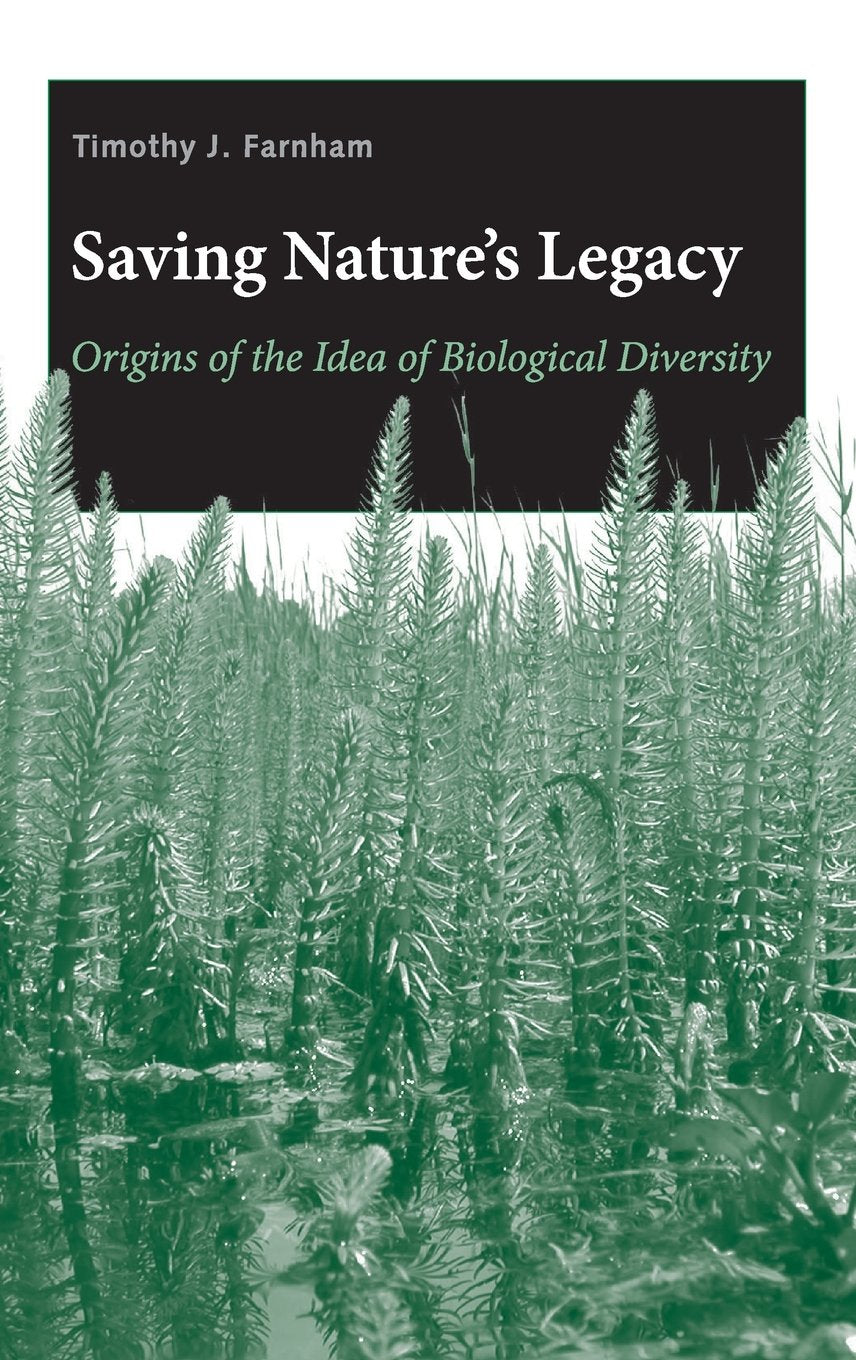
Title
Saving Nature's Legacy: Origins of the Idea of Biological Diversity,Used
Sold by Ergodebooks, an authorized reseller.
Returns accepted within 30 days | support@ergodebooks.com
Shipping Information
- Free Standard Shipping — United States only
- Processing Time: 3–5 business days
- Estimated Delivery: 6–10 business days after dispatch
- Double-boxed, fully insured & discreetly packaged
- Tracking number sent via email once dispatched
Returns & Refund
Returns accepted within 30 days of delivery.
Damaged or Defective Item
Free return shipping + replacement or full refund
Wrong Item Received
Free return shipping + replacement or full refund
Change of Mind
Return shipping at customer's expense · 25% restocking fee applies
Payment Option

Biological diversity is considered one of todays most urgent environmental concerns, yet the term was first coined only twentyfive years ago. Why did the concept of biological diversity so quickly capture public attention and emerge as a banner issue for the environmental movement? In this book, Timothy J. Farnham explores for the first time the historical roots of biological diversity, tracing the evolution of the term as well as the history of the conservation traditions that contributed to its rapid acceptance and popularity.Biological diversity is understood today as consisting of three componentsspecies diversity, genetic diversity, and ecosystem diversity. Farnham finds that these three tiers coincided with three earlier, disparate conservation traditions that converged when the cause of preserving biological diversity was articulated. He tells the stories of these different historical foundations, recounts how the term came into the environmental lexicon, and shows how the evolution of the idea of biological diversity reflects an evolution of American attitudes toward the natural world.
⚠️ WARNING (California Proposition 65):
This product may contain chemicals known to the State of California to cause cancer, birth defects, or other reproductive harm.
For more information, please visit www.P65Warnings.ca.gov.
- Q: What is the main focus of 'Saving Nature's Legacy'? A: 'Saving Nature's Legacy' by Timothy J. Farnham explores the concept of biological diversity, tracing its historical roots and the conservation traditions that contributed to its rapid acceptance as an important environmental issue.
- Q: Who is the author of 'Saving Nature's Legacy'? A: The author of 'Saving Nature's Legacy' is Timothy J. Farnham.
- Q: When was 'Saving Nature's Legacy' published? A: 'Saving Nature's Legacy' was published on June 5, 2007.
- Q: What are the main components of biological diversity discussed in the book? A: The book discusses three main components of biological diversity: species diversity, genetic diversity, and ecosystem diversity.
- Q: What is the condition of the book? A: 'Saving Nature's Legacy' is available in new condition.
- Q: What type of binding does 'Saving Nature's Legacy' have? A: 'Saving Nature's Legacy' is bound in hardcover.
- Q: How many pages are in 'Saving Nature's Legacy'? A: The book contains a total of 288 pages.
- Q: In which category is 'Saving Nature's Legacy' classified? A: 'Saving Nature's Legacy' is classified under the category 'Composers & Musicians'.
- Q: What topics are covered in the book related to environmental concerns? A: The book covers the historical evolution of the term biological diversity and its significance in the environmental movement, including the different conservation traditions that shaped its acceptance.
- Q: Is 'Saving Nature's Legacy' suitable for someone interested in environmental science? A: Yes, 'Saving Nature's Legacy' is suitable for readers interested in environmental science, conservation, and the historical context of biological diversity.