If you have any questions, you are always welcome to contact us. We'll get back to you as soon as possible, withing 24 hours on weekdays.
Customer service
All questions about your order, return and delivery must be sent to our customer service team by e-mail at yourstore@yourdomain.com
Sale & Press
If you are interested in selling our products, need more information about our brand or wish to make a collaboration, please contact us at press@yourdomain.com
Help
If you have any questions, you are always welcome to contact us. We'll get back to you as soon as possible, withing 24 hours on weekdays.
Customer service
All questions about your order, return and delivery must be sent to our customer service team by e-mail at yourstore@yourdomain.com
Sale & Press
If you are interested in selling our products, need more information about our brand or wish to make a collaboration, please contact us at press@yourdomain.com
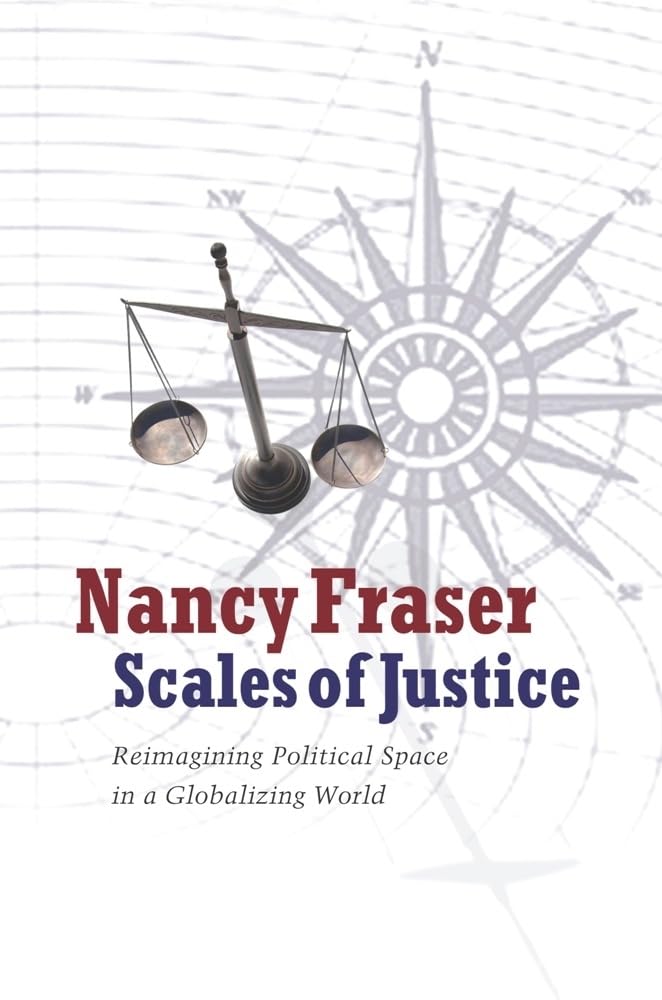
Until recently, struggles for justice proceeded against the background of a takenforgranted frame: the bounded territorial state. With that 'Westphalian' picture of political space assumed by default, the scope of justice was rarely subject to open dispute. Today, however, humanrights activists and international feminists join critics of structural adjustment and the World Trade Organization in challenging the view that justice can only be a domestic relation among fellow citizens. Targeting injustices that cut across borders, they are making the scale of justice an object of explicit struggle.Inspired by these efforts, Nancy Fraser asks: What is the proper frame for theorizing justice? Faced with a plurality of competing scales, how do we know which one is truly just? In exploring these questions, Fraser revises her widely discussed theory of redistribution and recognition. She introduces a third, 'political' dimension of justicerepresentationand elaborates a new, reflexive type of critical theory that foregrounds injustices of 'misframing.' Engaging with thinkers such as Jrgen Habermas, John Rawls, Michel Foucault, and Hannah Arendt, she envisions a 'postwestphalian' mapping of political space that accommodates transnational solidarity, transborder publicity, and democratic framesetting, as well as emancipatory projects that cross borders. The result is a sustained reflection on who should count with respect to what in a globalizing world.
⚠️ WARNING (California Proposition 65):
This product may contain chemicals known to the State of California to cause cancer,
birth defects, or other reproductive harm.
For MAP (Minimum Advertised Price) violations and Intellectual Property (IP) or Trademark concerns, please contact:
support@ergodebooks.com
⚠️ California Proposition 65 Warning: Some products sold on this website may expose you to chemicals known to the State of California to cause cancer, birth defects, or other reproductive harm. For more information, visit www.P65Warnings.ca.gov.