
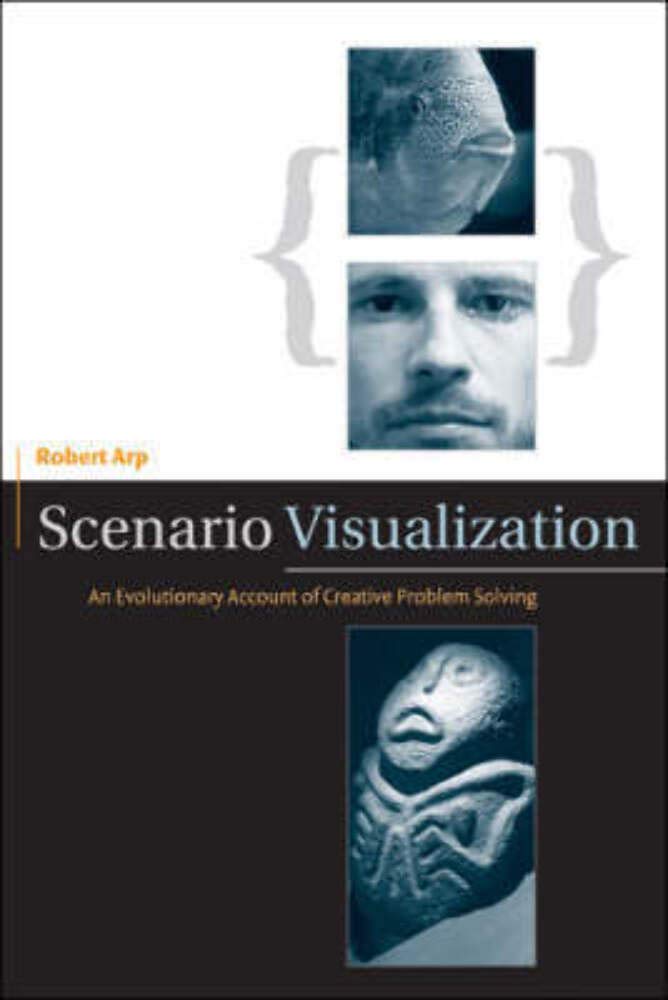
Title
Scenario Visualization: An Evolutionary Account of Creative Problem Solving,Used
Sold by Ergodebooks, an authorized reseller.
Returns accepted within 30 days | support@ergodebooks.com
Shipping Information
- Free Standard Shipping — United States only
- Processing Time: 3–5 business days
- Estimated Delivery: 6–10 business days after dispatch
- Double-boxed, fully insured & discreetly packaged
- Tracking number sent via email once dispatched
Returns & Refund
Returns accepted within 30 days of delivery.
Damaged or Defective Item
Free return shipping + replacement or full refund
Wrong Item Received
Free return shipping + replacement or full refund
Change of Mind
Return shipping at customer's expense · 25% restocking fee applies
Payment Option

An account of how humans evolved a conscious, visionrelated ability unique to their species in order to solve nonroutine problems.In order to solve problems, humans are able to synthesize apparently unrelated concepts, take advantage of serendipitous opportunities, hypothesize, invent, and engage in other similarly abstract and creative activities, primarily through the use of their visual systems. In Scenario Visualization, Robert Arp offers an evolutionary account of the unique human ability to solve nonroutine visionrelated problems. He argues that by the close of the Pleistocene epoch, humans evolved a conscious creative problemsolving capacity, which he terms scenario visualization, that enabled them to outlive other hominid species and populate the planet. Arp shows that the evidence for scenario visualizationby which images are selected, integrated, and then transformed and projected into visual scenarioscan be found in the kinds of complex tools our hominid ancestors invented in order to survive in the everchanging environments of the Pleistocene world.Arp also argues that this conscious capacity shares an analogous affinity with neurobiological processes of selectivity and integration in the visual system, and that similar processes can be found in the activities of organisms in general. The evolution of these processes, he writes, helps account for the modernday conscious ability of humans to use visual information to solve nonroutine problems creatively in their environments. Arp's account of scenario visualization and its emergence in evolutionary history suggests an answer to two basic questions asked by philosophers and biologists concerning human nature: why we are unique; and how we got that way.Robert Arp is Postdoctoral Research Fellow at the National Center for Biomedical Ontology. His areas of specialization include philosophy of biology and philosophy of mind. He is the author of numerous articles and the forthcoming An Integrated Approach to the Philosophy of Mind.
⚠️ WARNING (California Proposition 65):
This product may contain chemicals known to the State of California to cause cancer, birth defects, or other reproductive harm.
For more information, please visit www.P65Warnings.ca.gov.