If you have any questions, you are always welcome to contact us. We'll get back to you as soon as possible, withing 24 hours on weekdays.
Customer service
All questions about your order, return and delivery must be sent to our customer service team by e-mail at yourstore@yourdomain.com
Sale & Press
If you are interested in selling our products, need more information about our brand or wish to make a collaboration, please contact us at press@yourdomain.com
Help
If you have any questions, you are always welcome to contact us. We'll get back to you as soon as possible, withing 24 hours on weekdays.
Customer service
All questions about your order, return and delivery must be sent to our customer service team by e-mail at yourstore@yourdomain.com
Sale & Press
If you are interested in selling our products, need more information about our brand or wish to make a collaboration, please contact us at press@yourdomain.com
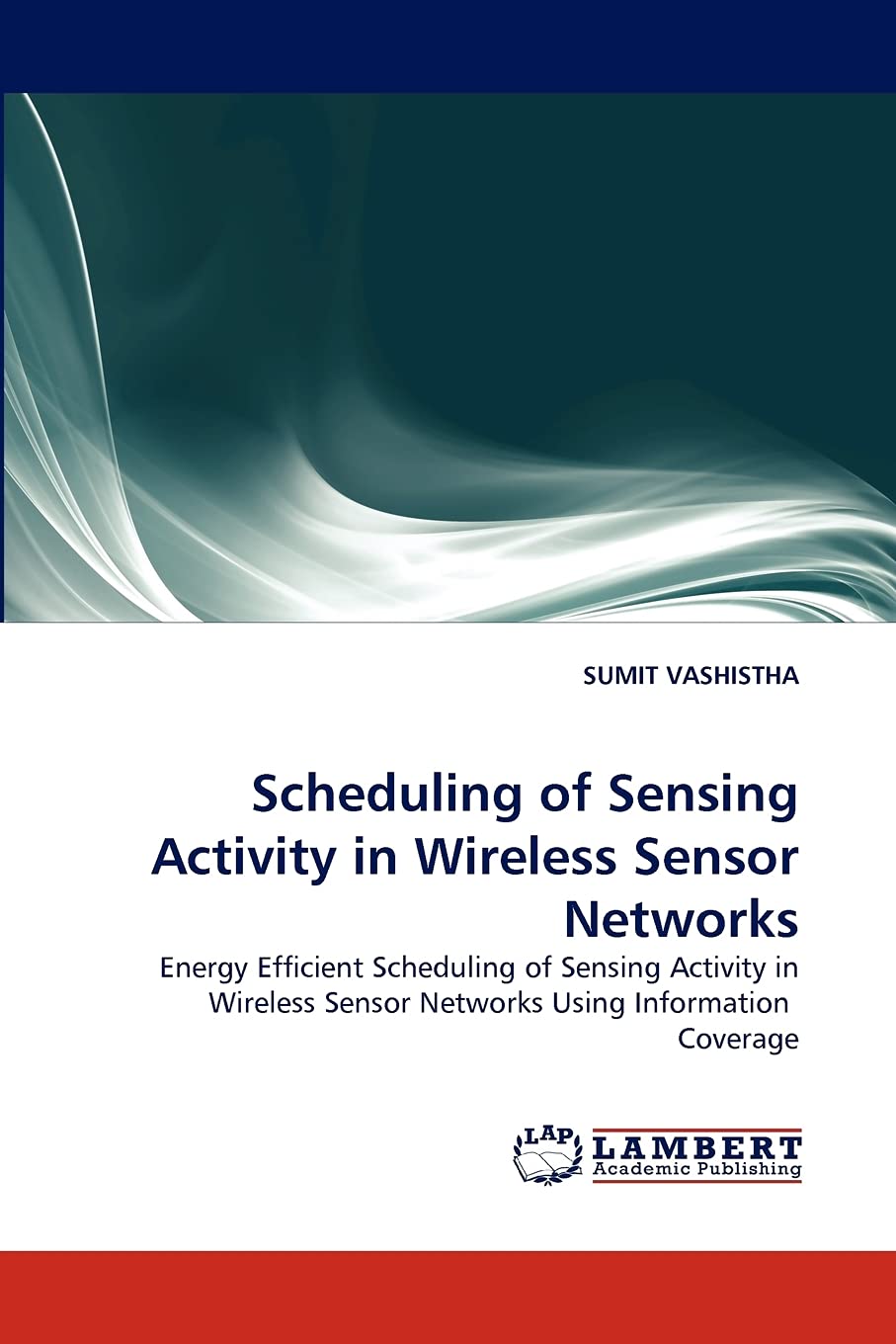
Focus in this work is on the efficient use of energy for sensing. In particular, we are concerned with energy efficient algorithms for scheduling the sensing activity of sensor nodes. By scheduling the sensing activity we mean when to activate a sensor node for sensing and when to keep it idle (sleep mode). The novel approach we adopt in this work to achieve efficient scheduling of sensing activity is an information coverage approach, rather than the widely adopted physical coverage approach. In the physical coverage approach, a point is said to be covered by a sensor node if that point lies within the physical coverage range (or the sensing radius) of that sensor, which is the maximum distance between the sensor and the point up to which the sensor can sense with acceptable accuracy. Information coverage, on the other hand, exploits cooperation among multiple sensors to accurately sense a point even if that point falls outside the physical coverage range of all the sensors. In this work, we address the question of how to schedule the activity of various sensor nodes in the network to enhance network lifetime using information coverage.
⚠️ WARNING (California Proposition 65):
This product may contain chemicals known to the State of California to cause cancer,
birth defects, or other reproductive harm.
For MAP (Minimum Advertised Price) violations and Intellectual Property (IP) or Trademark concerns, please contact:
support@ergodebooks.com
⚠️ California Proposition 65 Warning: Some products sold on this website may expose you to chemicals known to the State of California to cause cancer, birth defects, or other reproductive harm. For more information, visit www.P65Warnings.ca.gov.