If you have any questions, you are always welcome to contact us. We'll get back to you as soon as possible, withing 24 hours on weekdays.
Customer service
All questions about your order, return and delivery must be sent to our customer service team by e-mail at yourstore@yourdomain.com
Sale & Press
If you are interested in selling our products, need more information about our brand or wish to make a collaboration, please contact us at press@yourdomain.com
Help
If you have any questions, you are always welcome to contact us. We'll get back to you as soon as possible, withing 24 hours on weekdays.
Customer service
All questions about your order, return and delivery must be sent to our customer service team by e-mail at yourstore@yourdomain.com
Sale & Press
If you are interested in selling our products, need more information about our brand or wish to make a collaboration, please contact us at press@yourdomain.com
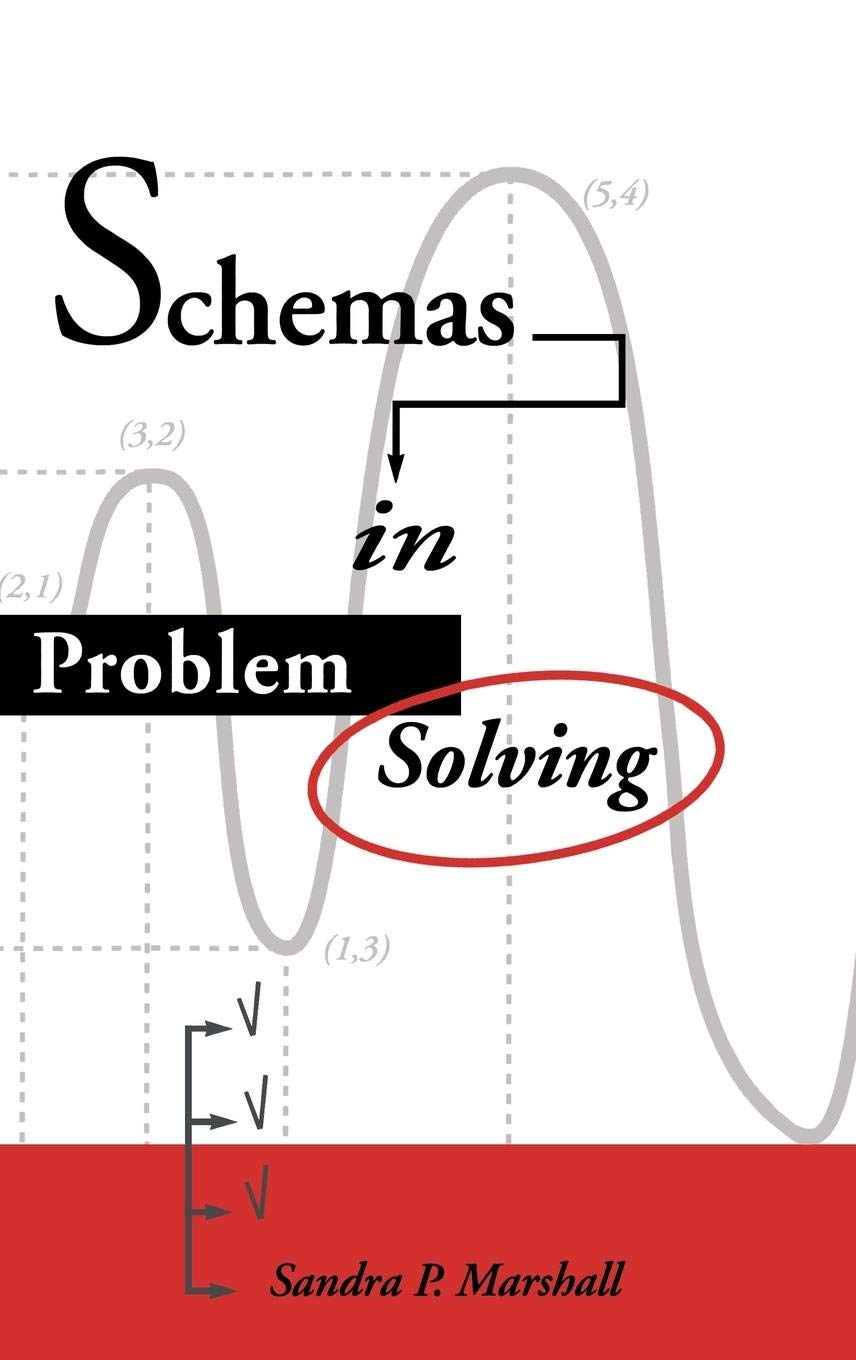
Schemas are major knowledge structures influencing the way people acquire and store information. Sandra Marshall explores a new theory of schema development and studies the applicability of the theory as a unified basis for understanding learning, instruction, and assessment. The theory's prescriptions for teaching are direct, and its application to assessment suggests new directions for tests. After examining the roots of the theory in earlier work by philosophers and psychologists, the author illustrates the main features of her theory with experimental evidence from students who are learning to recognize and solve arithmetic story problems. She describes individual performance with traditional empirical studies as well as computer simulation. The computer simulation reflects a new approach in modeling cognition. Marshall's model links neural networks with symbolic systems to form a hybrid model that uses pattern matching of sets of features as well as logical stepbystep rules. Educational researchers and psychologists as well as curriculum developers will be interested in the new approaches of this work.
⚠️ WARNING (California Proposition 65):
This product may contain chemicals known to the State of California to cause cancer,
birth defects, or other reproductive harm.
For MAP (Minimum Advertised Price) violations and Intellectual Property (IP) or Trademark concerns, please contact:
support@ergodebooks.com
⚠️ California Proposition 65 Warning: Some products sold on this website may expose you to chemicals known to the State of California to cause cancer, birth defects, or other reproductive harm. For more information, visit www.P65Warnings.ca.gov.