If you have any questions, you are always welcome to contact us. We'll get back to you as soon as possible, withing 24 hours on weekdays.
Customer service
All questions about your order, return and delivery must be sent to our customer service team by e-mail at yourstore@yourdomain.com
Sale & Press
If you are interested in selling our products, need more information about our brand or wish to make a collaboration, please contact us at press@yourdomain.com
Help
If you have any questions, you are always welcome to contact us. We'll get back to you as soon as possible, withing 24 hours on weekdays.
Customer service
All questions about your order, return and delivery must be sent to our customer service team by e-mail at yourstore@yourdomain.com
Sale & Press
If you are interested in selling our products, need more information about our brand or wish to make a collaboration, please contact us at press@yourdomain.com
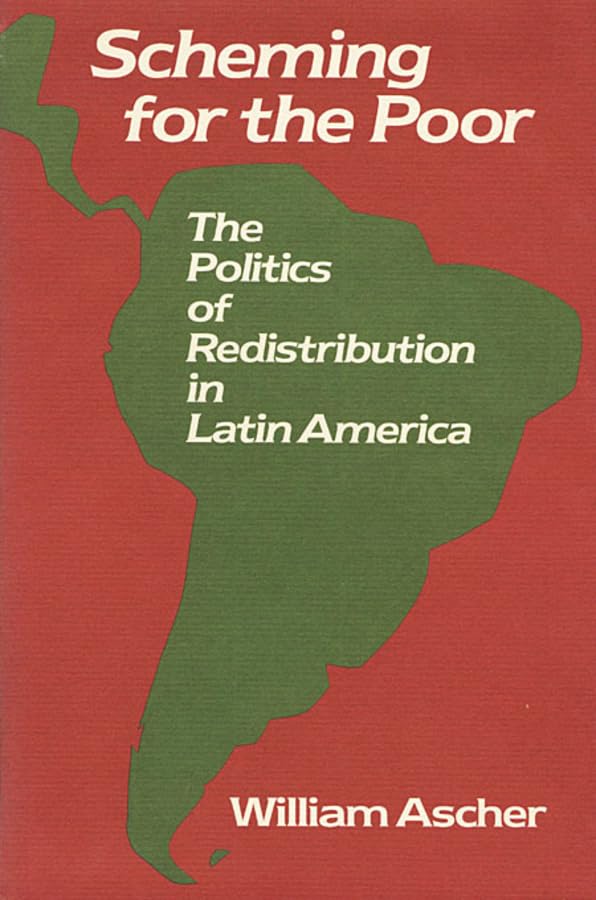
Scheming for the Poor is the first comparative analysis of redistributive policymaking in Latin America. William Ascher examines the success or failure of progressive policies launched by nine governments grouped into three regime typespopulist, reformist, and radicalover the course of the postwar history of Argentina, Chile, and Peru.His findings challenge the conventional views that redistribution in Latin America is either doomed to failure or else is the inevitable consequence of a balance of proredistributive and antiredistributive forces. Ascher shows that tactics and careful attention to practical politics and policy implementation are far more important than regime type and professed political objectives and credos. The adept policymakersfrom the Argentine authoritarian populist Juan Pern to the Chilean reformist Eduardo Freidelivered more as redistributionists than did the economic romantics.Integrating the political and economic aspects of redistribution, Ascher shows that in political terms success stems from subtlety rather than stridency, perceptions rather than economic realities, the astute formation of coalitions, and aversion of the mobilization of the opposition. Ultimately, of course, economic pressures impose a limit on what is politically possible, and Ascher demonstrates how economic requirements constrain the politics of income redistribution.
⚠️ WARNING (California Proposition 65):
This product may contain chemicals known to the State of California to cause cancer,
birth defects, or other reproductive harm.
For MAP (Minimum Advertised Price) violations and Intellectual Property (IP) or Trademark concerns, please contact:
support@ergodebooks.com
⚠️ California Proposition 65 Warning: Some products sold on this website may expose you to chemicals known to the State of California to cause cancer, birth defects, or other reproductive harm. For more information, visit www.P65Warnings.ca.gov.