
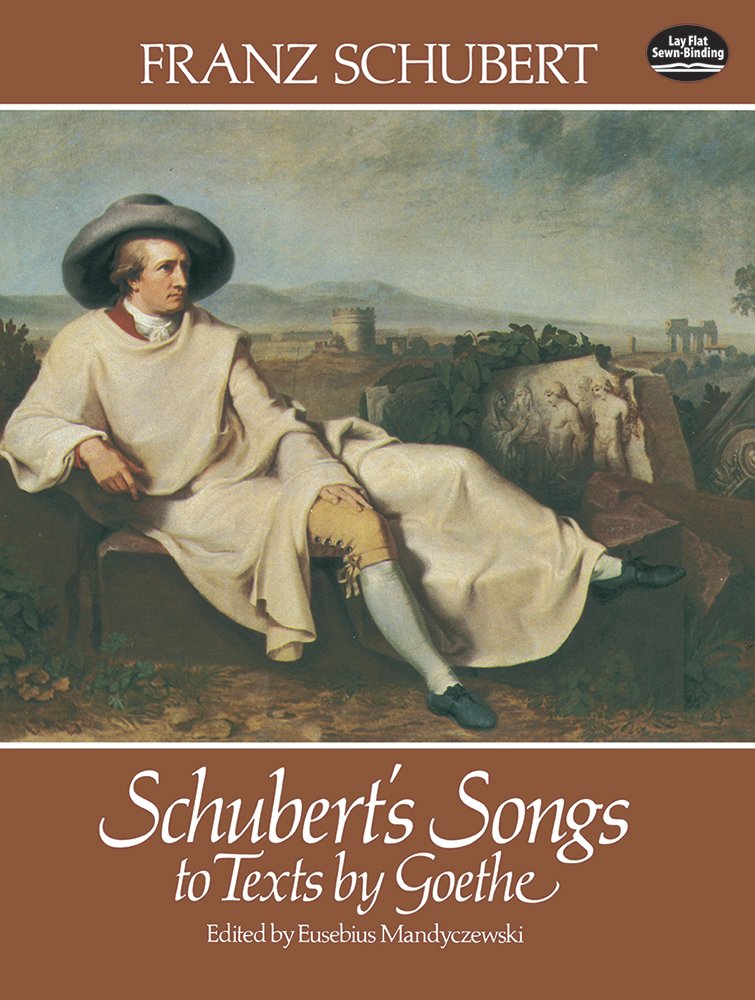
Title
Schubert's Songs to Texts by Goethe,New
Sold by Ergodebooks, an authorized reseller.
Returns accepted within 30 days | support@ergodebooks.com
Shipping Information
- Free Standard Shipping — United States only
- Processing Time: 3–5 business days
- Estimated Delivery: 6–10 business days after dispatch
- Double-boxed, fully insured & discreetly packaged
- Tracking number sent via email once dispatched
Returns & Refund
Returns accepted within 30 days of delivery.
Damaged or Defective Item
Free return shipping + replacement or full refund
Wrong Item Received
Free return shipping + replacement or full refund
Change of Mind
Return shipping at customer's expense · 25% restocking fee applies
Payment Option

Goethe failed to appreciate the songs which would link his poems to musical immortality. Schubert's tonal innovations and passionate insight into the great lyrics disconcerted the poet, but brought Schubert fame as master composer long before public recognition of his symphonies.The prolific Schubert (over 600 songs in 10 years) was inspired by Goethe's verse as a prodigious young songwriter ('Gretchen am Spinnrade,' his first masterpiece, was set at age 17) and stayed with the poems all his short life. The new edition includes all his versions for every lied to Goethe texts from the standard Breitkopf and Hrtel completescore edition of 188497. Eightfour songs (55 poems with 29 later versions) comprise this reading and playing edition, with modern literal prose translations of the poems by Stanley Appelbaum. No other onevolume edition of the famous songs is available; this volume offers authoritative complete scores, handsomely set with wide margins and strong binding, in a careful, accurate rendering of Goethe, at a price accessible to musicians, students, and all lovers of song.The songs include four versions of 'Erlknig' (The Elf King), singled out by Groves Dictionary for 'the wealth of harmonic resource, the structural unity of the song, the mounting tonal climaxes'; musicologist Karl Schumann remarks that 'the lashing storm rhythm . . . a wild triplet variant of Schubert's characteristic walking rhythm, was to remain an important tonal symbol for many years leading up to the opening of Wagner's 'Die Walkyrie.'' Also included are the scene from Faust, 'Der Snger,' 'Prometheus,' ('the greatest of his lyricodramatic songs' Grove's), and the Harper cycle ('There are modulations . . . of such searching expressive intensity that they almost reach the bounds of tonality; not even Beethoven's last string quartets . . . contain harmonic transitions of such audacity.' Schumann).
⚠️ WARNING (California Proposition 65):
This product may contain chemicals known to the State of California to cause cancer, birth defects, or other reproductive harm.
For more information, please visit www.P65Warnings.ca.gov.