
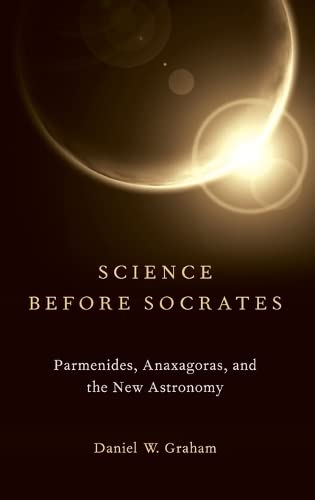
Title
Science before Socrates: Parmenides, Anaxagoras, and the New Astronomy,Used
Sold by Ergodebooks, an authorized reseller.
Returns accepted within 30 days | support@ergodebooks.com
Shipping Information
- Free Standard Shipping — United States only
- Processing Time: 3–5 business days
- Estimated Delivery: 6–10 business days after dispatch
- Double-boxed, fully insured & discreetly packaged
- Tracking number sent via email once dispatched
Returns & Refund
Returns accepted within 30 days of delivery.
Damaged or Defective Item
Free return shipping + replacement or full refund
Wrong Item Received
Free return shipping + replacement or full refund
Change of Mind
Return shipping at customer's expense · 25% restocking fee applies
Payment Option

In Science before Socrates, Daniel Graham argues against the prevalent belief that the Presocratic philosophers did not produce any empirical science and that the first major Greek science, astronomy, did not develop until at least the time of Plato. Instead, Graham proposes that the advances made by Presocratic philosophers in the study of astronomy deserve to be considered as scientific contributions.Whereas philosophers of the sixth century BC treated astronomical phenomena as ephemeral events continuous with weather processes, those of the fifth century treated heavenly bodies as independent stony masses whirled in a cosmic vortex. Two historic events help to date and account for the change: a solar eclipse in 478 BC and a meteoroid that fell to earth around 466. Both events influenced Anaxagoras, who transformed insights from Parmenides into explanations of lunar and solar eclipses, meteors, and rainbows.Virtually all philosophers came to accept Anaxagoras' theory of lunar light and eclipses. Aristotle endorsed Anaxagoras' theory of eclipses as a paradigm of scientific explanation. Anaxagoras' theories launched a geometrical approach to astronomy and were accepted as foundational principles by all mathematical astronomers from Aristarchus to Ptolemy to Copernicus and Galileoand to the present day.
⚠️ WARNING (California Proposition 65):
This product may contain chemicals known to the State of California to cause cancer, birth defects, or other reproductive harm.
For more information, please visit www.P65Warnings.ca.gov.