
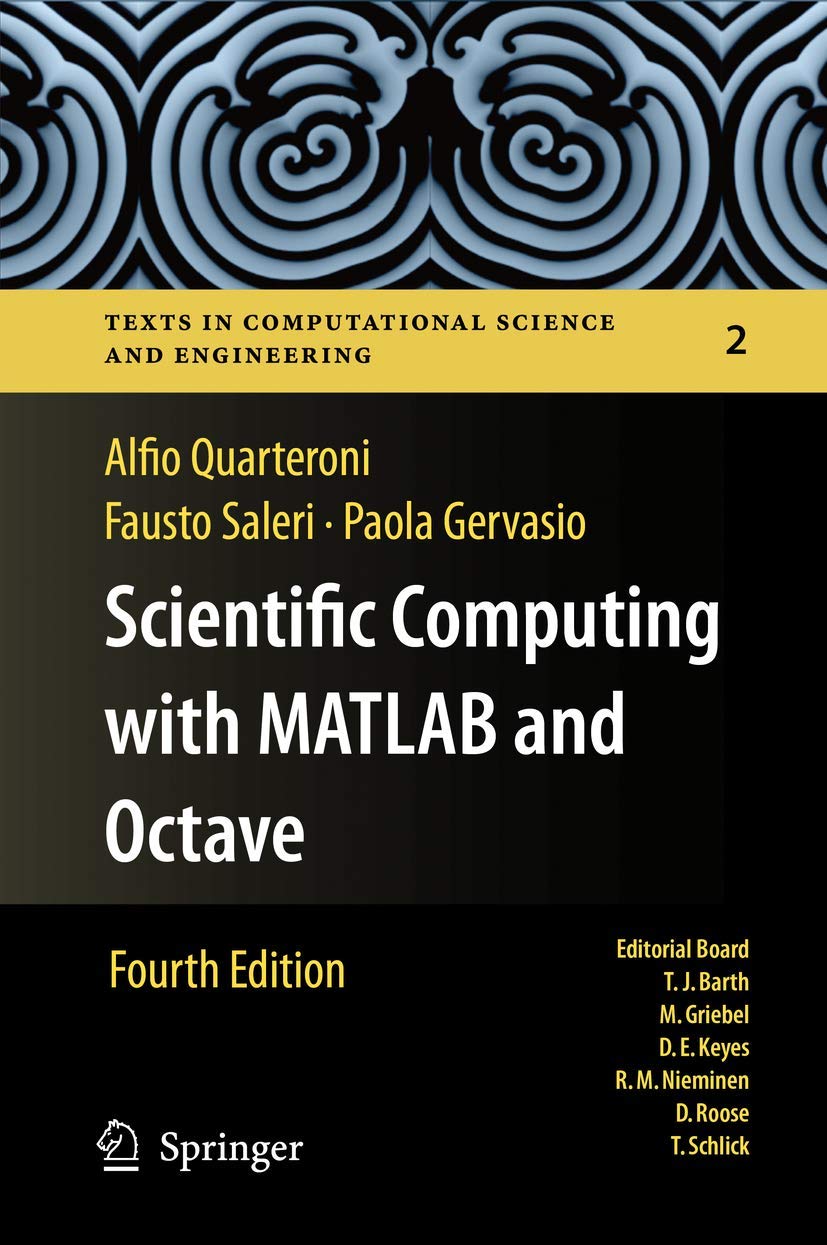
Title
Scientific Computing With Matlab And Octave (Texts In Computational Science And Engineering, 2)
Sold by Ergodebooks, an authorized reseller.
Returns accepted within 30 days | support@ergodebooks.com
Shipping Information
- Free Standard Shipping — United States only
- Processing Time: 3–5 business days
- Estimated Delivery: 6–10 business days after dispatch
- Double-boxed, fully insured & discreetly packaged
- Tracking number sent via email once dispatched
Returns & Refund
Returns accepted within 30 days of delivery.
Damaged or Defective Item
Free return shipping + replacement or full refund
Wrong Item Received
Free return shipping + replacement or full refund
Change of Mind
Return shipping at customer's expense · 25% restocking fee applies
Payment Option

This Textbook Is An Introduction To Scientific Computing, In Which Several Numerical Methods For The Computerbased Solution Of Certain Classes Of Mathematical Problems Are Illustrated. The Authors Show How To Compute The Zeros, The Extrema, And The Integrals Of Continuous Functions, Solve Linear Systems, Approximate Functions Using Polynomials And Construct Accurate Approximations For The Solution Of Ordinary And Partial Differential Equations. To Make The Format Concrete And Appealing, The Programming Environments Matlab And Octave Are Adopted As Faithful Companions. The Book Contains The Solutions To Several Problems Posed In Exercises And Examples, Often Originating From Important Applications. At The End Of Each Chapter, A Specific Section Is Devoted To Subjects Which Were Not Addressed In The Book And Contains Bibliographical References For A More Comprehensive Treatment Of The Material.From The Review:.... This Carefully Written Textbook, The Third English Edition, Contains Substantial New Developments On The Numerical Solution Of Differential Equations. It Is Typeset In A Twocolor Design And Is Written In A Style Suited For Readers Who Have Mathematics, Natural Sciences, Computer Sciences Or Economics As A Background And Who Are Interested In A Wellorganized Introduction To The Subject. Roberto Plato (Siegen), Zentralblatt Math 1205.65002.
⚠️ WARNING (California Proposition 65):
This product may contain chemicals known to the State of California to cause cancer, birth defects, or other reproductive harm.
For more information, please visit www.P65Warnings.ca.gov.
- Q: How many pages does this book have? A: This book has four hundred sixty-eight pages. It provides a comprehensive introduction to scientific computing methods.
- Q: What are the dimensions of this book? A: The book measures six point four two inches in length, nine point three inches in height, and zero point nine one inches in width.
- Q: What type of binding does this textbook have? A: This textbook is bound in hardcover. Hardcover binding offers durability and protection for frequent use.
- Q: Who is the author of this book? A: The author of this book is Alfio Quarteroni. He is known for his expertise in computational science and engineering.
- Q: What topics are covered in this textbook? A: This textbook covers numerical methods for solving mathematical problems, including zeros, extrema, integrals, and differential equations.
- Q: Is this book suitable for beginners? A: Yes, this book is suitable for beginners with a background in mathematics or natural sciences. It is organized to help new learners grasp scientific computing concepts.
- Q: What programming environments are used in this book? A: The book utilizes Matlab and Octave as programming environments. These tools are essential for implementing the numerical methods discussed.
- Q: Are there exercises included in the book? A: Yes, the book includes exercises and examples. Solutions to several problems are provided to enhance understanding.
- Q: How should I care for this textbook? A: To care for this textbook, store it in a cool, dry place and avoid exposure to direct sunlight. This helps preserve the cover and pages.
- Q: Is this book appropriate for advanced readers? A: Yes, advanced readers will find valuable information in this textbook. It includes substantial developments in the numerical solution of differential equations.
- Q: What is the target audience for this book? A: The target audience includes students and professionals in mathematics, natural sciences, computer sciences, or economics.
- Q: Can I find bibliographical references in the book? A: Yes, the book contains bibliographical references for topics not fully addressed. This aids in further exploration of the material.
- Q: What if the book arrives damaged? A: If the book arrives damaged, you can initiate a return process. Please contact customer support for assistance with returns.
- Q: Is there a warranty for this textbook? A: No, textbooks typically do not come with a warranty. However, you may have options for returns or exchanges.
- Q: How should I store this textbook? A: Store this textbook upright on a shelf or flat on a table. Avoid stacking heavy items on top to prevent damage.
- Q: What makes this textbook unique? A: This textbook is unique due to its well-organized introduction and substantial new developments in scientific computing methods.