If you have any questions, you are always welcome to contact us. We'll get back to you as soon as possible, withing 24 hours on weekdays.
Customer service
All questions about your order, return and delivery must be sent to our customer service team by e-mail at yourstore@yourdomain.com
Sale & Press
If you are interested in selling our products, need more information about our brand or wish to make a collaboration, please contact us at press@yourdomain.com
Help
If you have any questions, you are always welcome to contact us. We'll get back to you as soon as possible, withing 24 hours on weekdays.
Customer service
All questions about your order, return and delivery must be sent to our customer service team by e-mail at yourstore@yourdomain.com
Sale & Press
If you are interested in selling our products, need more information about our brand or wish to make a collaboration, please contact us at press@yourdomain.com
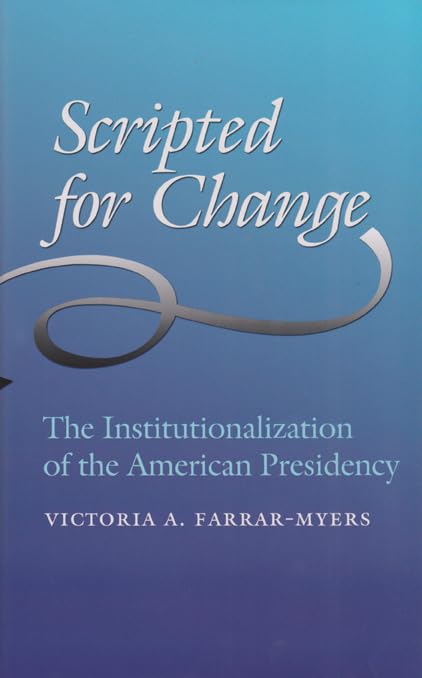
Without a doubt, the institution of the presidency today is quite different from the one that existed throughout the early part of the nations history, despite only minimal revisions to its formal constitutional structure. The processes by which the institution of the presidency has developed have remained largely unexamined, however.Victoria A. FarrarMyers offers a carefully crafted argument about how changes in presidential authority transform the institution. Her analysis tracks interactions between the president and Congress during the years 18811920 in three policy areas: the commitment of troops, the creation of administrative agencies, and the adoption of tariff policy.FarrarMyers shows that Congress and the president have in fact created a coordinated script that provides the basis of precedent for future interactions under similar circumstances. Changes in presidential authority, she argues, are the residual of everyday actions, which create new shared understandings of expected behavior. As these understandings are reinforced over time, they become interwoven into the institution of the presidency itself. FarrarMyerss analysis will offer theoretical guidance for political scientists understanding of the development of presidential authority and the processes that drive the institutionalization of the presidency, and will provide historians with a nuanced understanding of the institution from the period between the end of Reconstruction and the Progressive era.
⚠️ WARNING (California Proposition 65):
This product may contain chemicals known to the State of California to cause cancer,
birth defects, or other reproductive harm.
For MAP (Minimum Advertised Price) violations and Intellectual Property (IP) or Trademark concerns, please contact:
support@ergodebooks.com
⚠️ California Proposition 65 Warning: Some products sold on this website may expose you to chemicals known to the State of California to cause cancer, birth defects, or other reproductive harm. For more information, visit www.P65Warnings.ca.gov.