
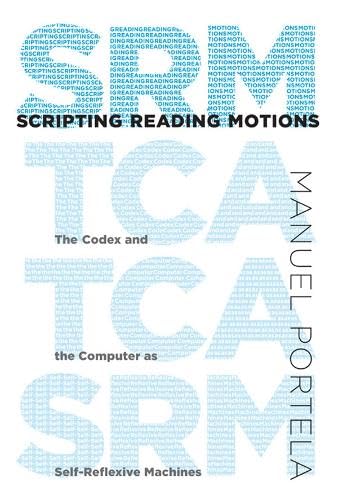
Title
Scripting Reading Motions: The Codex and the Computer as SelfReflexive Machines,Used
Sold by Ergodebooks, an authorized reseller.
Returns accepted within 30 days | support@ergodebooks.com
Shipping Information
- Free Standard Shipping — United States only
- Processing Time: 1–3 business days
- Estimated Delivery: 3–5 business days after dispatch
- Double-boxed, fully insured & discreetly packaged
- Tracking number sent via email once dispatched
- Orders over $250 require signature upon delivery. Taxes calculated at checkout.
Returns & Refund
Returns accepted within 30 days of delivery.
Damaged or Defective Item
Free return shipping + replacement or full refund
Wrong Item Received
Free return shipping + replacement or full refund
Change of Mind
Return shipping at customer's expense · 25% restocking fee applies
Payment Option

An exploration of what experimental literature in both print and programmable media tells us about the act of reading.In Scripting Reading Motions, Manuel Portela explores the expressive use of book forms and programmable media in experimental works of both print and electronic literature and finds a selfconscious play with the dynamics of reading and writing. Portela examines a series of print and digital works by Johanna Drucker, Mark Z. Danielewski, Rui Torres, Jim Andrews, and others, for the insights they yield about the semiotic and interpretive actions through which readers produce meaning when interacting with codes. Analyzing these works as embodiments and simulations of the motions of reading, Portela pays particular attention to the ways in which awareness of eye movements and haptic interactions in both print and electronic media feeds back onto the material and semantic layers of the works. These feedbacks, he argues, sustain selfreflexive loops that link the body of the reader to the embodied work. Readers' haptic actions and eye movements coinstantiate the object that they are reading.Portela discusses typographic and graphic marks as choreographic notations for reading movements; examines digital recreations of experimental print literary artifacts; considers reading motions in kinetic and generated texts; analyzes the relationship of bibliographic, linguistic, and narrative coding in Danielewski's novelpoem, Only Revolutions; and describes emergent meanings in interactive textual instruments. The expressive use of print and programmable media, Portela shows, offers a powerful model of the semiotic, interpretive, and affective operations embodied in reading processes.Important Notice: The digital edition of this book is missing some of the images found in the physical edition.
⚠️ WARNING (California Proposition 65):
This product may contain chemicals known to the State of California to cause cancer, birth defects, or other reproductive harm.
For more information, please visit www.P65Warnings.ca.gov.