If you have any questions, you are always welcome to contact us. We'll get back to you as soon as possible, withing 24 hours on weekdays.
Customer service
All questions about your order, return and delivery must be sent to our customer service team by e-mail at yourstore@yourdomain.com
Sale & Press
If you are interested in selling our products, need more information about our brand or wish to make a collaboration, please contact us at press@yourdomain.com
Help
If you have any questions, you are always welcome to contact us. We'll get back to you as soon as possible, withing 24 hours on weekdays.
Customer service
All questions about your order, return and delivery must be sent to our customer service team by e-mail at yourstore@yourdomain.com
Sale & Press
If you are interested in selling our products, need more information about our brand or wish to make a collaboration, please contact us at press@yourdomain.com
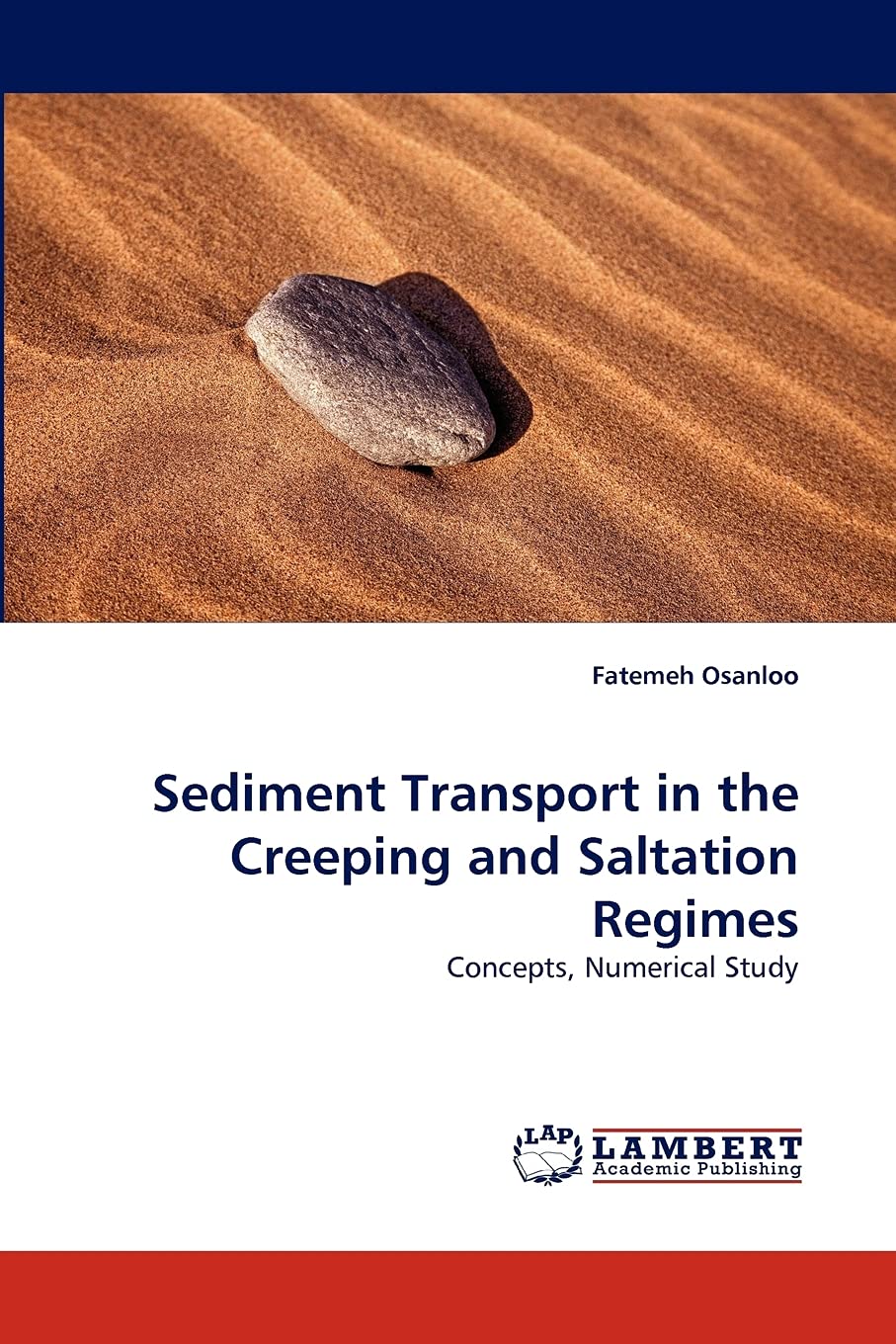
Sediment transport by laminar and turbulent flow are phenomena involved in the natural environment and industrial processes. In this book we present a study of sediment transport in the creeping and saltation regimes by laminar and turbulent flows. In our model the particles are supposed as hard disks in a twodimensional domain with periodic boundary conditions in the horizontal direction. The motion of particles is calculated by the event driven molecular dynamics method. The fluid that is modeled by its velocity profile, flows over the bed, so the particles can be entrained by the fluid and move under the influence of the drag force and gravity. We consider two velocity profiles for the fluid, parabolic and logarithmic. The first one models laminar flow and the second corresponds to turbulent flow. We find that for the logarithmic profile, the saturated flux shows a quadratic increase with the strength of the flow, and for parabolic profile, a cubic increase. We also find that for the parabolic profile, near the threshold velocity, saturated flux increases quadratically with the shear velocity. The velocity distribution functions of grains are used to interpret the results.
⚠️ WARNING (California Proposition 65):
This product may contain chemicals known to the State of California to cause cancer,
birth defects, or other reproductive harm.
For MAP (Minimum Advertised Price) violations and Intellectual Property (IP) or Trademark concerns, please contact:
support@ergodebooks.com
⚠️ California Proposition 65 Warning: Some products sold on this website may expose you to chemicals known to the State of California to cause cancer, birth defects, or other reproductive harm. For more information, visit www.P65Warnings.ca.gov.