
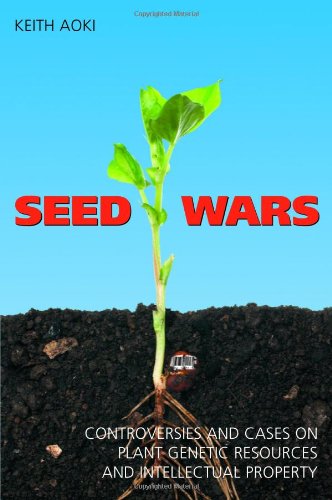
Title
Seed Wars: Controversies and Cases on Plant Genetic Resources and Intellectual Property,Used
Sold by Ergodebooks, an authorized reseller.
Returns accepted within 30 days | support@ergodebooks.com
Shipping Information
- Free Standard Shipping — United States only
- Processing Time: 3–5 business days
- Estimated Delivery: 6–10 business days after dispatch
- Double-boxed, fully insured & discreetly packaged
- Tracking number sent via email once dispatched
Returns & Refund
Returns accepted within 30 days of delivery.
Damaged or Defective Item
Free return shipping + replacement or full refund
Wrong Item Received
Free return shipping + replacement or full refund
Change of Mind
Return shipping at customer's expense · 25% restocking fee applies
Payment Option

Seed Wars is a comprehensive overview of the current domestic and international legal controversies regarding intellectual property protections for plant genetic resources (PGRs) over the past three decades. This book examines these controversies on three fronts: (1) the rise of intellectual property protections for plant varieties and the enclosure of the 'genetic' commons; (2) the subsequent move of the agrochemical industry from manufacturing fertilizers, pesticides, and herbicides to 'manufacturing' seeds in the context of industrial agriculture; and (3) the emergence of overlapping regimes of domestic and multilateral treaties such as the TradeRelated Aspects of Intellectual Property (TRIPS, 1994), the Convention on Biodiversity (CBD, 1992) and the International Treaty on Plant Genetic Resources (ITPGR, 2004) from the 1990s on. Finally, this book speculates on possible directions that intellectual property protection for PGRs may take in the 21st century.While intellectual property protection for plants has been available in the United States since 1930, the decade of the 1960s saw the rise of Plant Variety Protections in Europe and by 1980, the U.S. Supreme Court embraced the idea that living organisms could be patented, paving the way for new plant varieties to receive utility patent protection in the U.S.'Seed Wars provides an excellent overview of the issues and suggests a range of options to overcome the ill effects of expanding intellectual property rights on access to plant genetic resources, seeds and plant varieties. Aoki does a nice job of drawing the linkage between IPRs and PGRs, without suggesting a return to the old Common Heritage system or arguing for a revision in the current IP regime.' Law & Politics Book Review
⚠️ WARNING (California Proposition 65):
This product may contain chemicals known to the State of California to cause cancer, birth defects, or other reproductive harm.
For more information, please visit www.P65Warnings.ca.gov.
- Q: What is the main focus of the book 'Seed Wars'? A: 'Seed Wars' provides a comprehensive overview of legal controversies surrounding intellectual property protections for plant genetic resources over the past three decades. It examines the rise of these protections, the shift in the agro-chemical industry, and the development of international treaties.
- Q: Who is the author of 'Seed Wars'? A: The author of 'Seed Wars' is Keith Aoki, who explores the intersection of intellectual property rights and plant genetic resources.
- Q: What can I learn about intellectual property in agriculture from this book? A: The book discusses the evolution of plant variety protections, the patenting of living organisms, and the implications of expanding intellectual property rights on access to seeds and plant varieties.
- Q: Is 'Seed Wars' suitable for someone not familiar with legal terms? A: Yes, 'Seed Wars' is written to be accessible, providing clear explanations of legal concepts and their implications for plant genetic resources, making it suitable for both legal professionals and general readers.
- Q: How many pages does 'Seed Wars' have? A: 'Seed Wars' has a total of 280 pages, providing a thorough exploration of its subject matter.
- Q: What type of binding does the book 'Seed Wars' have? A: 'Seed Wars' is available in paperback binding, making it lightweight and easy to handle.
- Q: When was 'Seed Wars' published? A: 'Seed Wars' was published on January 1, 2008, with a release date of July 30, 2007.
- Q: What are the key themes discussed in 'Seed Wars'? A: Key themes include the rise of intellectual property protections, the agro-chemical industry's shift to seed manufacturing, and the impact of international treaties on plant genetic resources.
- Q: What condition is the used book in? A: The used book is described as being in good condition, ensuring that it is still a reliable resource for readers.
- Q: Does 'Seed Wars' offer solutions to the challenges it discusses? A: Yes, the book suggests various options to mitigate the negative effects of expanding intellectual property rights on access to plant genetic resources.