
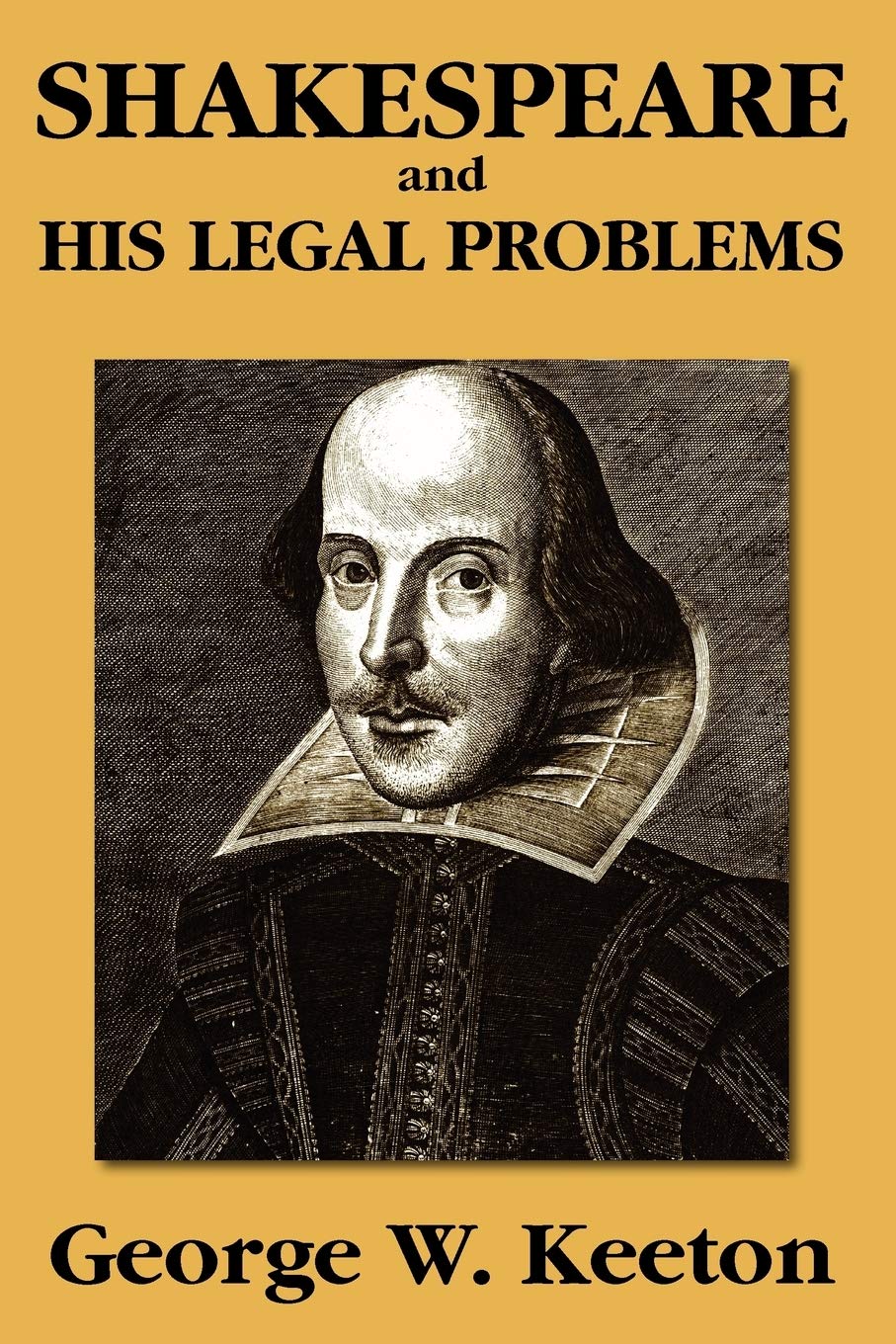
Title
Shakespeare and his Legal Problems,New
Sold by Ergodebooks, an authorized reseller.
Returns accepted within 30 days | support@ergodebooks.com
Shipping Information
- Free Standard Shipping — United States only
- Processing Time: 3–5 business days
- Estimated Delivery: 6–10 business days after dispatch
- Double-boxed, fully insured & discreetly packaged
- Tracking number sent via email once dispatched
Returns & Refund
Returns accepted within 30 days of delivery.
Damaged or Defective Item
Free return shipping + replacement or full refund
Wrong Item Received
Free return shipping + replacement or full refund
Change of Mind
Return shipping at customer's expense · 25% restocking fee applies
Payment Option

In this fascinating study, Keeton addresses general themes, such as the law of debt and the development of the common law (as demonstrated by Shylock), as well as specific topics like the trial of Hermione and the divorce of Queen Katherine. 'This is a book for which there has been a real need for many years, and lawyers as well as laymen are greatly indebted to Mr. Keeton for this admirable treatment of his subject. For we should understand at the outset that Mr. Keeton's job might well have been done in a miserable fashion; and, in general, that the borderline subjects between law and literature have quite often been handled with a low grade of workmanship. For to write of the law as it is found in Shakespeare's plays, one must be a Shakespearian scholar, a trained lawyer, and a legal historian; and most important of all, one should handle this vast field of learning efficiently but not too ponderously. With all his learning Mr. Keeton never makes his erudition oppressive, and with all the mastery with which the subject is handled, he treats everything lightly and easily, so that the reader is hardly conscious of the wealth which he receives.' Paul L. Sayre, Iowa Law Review 17 (19311932) 14647. 'Although I do not think that any notice by me is required, yet I cannot but commend this little book to all who may incline to learn something of the law as Shakespeare knew it, and are curious regarding the use he made of legal procedure in his plays. For my own part I have found especially interesting and profitable, Mr. Keeton's examination of the cause of Shylock and Antonio, his explanation of the various arguments employed by Portia, and his conjectures concerning the absence of other contentions who relevance, at a first glance, may appear sufficient to have justified their submission to the judgement of the Doge. As it is, the speech of Portia would perhaps more closely resemble the addresses to which juries are privileged to listen did it contain more false points than it does.' From the preface by the Rt. Hon. Lord Darling 'Mr. Keeton's studies will be found instructive and interesting in various degrees by readers who know their Shakespeare but are not learned in the law, by lawyers who want an occasion for improving their knowledge of Shakespeare and sharpening their wits, and by Shakespearean students of all sorts. It is no great matter whether they agree with all his conclusions or not, for at any rate he knows what he is talking about and will make them think.' Sir Frederick Pollock, Law Quarterly Review 46 (1930) 522 George W. Keeton was a barrister of Gray's Inn, where he was the Bacon Scholar, Foundation Scholar in Law of Gonville and Caius College, Cambridge, and Senior Lecturer in Law at the Victoria University of Manchester. A remarkably prolific author, he published notable works on charities, equity, legal history, trusts and international law. CONTENTS FOREWORD I. THE BASTARDY OF FALCONBRIDGE II. SHYLOCK AND THE DEVELOPMENT OF THE COMMON LAW III. HENRY VIII AND HIS COUNCIL IV. LOCAL JUSTICE IN SHAKESPEARE'S PLAYS V. INTERNATIONAL LAW IN SHAKESPEARE VI. THE LAW OF DEBT IN SHAKESPEARE VII. MEASURE FOR MEASURE: THE PROBLEM OF CRIME VIII. THE TITLE TO THE CROWN IN THE HISTORIES IX. SHAKESPEARE'S VIEW OF THE ENGLISH KINGSHIP X. THE TRIAL OF HERMIONE XI. LORD CHIEF JUSTICE GASCOIGNE XII. RICHARD II. AND THE TRIAL OF THE EARL OF ESSEX XIII. TRIAL BY BATTLE IN SHAKESPEARE XIV. HENRY GARNET, THE EQUIVOCATOR XV. THE TRIAL OF THE DUCHESS OF GLOUCESTER FOR WITCHCRAFT XVI. THE DIVORCE OF QUEEN KATHARINE XVII. HENRY V.'S CLAIM TO THE FRENCH THRONE XVIII. THE DEATH OF HUMPHREY, DUKE OF GLOUCESTER INDEX INDEX TO PLAYS
⚠️ WARNING (California Proposition 65):
This product may contain chemicals known to the State of California to cause cancer, birth defects, or other reproductive harm.
For more information, please visit www.P65Warnings.ca.gov.
- Q: What is the main focus of 'Shakespeare and his Legal Problems'? A: The book explores the intersection of law and literature, specifically how legal themes are presented in Shakespeare's plays, including topics like the law of debt, trials, and the legal procedures of his time.
- Q: Who is the author of this book? A: The author is George W. Keeton, a barrister and legal scholar known for his expertise in legal history and his scholarly works on various legal subjects.
- Q: What topics are covered in the book? A: The book covers a range of topics, including Shylock's role in the development of common law, local justice in Shakespeare's plays, international law, and specific trials depicted in Shakespeare's works.
- Q: Is this book suitable for readers without a legal background? A: Yes, the book is written to be accessible to both legal professionals and general readers interested in Shakespeare, making it informative for those without a legal background.
- Q: How many pages does the book have? A: The book contains 250 pages.
- Q: What is the binding type of this book? A: The book is available in a paperback binding.
- Q: When was 'Shakespeare and his Legal Problems' published? A: The book was published on October 16, 2009.
- Q: What edition of the book is this? A: This is a reprint edition of the original work.
- Q: What condition is the book in? A: The book is in new condition.
- Q: Can this book help with understanding Shakespeare's use of legal procedures? A: Yes, the book provides insights into how Shakespeare incorporated legal themes and procedures into his plays, making it valuable for understanding his works in a legal context.