
Title
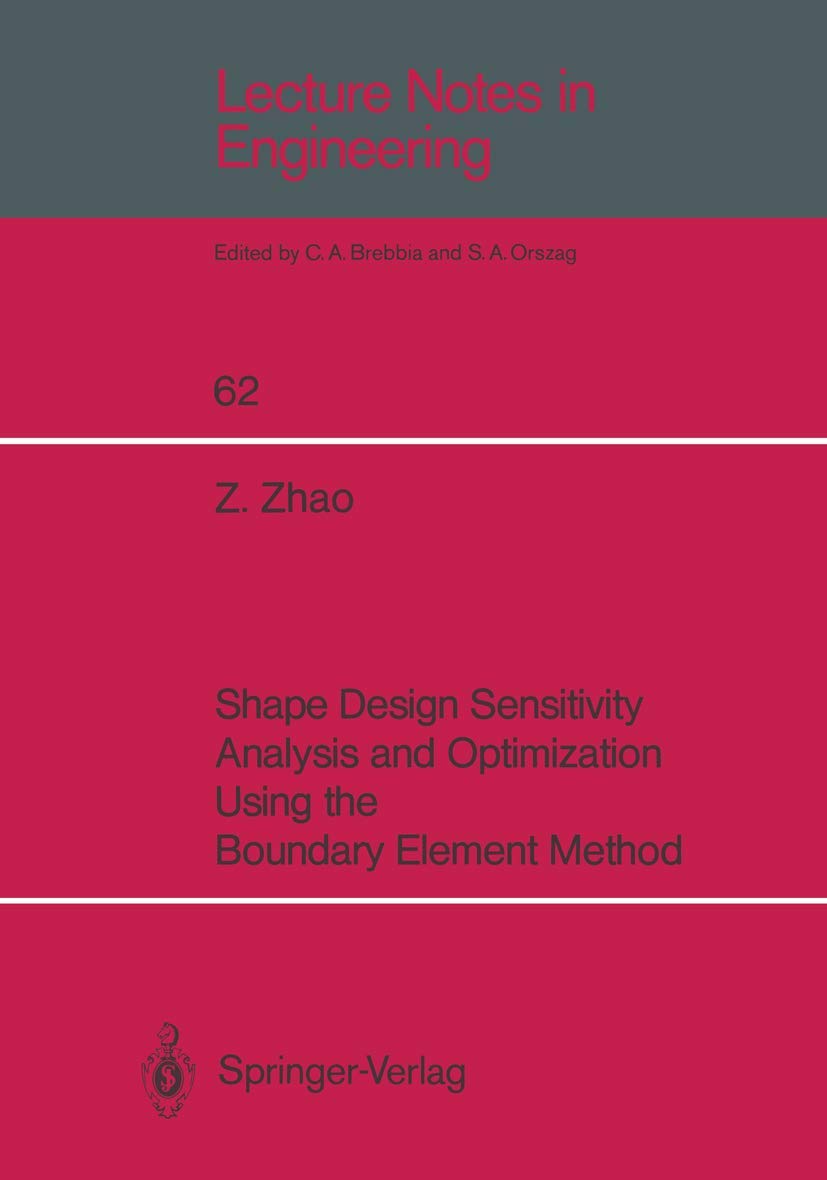
Shape Design Sensitivity Analysis and Optimization Using the Boundary Element Method (Lecture Notes in Engineering, 62),Used
Sold by Ergodebooks, an authorized reseller.
Returns accepted within 30 days | support@ergodebooks.com
Shipping Information
- Free Standard Shipping — United States only
- Processing Time: 3–5 business days
- Estimated Delivery: 6–10 business days after dispatch
- Double-boxed, fully insured & discreetly packaged
- Tracking number sent via email once dispatched
Returns & Refund
Returns accepted within 30 days of delivery.
Damaged or Defective Item
Free return shipping + replacement or full refund
Wrong Item Received
Free return shipping + replacement or full refund
Change of Mind
Return shipping at customer's expense · 25% restocking fee applies
Payment Option

This book investigates the various aspects of shape optimization of two dimensional continuum structures, including shape design sensitivity analysis, structural analysis using the boundary element method (BEM), and shape optimization implementation. The book begins by reviewing the developments of shape optimization, followed by the presentation of the mathematical programming methods for solving optimization problems. The basic theory of the BEM is presented which will be employed later on as the numerical tool to provide the structural responses and the shape design sensitivities. The key issue of shape optimization, the shape design sensitivity analy sis, is fully investigated. A general formulation of stress sensitivity using the continuum approach is presented. The difficulty of the modelling of the ad joint problem is studied, and two approaches are presented for the modelling of the adjoint problem. The first approach uses distributed loads to smooth the concentrated adjoint loads, and the second approach employs the singu larity subtraction method to remove the singular boundary displacements and tractions from the BEM equation. A novel finite difference based approach to shape design sensitivity is pre sented, which overcomes the two drawbacks of the conventional finite difference method. This approach has the advantage of being simple in concept, and eas ier implementation. A shape optimization program for twodimensional continuum structures is developed, including structural analysis using the BEM, shape design sensitiv ity analysis, mathematical programming, and the design boundary modelling.
⚠️ WARNING (California Proposition 65):
This product may contain chemicals known to the State of California to cause cancer, birth defects, or other reproductive harm.
For more information, please visit www.P65Warnings.ca.gov.