
Title
Sharing the Light: Representations of Women and Virtue in Early China (S U N Y Series in Chinese Philosophy and Culture),New
Sold by Ergodebooks, an authorized reseller.
Returns accepted within 30 days | support@ergodebooks.com
Shipping Information
- Free Standard Shipping — United States only
- Processing Time: 3–5 business days
- Estimated Delivery: 6–10 business days after dispatch
- Double-boxed, fully insured & discreetly packaged
- Tracking number sent via email once dispatched
Returns & Refund
Returns accepted within 30 days of delivery.
Damaged or Defective Item
Free return shipping + replacement or full refund
Wrong Item Received
Free return shipping + replacement or full refund
Change of Mind
Return shipping at customer's expense · 25% restocking fee applies
Payment Option

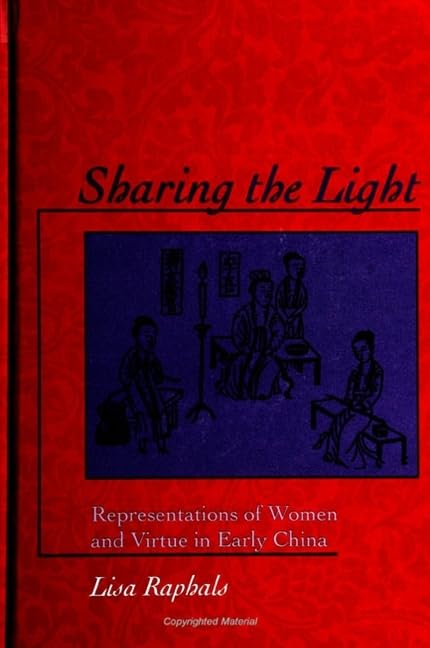
Explores historical and philosophical shifts in the depiction of women and virtue in the early years of the Chinese state. Includes an examination of the history of yinyang theories. Sharing the Light explores historical and philosophical shifts in the depiction of women and virtue in the early centuries of the Chinese state. These changes had farreaching effects on both the treatment of women in Chinese society and on the formation of Chinese philosophical discourse on ethics, cosmology, epistemology, and selfcultivation. Warring States and Han dynasty narratives frequently represented women as intellectually adroit, politically astute, and ethically virtuous; these histories, discourses, and life stories portray women as active participants within their own society, not inert victims of it. The women depicted resembled sages, ministers, and generals as the mainstays and destroyers of dynasties. These stories emphasized that sagacity, intellect, strategy, and statecraft were virtues proper to women, an emphasis that effectively disappeared from later collections and instruction texts by and for women. During the same period, there were also important changes in the understanding of two polarities that delineated what now is called gender. Han correlative cosmology included a range of hierarchical analogies between yin and yang and men and women, and the understanding of yin and yang shifted from complementarity toward hierarchy. Similarly, the doctrine of separate spheres (inner and outer, neiwai) shifted from a notion of appropriate distinction between men and women toward physical, social, and intellectual separation and isolation. 'This book challenges several widely held paradigms concerning women in traditional China that are in dire need of the kind of nuanced and sustained reassessment present throughout the work. It is a fine piece of scholarship.' Sarah A. Queen, Connecticut College
⚠️ WARNING (California Proposition 65):
This product may contain chemicals known to the State of California to cause cancer, birth defects, or other reproductive harm.
For more information, please visit www.P65Warnings.ca.gov.