
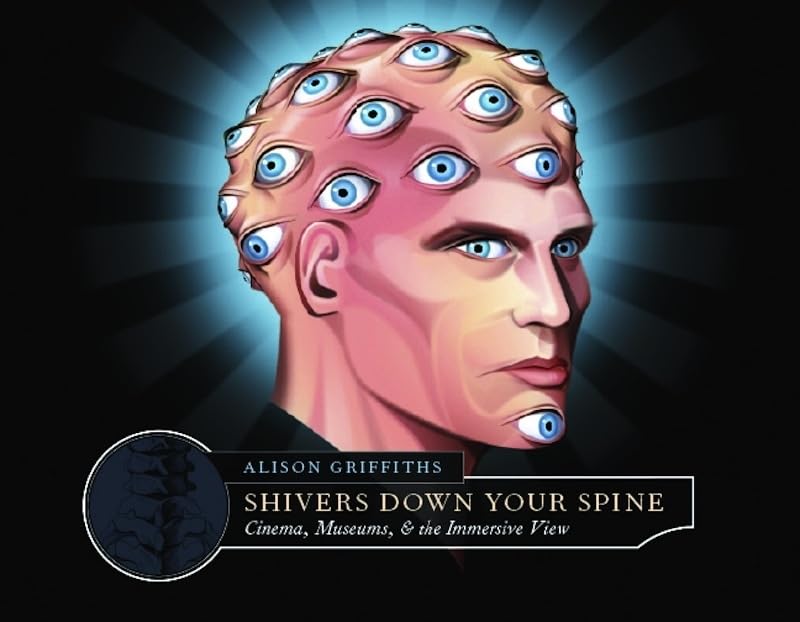
Title
Shivers Down Your Spine: Cinema, Museums, and the Immersive View,Used
Sold by Ergodebooks, an authorized reseller.
Returns accepted within 30 days | support@ergodebooks.com
Shipping Information
- Free Standard Shipping — United States only
- Processing Time: 3–5 business days
- Estimated Delivery: 6–10 business days after dispatch
- Double-boxed, fully insured & discreetly packaged
- Tracking number sent via email once dispatched
Returns & Refund
Returns accepted within 30 days of delivery.
Damaged or Defective Item
Free return shipping + replacement or full refund
Wrong Item Received
Free return shipping + replacement or full refund
Change of Mind
Return shipping at customer's expense · 25% restocking fee applies
Payment Option

From the architectural spectacle of the medieval cathedral and the romantic sublime of the nineteenthcentury panorama to the technofetishism of today's London Science Museum, humans have gained a deeper understanding of the natural world through highly illusionistic representations that engender new modes of seeing, listening, and thinking. What unites and defines many of these wondrous spaces is an immersive viewan invitation to step inside the virtual world of the image and become a part of its universe, if only for a short time.Since their inception, museums of science and natural history have mixed education and entertainment, often to incredible, eyeopening effect. Immersive spaces of visual display and modes of exhibition send 'shivers' down our spines, engaging the distinct cognitive and embodied mapping skills we bring to spectacular architecture and illusionistic media. They also force us to reconsider traditional models of film spectatorship in the context of a mobile and interactive spectator.Through a series of detailed historical case studies, Alison Griffiths masterfully explores the uncanny and unforgettable visceral power of the medieval cathedral, the panorama, the planetarium, the IMAX theater, and the science museum. Examining these structures as exemplary spaces of immersion and interactivity, Griffiths reveals the sometimes surprising antecedents of modern media forms, suggesting the spectator's deepseated desire to become immersed in a virtual world. Shivers Down Your Spine demonstrates how immersive and interactive museum display techniques such as large video displays, reconstructed environments, and touchscreen computer interactives have redefined the museum space, fueling the opposition between public and private, science and spectacle, civic and corporate interests, voice and text, and life and death. In her remarkable study of sensual spaces, Griffiths explains why, for centuries, we keep coming back for more.
⚠️ WARNING (California Proposition 65):
This product may contain chemicals known to the State of California to cause cancer, birth defects, or other reproductive harm.
For more information, please visit www.P65Warnings.ca.gov.
- Q: What is the page count of 'Shivers Down Your Spine'? A: The book has three hundred ninety-two pages. This extensive page count allows for a deep exploration of immersive experiences in museums and cinema.
- Q: What are the dimensions of this book? A: The book measures nine point zero two inches in length, one point one inches in width, and seven point zero one inches in height. These dimensions make it easy to handle and store.
- Q: What type of binding does this book have? A: This book is a paperback. Paperback bindings are generally flexible and lightweight, making them ideal for reading on the go.
- Q: Who is the author of 'Shivers Down Your Spine'? A: The author is Alison Griffiths. She is known for her insightful analysis of immersive media and exhibition techniques.
- Q: What is the genre of 'Shivers Down Your Spine'? A: The book falls under the category of Performing Arts. It delves into the intersections of cinema, museums, and immersive experiences.
- Q: Is this book suitable for all ages? A: Yes, the book is suitable for a general audience. However, it is best appreciated by those interested in art, history, and media studies.
- Q: How can I use this book in an educational setting? A: You can use this book as a resource for courses on media studies or art history. It provides valuable insights into immersive experiences that can enhance classroom discussions.
- Q: Is there a specific audience this book is aimed at? A: The book is particularly aimed at scholars and enthusiasts of media studies and museum science. Its in-depth analysis makes it a valuable read for those in these fields.
- Q: Can this book be used for research purposes? A: Yes, this book is an excellent resource for research. Its historical case studies and thorough exploration of immersive spaces provide valuable information for academic work.
- Q: How should I care for this book to keep it in good condition? A: To keep this book in good condition, store it in a cool, dry place away from direct sunlight. Avoid bending the covers and pages to maintain its shape.
- Q: Is it recommended to clean the book's cover? A: No, it is not recommended to clean the book's cover with water or chemicals. Instead, wipe it gently with a dry cloth if necessary.
- Q: What should I do if the book arrives damaged? A: If the book arrives damaged, you should contact the seller for a return or exchange. Make sure to keep the original packaging for any potential returns.
- Q: Does this book come with a warranty? A: No, this book does not come with a warranty. However, you can check the return policy from the seller for any issues.
- Q: Is there a digital version of this book available? A: Yes, a digital version may be available through various online platforms. This allows for convenient reading on electronic devices.
- Q: How does this book compare to other works in the same genre? A: This book offers a unique perspective on immersive experiences, setting it apart from others by blending historical analysis with contemporary examples in the arts.
- Q: Are there any specific themes explored in this book? A: Yes, themes include the intersection of art and technology, the evolution of spectator experiences, and the role of immersive environments in shaping perception.