
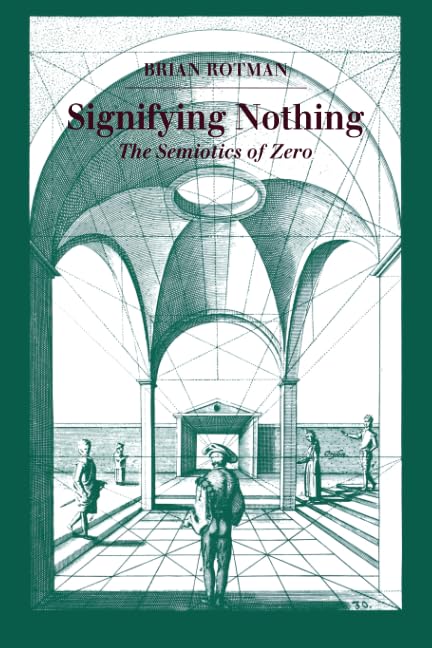
Title
Signifying Nothing: The Semiotics Of Zero,Used
Sold by Ergodebooks, an authorized reseller.
Returns accepted within 30 days | support@ergodebooks.com
Shipping Information
- Free Standard Shipping — United States only
- Processing Time: 3–5 business days
- Estimated Delivery: 6–10 business days after dispatch
- Double-boxed, fully insured & discreetly packaged
- Tracking number sent via email once dispatched
Returns & Refund
Returns accepted within 30 days of delivery.
Damaged or Defective Item
Free return shipping + replacement or full refund
Wrong Item Received
Free return shipping + replacement or full refund
Change of Mind
Return shipping at customer's expense · 25% restocking fee applies
Payment Option

This Unusual Book Is A Delightful Analysis Of The Nature Of Zero As A Sign Intimately Connected To The Idea Of Nothing. Rotman Draws Interesting Parallels Using The Textual Code Systems Of Mathematics, Painting, And Economic Exchange And Their Respective Metasigns Zero, The Vanishing Point, Imaginary Money Which Represent The Absence Of Certain Signs. Focusing On The Renaissance Period, The Author Argues That The Introduction Of A Metasign Disrupts A Code System That Prompts The Creating Of New Sign Systems, As Represented By The Multifarious Transitions From Roman To Hindu Numerals, From Iconic To Perspective Art, And From Gold Money To Imaginary Bank Money. Adopting An Interdisciplinary Approach...Rotman Builds A Viable Thesis For The Semiotics Of Zero Via A Thorough Examination Of Montaigne'S 'Essays,' Shakespeare'S 'King Lear', The 'Kabbalah,' And Vermeer'S Paintings. Choice
⚠️ WARNING (California Proposition 65):
This product may contain chemicals known to the State of California to cause cancer, birth defects, or other reproductive harm.
For more information, please visit www.P65Warnings.ca.gov.
- Q: What is the page count of this book? A: This book has one hundred twenty-two pages. It provides an in-depth analysis of the semiotics of zero.
- Q: What is the binding type of this book? A: This book is a paperback edition. This makes it lightweight and easy to handle.
- Q: What are the dimensions of this book? A: The book measures six inches in length, zero point thirty-one inches in width, and nine point zero two inches in height. These dimensions make it suitable for easy reading.
- Q: How do I read this book? A: You can read this book like any standard paperback. It's ideal for anyone interested in semiotics and mathematical concepts.
- Q: Is this book suitable for beginners? A: Yes, this book is suitable for beginners. It introduces complex ideas in an accessible manner.
- Q: What themes does this book cover? A: The book covers themes of mathematical signs, semiotics, and cultural transitions. It draws parallels across various disciplines.
- Q: How should I store this book? A: Store this book in a cool, dry place to maintain its condition. Keeping it upright on a shelf is recommended.
- Q: Can I clean this book? A: No, do not clean this book with water or chemicals. Instead, gently dust the cover if needed.
- Q: Is this book safe for children? A: Yes, this book is appropriate for older children and teens. However, it is recommended for those interested in complex themes.
- Q: What if the book arrives damaged? A: If the book arrives damaged, you can return it for a replacement or refund. Check the return policy for specific instructions.
- Q: Is there a warranty for this book? A: No, there is no warranty for this book. However, returns are accepted if it arrives in unsatisfactory condition.
- Q: How does this book compare to other works in semiotics? A: This book offers a unique perspective on zero as a sign. It stands out by linking mathematical concepts with cultural analysis.
- Q: Is the author well-known in this field? A: Yes, Brian Rotman is a recognized author in semiotics and mathematics. His interdisciplinary approach adds depth to the topic.
- Q: What is the target audience for this book? A: The target audience includes academics, students, and anyone interested in mathematics and semiotics. It is particularly suited for those exploring cultural studies.
- Q: Does this book include illustrations? A: No, this book does not include illustrations. It focuses on text to convey its complex ideas.