
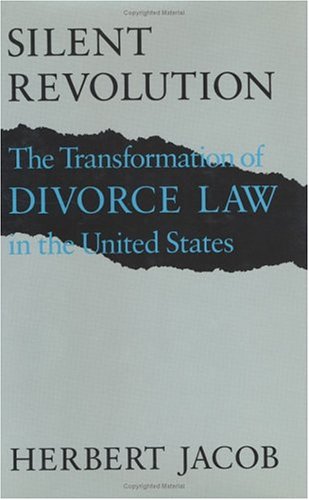
Title
Silent Revolution: The Transformation of Divorce Law in the United States,Used
Sold by Ergodebooks, an authorized reseller.
Returns accepted within 30 days | support@ergodebooks.com
Shipping Information
- Free Standard Shipping — United States only
- Processing Time: 3–5 business days
- Estimated Delivery: 6–10 business days after dispatch
- Double-boxed, fully insured & discreetly packaged
- Tracking number sent via email once dispatched
Returns & Refund
Returns accepted within 30 days of delivery.
Damaged or Defective Item
Free return shipping + replacement or full refund
Wrong Item Received
Free return shipping + replacement or full refund
Change of Mind
Return shipping at customer's expense · 25% restocking fee applies
Payment Option

Conflict and controversy usually accompany major social changes in America. Such issues as civil rights, abortion, and the proposed Equal Rights Amendment provoke strong and divisive reactions, attract extensive media coverage, and generate heated legislative debate. Some theorists even claim that only mobilization and publicity can stimulate significant legislative change. How is it possible, then, that a wholesale revamping of American divorce law occurred with scarcely a whisper of controversy and without any national debate? This is the central question posedand authoritatively answeredin Herbert Jacobs Silent Revolution.Since 1966, divorce laws in the United States have undergone a radical transformation. Nofault divorce is now universally available. Alimony functions simply as a brief transitional payment to help a dependent spouse become independent. Most states divide assets at divorce according to a community property scheme, and, whenever possible, many courts prefer to award custody of children to the mother and the father jointly.These changes in policy represent a profound departure from traditional American values, and yet the legislation by which they were enacted was treated as a technical correction of minor problems. Nofault divorce, for example, was a response to the increasing number of fraudulent divorce petitions. Since couples were often forced to manufacture the evidence of guilt that many states required, and since judges frequently looked the other way, legal reformers sought no more than to bring divorce statutes into line with current practice.On the basis of such observations, Jacob formulates a new theory of routineas opposed to conflictualpolicymaking processes. Many potentially controversial policiesdivorce law reforms among thempass unnoticed in America because legislators treat them as matters of routine. Jacobs is indeed the most plausible account of the enormous number and steady flow of policy decisions made by state legislatures. It also explains why no attention was paid to the effect divorce reform would have on divorced women and their children, a subject that has become increasingly controversial and that, consequently, is not likely to be handled by the routine policymaking process in the future.
⚠️ WARNING (California Proposition 65):
This product may contain chemicals known to the State of California to cause cancer, birth defects, or other reproductive harm.
For more information, please visit www.P65Warnings.ca.gov.
- Q: What is the main theme of 'Silent Revolution'? A: The main theme of 'Silent Revolution' is the transformation of divorce law in the United States, exploring how significant changes occurred with minimal public controversy or debate.
- Q: Who is the author of 'Silent Revolution'? A: The author of 'Silent Revolution' is Herbert Jacob.
- Q: When was 'Silent Revolution' published? A: 'Silent Revolution' was published on July 27, 1988.
- Q: What are some key changes in divorce law discussed in the book? A: Key changes include the introduction of no-fault divorce, revised alimony practices, and the shift towards community property schemes during asset division.
- Q: How many pages does 'Silent Revolution' have? A: 'Silent Revolution' contains 220 pages.
- Q: What type of binding does this book have? A: 'Silent Revolution' is available in hardcover binding.
- Q: What category does 'Silent Revolution' fall under? A: 'Silent Revolution' falls under the category of Divorce & Separation.
- Q: Is 'Silent Revolution' a new book? A: Yes, 'Silent Revolution' is listed as 'New' in its condition.
- Q: What significant societal issues does the book address? A: The book addresses societal issues related to divorce law reforms and their implications for divorced women and children.
- Q: What is the edition of 'Silent Revolution'? A: 'Silent Revolution' is in its first edition.