
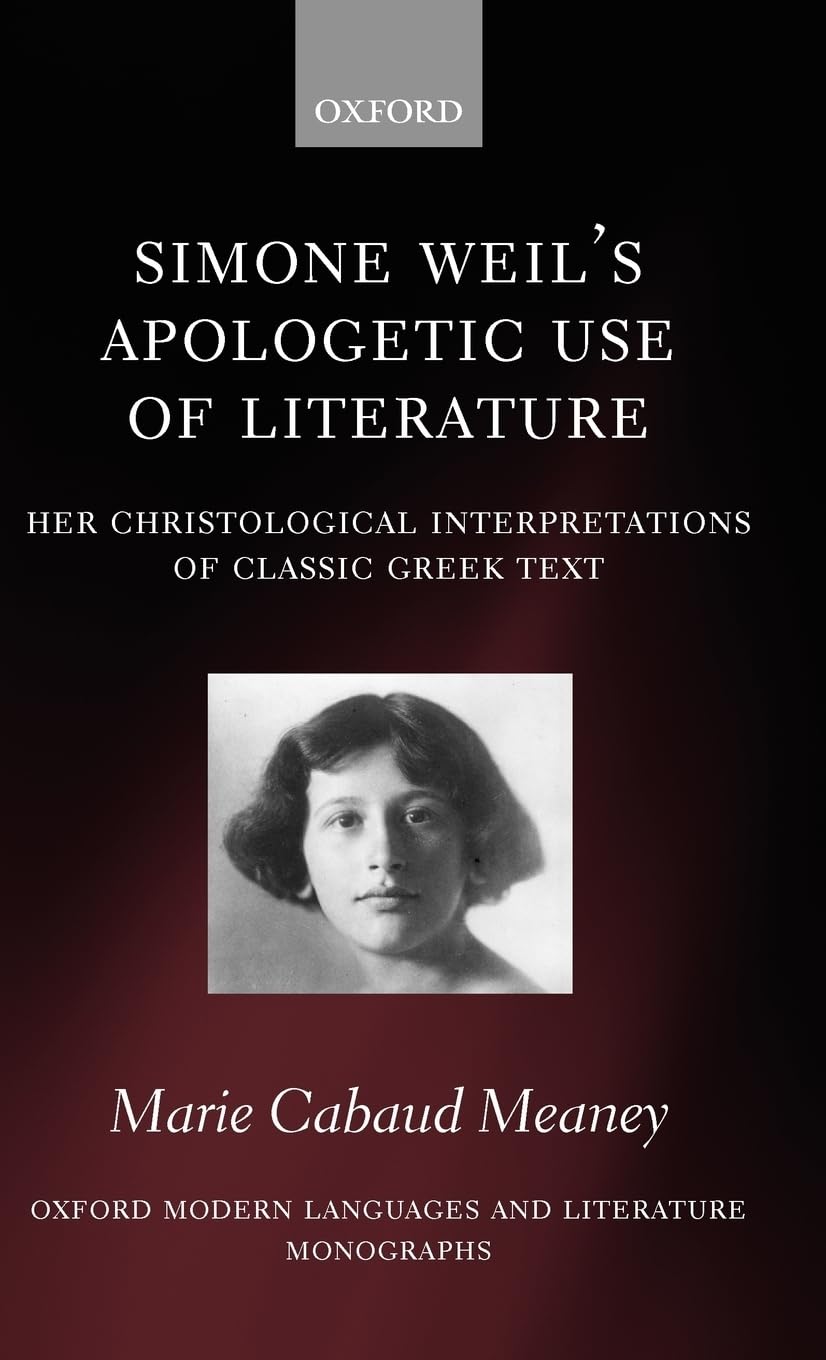
Title
Simone Weil'S Apologetic Use Of Literature: Her Christological Interpretation Of Classic Greek Texts (Oxford Modern Languages An
Sold by Ergodebooks, an authorized reseller.
Returns accepted within 30 days | support@ergodebooks.com
Shipping Information
- Free Standard Shipping — United States only
- Processing Time: 3–5 business days
- Estimated Delivery: 6–10 business days after dispatch
- Double-boxed, fully insured & discreetly packaged
- Tracking number sent via email once dispatched
Returns & Refund
Returns accepted within 30 days of delivery.
Damaged or Defective Item
Free return shipping + replacement or full refund
Wrong Item Received
Free return shipping + replacement or full refund
Change of Mind
Return shipping at customer's expense · 25% restocking fee applies
Payment Option

Marie Cabaud Meaney Looks At Simone Weil'S Christological Interpretations Of The Sophoclean Antigone And Electra, The Iliad And Aeschylus' Prometheus Bound. Apart From Her Article On The Iliad, Weil'S Interpretations Are Not Widely Known, Probably Because They Are Fragmentary And Boldly Twist The Classics, Sometimes Even Contradicting Their Literal Meaning. Meaney Argues That Weil Had An Apologetic Purpose In Mind: To The Spiritual Ills Of Ideology And Fanaticism In World War Ii She Wanted To Give A Spiritual Answer, Namely The Rechristianization Of Europe To Which She (Though Not Baptized Herself) Wished To Contribute In Some Way. To The Intellectual Agnostics Of Her Day She Intended To Show Through Her Interpretations That The Texts They Cherished So Much Could Only Be Fully Understood In Light Of Christ; To The Catholics She Sought To Reveal That Catholicism Was Much More Universal Than Generally Believed, Since Greek Culture Already Embodied The Christian Spirit Perhaps To A Greater Extent Than The Catholic Church Ever Had. Despite Or Perhaps Because Of This Apologetic Slant, Weil'S Readings Uncover New Layers Of These Familiar Texts: Antigone Is A Christological Figure, Combating Creon'S Ideology Of The State By A Folly Of Love That Leads Her To A Passion In Which She Experiences An Abandonment Similar To That Of Christ On The Cross. The Iliad Depicts A World As Yet Unredeemed, But Which Traces Objectively The Reign Of Force To Which Both Oppressors And Oppressed Are Subject. Prometheus Bound Becomes The Vehicle Of Her Theodicy, In Which She Shows That Suffering Only Makes Sense In Light Of The Cross. But The Pinnacle Of The Spiritual Life Is Described In Electra Which, She Believes, Reflects A Mystical Experience Something Weil Herself Had Experienced Unexpectedly When Christ Himself Came Down And Took Her In November 1938. In Order To Do Justice To Weil'S Readings, Meaney Not Only Traces Her Apologetic Intentions And Explains The Manner In Which She Recasts Familiar Christian Concepts (Thereby Letting Them Come Alive Something Every Good Apologist Should Be Able To Do), But Also Situates Them Among Standard Approaches Used By Classicists Today, Thereby Showing That Her Interpretations Truly Contribute Something New.
⚠️ WARNING (California Proposition 65):
This product may contain chemicals known to the State of California to cause cancer, birth defects, or other reproductive harm.
For more information, please visit www.P65Warnings.ca.gov.
- Q: What is the binding type of this book? A: This book is hardcover. Hardcover bindings are durable and suitable for extensive reading.
- Q: How many pages does this book have? A: This book has two hundred sixty-four pages. It provides a comprehensive exploration of Simone Weil's interpretations.
- Q: What are the dimensions of this book? A: The book measures eight point five inches in length, five point five one inches in width, and five point five nine inches in height.
- Q: Who is the author of this book? A: The author is Marie Cabaud Meaney. She provides insights into Simone Weil's literary interpretations.
- Q: What genre does this book belong to? A: This book is categorized under Criticism and Theory. It analyzes classic Greek texts through a Christological lens.
- Q: What themes are explored in this book? A: The book explores themes of ideology, fanaticism, and the spiritual interpretation of classic texts. It focuses on Christological readings.
- Q: How should I approach reading this book? A: You should read this book with an understanding of classic Greek literature. It is suitable for those with an interest in literary criticism.
- Q: Is this book suitable for beginners in literary criticism? A: Yes, this book can be suitable for beginners. However, some familiarity with the classics may enhance understanding.
- Q: What is the main purpose of this book? A: The main purpose is to present Simone Weil's apologetic interpretations of classic texts. It aims to bridge literature and spirituality.
- Q: How do I keep this book in good condition? A: To maintain the book's condition, store it upright in a dry place and avoid exposure to direct sunlight.
- Q: Can I lend this book to others? A: Yes, you can lend this book. Just ensure it is returned in good condition to maintain its quality.
- Q: What if I receive a damaged copy of the book? A: If you receive a damaged copy, contact the seller for a replacement or refund. Most sellers have return policies for such issues.
- Q: Is this book appropriate for academic use? A: Yes, this book is appropriate for academic use. It provides critical analyses relevant for literature and theology studies.
- Q: Does this book contain any illustrations or images? A: No, this book does not contain illustrations or images. It focuses on text and literary analysis.
- Q: Where was this book published? A: This book was published by Oxford University Press, USA. It is a recognized publisher in academia.