
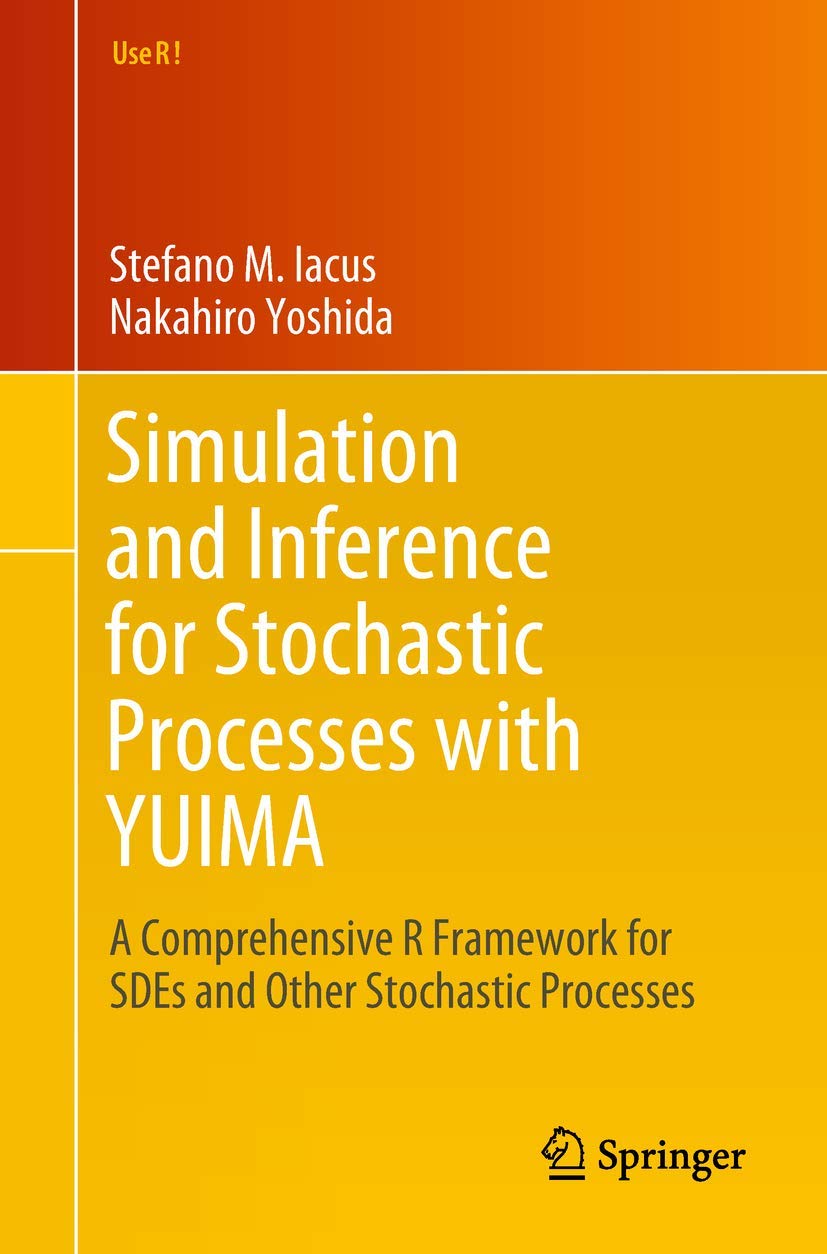
Title
Simulation and Inference for Stochastic Processes with YUIMA: A Comprehensive R Framework for SDEs and Other Stochastic Processe,Used
Sold by Ergodebooks, an authorized reseller.
Returns accepted within 30 days | support@ergodebooks.com
Shipping Information
- Free Standard Shipping — United States only
- Processing Time: 3–5 business days
- Estimated Delivery: 6–10 business days after dispatch
- Double-boxed, fully insured & discreetly packaged
- Tracking number sent via email once dispatched
Returns & Refund
Returns accepted within 30 days of delivery.
Damaged or Defective Item
Free return shipping + replacement or full refund
Wrong Item Received
Free return shipping + replacement or full refund
Change of Mind
Return shipping at customer's expense · 25% restocking fee applies
Payment Option

The YUIMA package is the first comprehensive R framework based on S4 classes and methods which allows for the simulation of stochastic differential equations driven by Wiener process, Lvy processes or fractional Brownian motion, as well as CARMA, COGARCH, and Point processes. The package performs various central statistical analyses such as quasi maximum likelihood estimation, adaptive Bayes estimation, structural change point analysis, hypotheses testing, asynchronous covariance estimation, leadlag estimation, LASSO model selection, and so on. YUIMA also supports stochastic numerical analysis by fast computation of the expected value of functionals of stochastic processes through automatic asymptotic expansion by means of the Malliavin calculus. All models can be multidimensional, multiparametric or non parametric.The book explains briefly the underlying theory for simulation and inference of several classes of stochastic processes and then presents both simulation experiments and applications to real data. Although these processes have been originally proposed in physics and more recently in finance, they are becoming popular also in biology due to the fact the time course experimental data are now available. The YUIMA package, available on CRAN, can be freely downloaded and this companion book will make the user able to start his or her analysis from the first page.
⚠️ WARNING (California Proposition 65):
This product may contain chemicals known to the State of California to cause cancer, birth defects, or other reproductive harm.
For more information, please visit www.P65Warnings.ca.gov.
- Q: What is the main focus of the book 'Simulation and Inference for Stochastic Processes with YUIMA'? A: The book focuses on the YUIMA package, which provides a comprehensive R framework for simulating stochastic differential equations and performing various statistical analyses related to stochastic processes.
- Q: Who is the author of the book? A: The author of the book is Stefano M. Iacus.
- Q: What types of stochastic processes does the YUIMA package support? A: The YUIMA package supports stochastic differential equations driven by Wiener processes, Lévy processes, fractional Brownian motion, CARMA, COGARCH, and Point processes.
- Q: How many pages does the book contain? A: The book contains 281 pages.
- Q: What are some statistical analyses covered in the book? A: The book covers analyses such as quasi maximum likelihood estimation, adaptive Bayes estimation, structural change point analysis, hypotheses testing, and LASSO model selection.
- Q: Is the YUIMA package available for free? A: Yes, the YUIMA package is available for free download on CRAN.
- Q: What edition of the book is available? A: The book is available in its 1st edition, published on June 12, 2018.
- Q: What is the binding type of the book? A: The book is available in paperback binding.
- Q: What is the condition of the book being sold? A: The book is in new condition.
- Q: What applications are discussed in relation to the stochastic processes? A: The book discusses applications of stochastic processes in various fields, including physics, finance, and biology, particularly in relation to time course experimental data.