If you have any questions, you are always welcome to contact us. We'll get back to you as soon as possible, withing 24 hours on weekdays.
Customer service
All questions about your order, return and delivery must be sent to our customer service team by e-mail at yourstore@yourdomain.com
Sale & Press
If you are interested in selling our products, need more information about our brand or wish to make a collaboration, please contact us at press@yourdomain.com
Help
If you have any questions, you are always welcome to contact us. We'll get back to you as soon as possible, withing 24 hours on weekdays.
Customer service
All questions about your order, return and delivery must be sent to our customer service team by e-mail at yourstore@yourdomain.com
Sale & Press
If you are interested in selling our products, need more information about our brand or wish to make a collaboration, please contact us at press@yourdomain.com
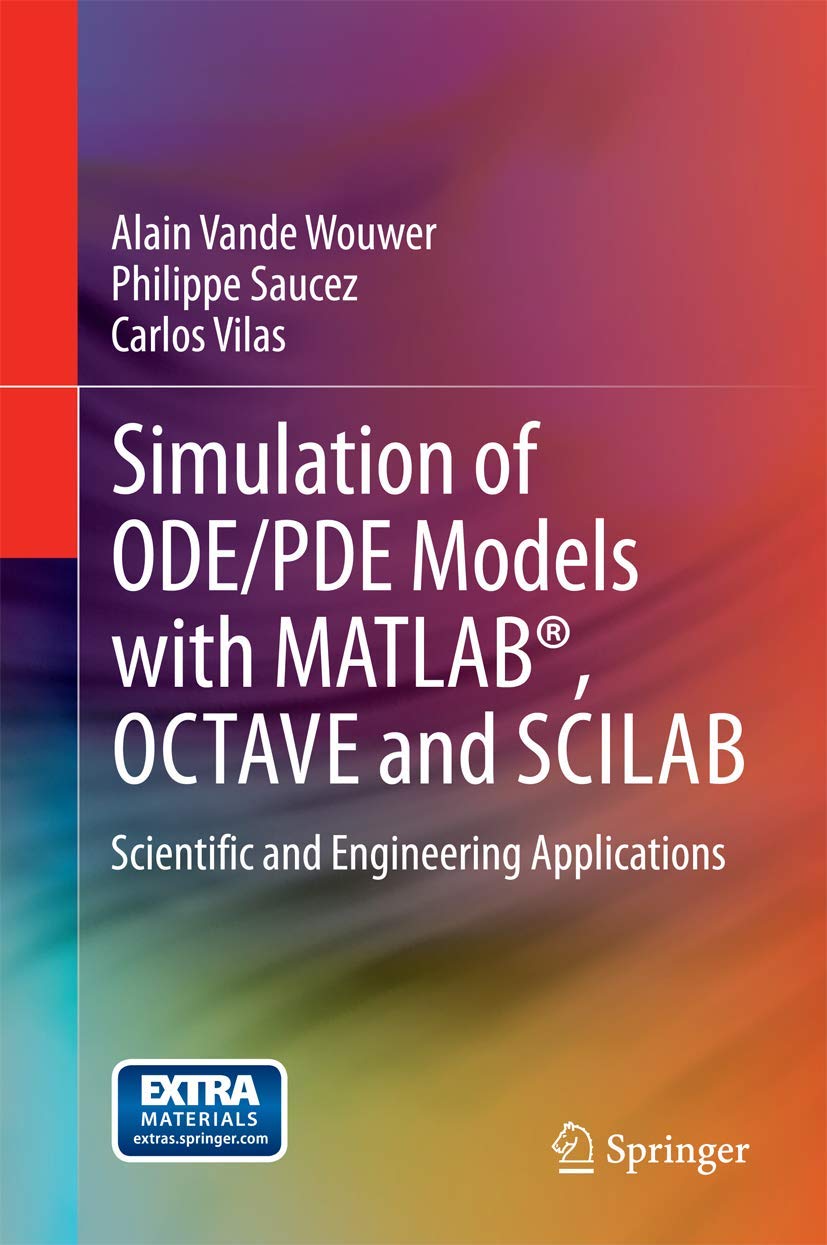
Simulation of ODE/PDE Models with MATLAB, OCTAVE and SCILAB shows the reader how to exploit a fuller array of numerical methods for the analysis of complex scientific and engineering systems than is conventionally employed. The book is dedicated to numerical simulation of distributed parameter systems described by mixed systems of algebraic equations, ordinary differential equations (ODEs) and partial differential equations (PDEs). Special attention is paid to the numerical method of lines (MOL), a popular approach to the solution of timedependent PDEs, which proceeds in two basic steps: spatial discretization and time integration.Besides conventional finitedifference and element techniques, more advanced spatialapproximation methods are examined in some detail, including nonoscillatory schemes and adaptivegrid approaches. A MOL toolbox has been developed within MATLAB/OCTAVE/SCILAB. In addition to a set of spatial approximations and time integrators, this toolbox includes a collection of application examples, in specific areas, which can serve as templates for developing new programs.Simulation of ODE/PDE Models with MATLAB, OCTAVE and SCILAB provides a practical introduction to some advanced computational techniques for dynamic system simulation, supported by many worked examples in the text, and a collection of codes available for download from the books page at www.springer.com. This text is suitable for selfstudy by practicing scientists and engineers and as a finalyear undergraduate course or at the graduate level.
⚠️ WARNING (California Proposition 65):
This product may contain chemicals known to the State of California to cause cancer,
birth defects, or other reproductive harm.
For MAP (Minimum Advertised Price) violations and Intellectual Property (IP) or Trademark concerns, please contact:
support@ergodebooks.com
⚠️ California Proposition 65 Warning: Some products sold on this website may expose you to chemicals known to the State of California to cause cancer, birth defects, or other reproductive harm. For more information, visit www.P65Warnings.ca.gov.