
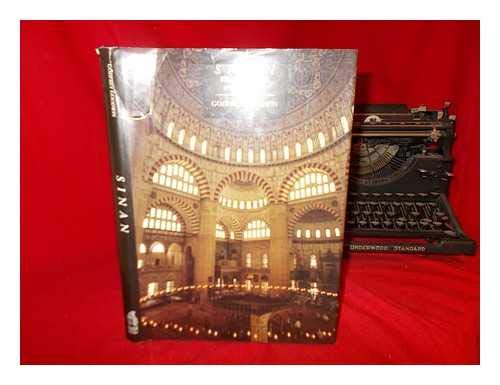
Title
Sinan: Ottoman Architecture And Its Values Today,Used
Sold by Ergodebooks, an authorized reseller.
Returns accepted within 30 days | support@ergodebooks.com
Shipping Information
- Free Standard Shipping — United States only
- Processing Time: 3–5 business days
- Estimated Delivery: 6–10 business days after dispatch
- Double-boxed, fully insured & discreetly packaged
- Tracking number sent via email once dispatched
Returns & Refund
Returns accepted within 30 days of delivery.
Damaged or Defective Item
Free return shipping + replacement or full refund
Wrong Item Received
Free return shipping + replacement or full refund
Change of Mind
Return shipping at customer's expense · 25% restocking fee applies
Payment Option

In this major contribution to an understanding of the development of Ottoman architecture, Godfrey Goodwin focuses on the work of one of the greatest 16thcentury architects, Sinan Abdulmennan, showing how he revolutionized inherited Ottoman building methodsa tradition based on structureby an awareness of the psychology of space.Until Sinan, Ottoman architecture had been a reading of parts. He broke down the distinct forms that had created a certain rigidity, thus freeing interior space and interior form simultaneously.Underlying his architectural concepts are the mathematical theories and practices of classical Greece. Sinan shared these ideals of proportion and balance with builders in the Westindeed, the author argues that the work of Sinan and that of Bramante and Palladio must be seen as part of the same intellectual revolution.This is not a life of Sinanvery few biographical materials are available. Goodwin nevertheless shows the importance of the architects long years in the army and his experience of bridges, siegeworks, fortifications, and the behaviour of stone and masonry before he was appointed Royal Architect in 1538.Goodwin bases his analysis on a detailed comparative study of certain of Sinans buildings, the supreme example being the imaginative leap represented by the mosque of Selim II at Edirne, second capital of the Ottoman empire.Included are chapters on light and space; the dome, the minaret and the apsidal form; decoration and tiles.The text is illustrate dby photographs, plans and evaluations of many of Sinans works ranging from the grandiose Sleymaniye complex in Istanbul to the experimental Kili Ali Pasha mosque. Of outstanding interest are the plates by the 19thcentury German architect Gurlitt, many of which show features before later restoration.
⚠️ WARNING (California Proposition 65):
This product may contain chemicals known to the State of California to cause cancer, birth defects, or other reproductive harm.
For more information, please visit www.P65Warnings.ca.gov.