
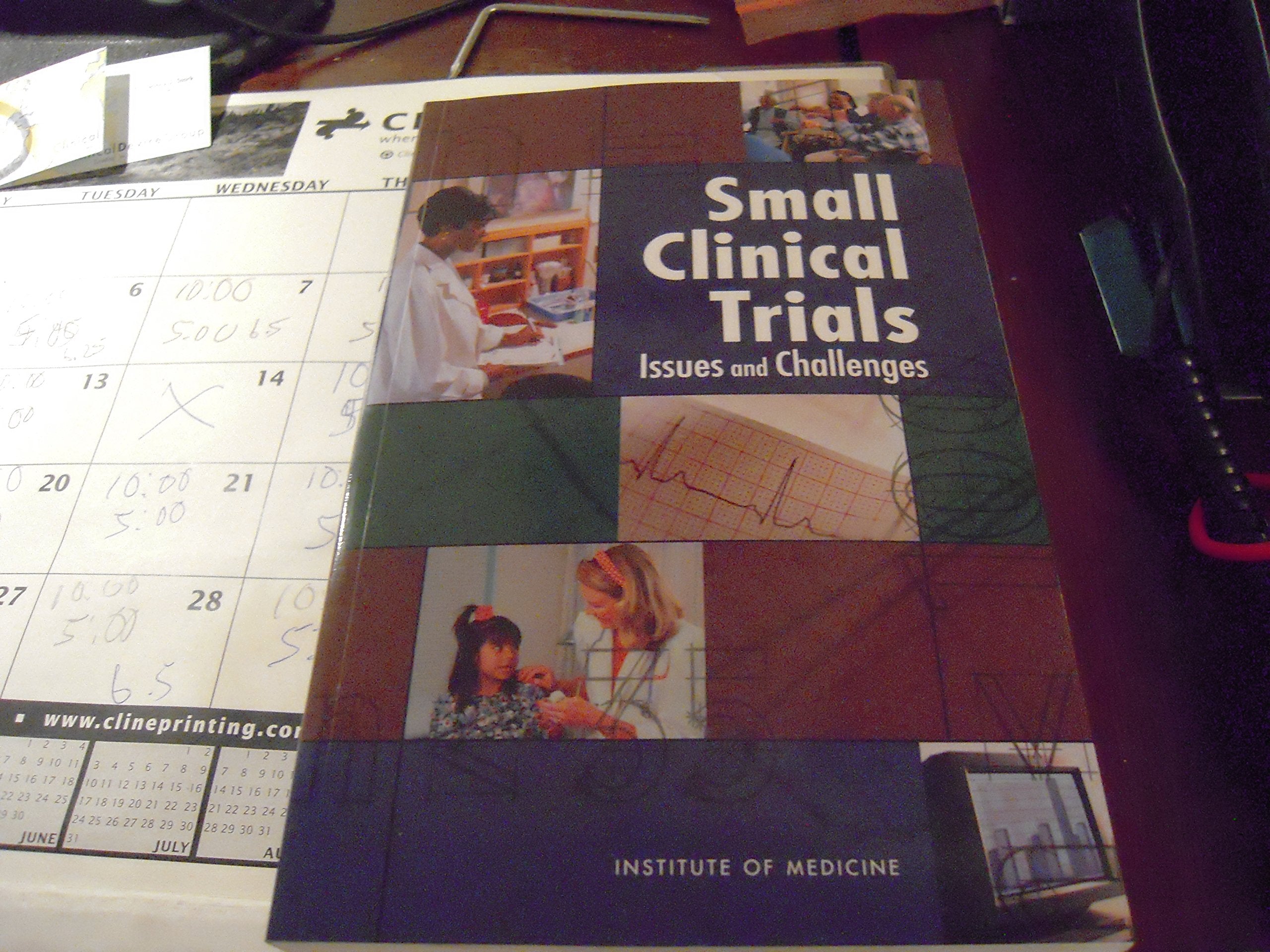
Title


Small Clinical Trials: Issues and Challenges (Compass Series),Used
Sold by Ergodebooks, an authorized reseller.
Returns accepted within 30 days | support@ergodebooks.com
Shipping Information
- Free Standard Shipping — United States only
- Processing Time: 3–5 business days
- Estimated Delivery: 6–10 business days after dispatch
- Double-boxed, fully insured & discreetly packaged
- Tracking number sent via email once dispatched
Returns & Refund
Returns accepted within 30 days of delivery.
Damaged or Defective Item
Free return shipping + replacement or full refund
Wrong Item Received
Free return shipping + replacement or full refund
Change of Mind
Return shipping at customer's expense · 25% restocking fee applies
Payment Option

Clinical trials are used to elucidate the most appropriate preventive, diagnostic, or treatment options for individuals with a given medical condition. Perhaps the most essential feature of a clinical trial is that it aims to use results based on a limited sample of research participants to see if the intervention is safe and effective or if it is comparable to a comparison treatment. Sample size is a crucial component of any clinical trial. A trial with a small number of research participants is more prone to variability and carries a considerable risk of failing to demonstrate the effectiveness of a given intervention when one really is present. This may occur in phase I (safety and pharmacologic profiles), II (pilot efficacy evaluation), and III (extensive assessment of safety and efficacy) trials. Although phase I and II studies may have smaller sample sizes, they usually have adequate statistical power, which is the committee's definition of a 'large' trial. Sometimes a trial with eight participants may have adequate statistical power, statistical power being the probability of rejecting the null hypothesis when the hypothesis is false.Small Clinical Trials assesses the current methodologies and the appropriate situations for the conduct of clinical trials with small sample sizes. This report assesses the published literature on various strategies such as (1) metaanalysis to combine disparate information from several studies including Bayesian techniques as in the confidence profile method and (2) other alternatives such as assessing therapeutic results in a single treated population (e.g., astronauts) by sequentially measuring whether the intervention is falling above or below a preestablished probability outcome range and meeting predesigned specifications as opposed to incremental improvement.
⚠️ WARNING (California Proposition 65):
This product may contain chemicals known to the State of California to cause cancer, birth defects, or other reproductive harm.
For more information, please visit www.P65Warnings.ca.gov.
- Q: What is the main focus of 'Small Clinical Trials: Issues and Challenges'? A: The book primarily focuses on the methodologies and challenges associated with conducting clinical trials that involve small sample sizes.
- Q: Who is the author of this book? A: The author of 'Small Clinical Trials: Issues and Challenges' is the Institute of Medicine.
- Q: When was 'Small Clinical Trials: Issues and Challenges' published? A: The book was published on February 1, 2001.
- Q: What are the key components discussed in the book regarding clinical trials? A: The book discusses sample size, statistical power, and various methodologies such as meta-analysis and Bayesian techniques.
- Q: How many pages does this book contain? A: The book contains 221 pages.
- Q: What type of binding does the book have? A: The book is available in paperback binding.
- Q: What edition of the book is available? A: This is the first edition of 'Small Clinical Trials: Issues and Challenges'.
- Q: Why are small clinical trials considered more challenging? A: Small clinical trials are more challenging due to their increased variability and the higher risk of failing to demonstrate effectiveness due to limited participant numbers.
- Q: What methodologies are explored for small sample size trials? A: The book explores methodologies such as meta-analysis and assessing therapeutic results in specific populations, among others.
- Q: Is this book suitable for researchers in clinical trial design? A: Yes, this book is suitable for researchers and practitioners interested in understanding the complexities and strategies of small clinical trials.